Sameer Sharma: The Agra sketch artist who lied to his dad and met Bollywood stars
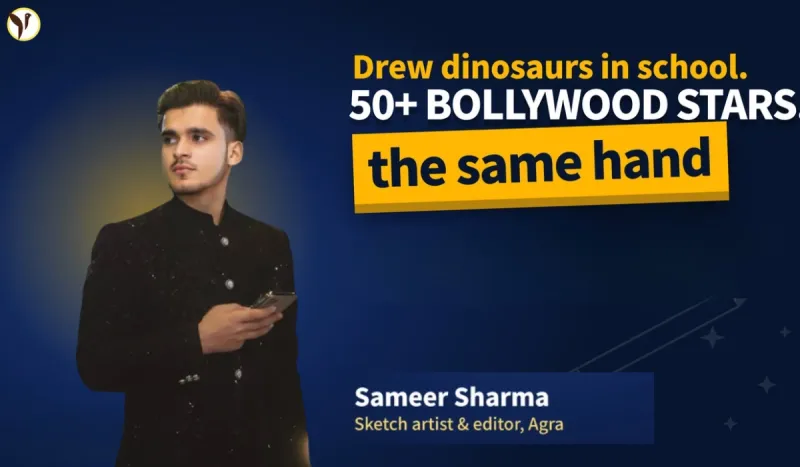
Sameer Sharma drew dinosaurs in school, lied to his dad to meet Milind Gaba, and sketched 50+ Bollywood stars. One Sidharth Malhotra snub went viral he stayed polite.

- Published
- Reading time
- 6 minutes
Sameer Sharma spent most of his childhood drawing dinosaurs. By the time he was twenty, he had sketched more than fifty Bollywood stars, lied to his father on more college days than he can count, been personally pulled through twenty bouncers by Ranveer Singh, and lived through one very public moment when Sidharth Malhotra looked right past him at an airport. The last one broke the internet. Everything else got him to a point where it mattered that it did.
The boy with the class diagrams
Growing up, Sameer drew the way other kids played cricket — all day, badly, happily. Dinosaurs. Dragons. Diagrams for science projects. When teachers set a notebook assignment that needed a figure, half his classmates would stack their notebooks on his desk and let him do their diagrams for them, one after the other. He didn’t mind. He was going to be drawing anyway.
Faces came later, almost by accident. One day in Class 9, bored of dinosaurs, he sat down and tried to sketch the school principal. He himself didn’t think it looked like her. But the people around him did “arre, principal madam bana di” and that one reaction flipped the switch. He could draw faces. He kept drawing them.
Lying to his father to go meet Bollywood
The first Bollywood sketch was Milind Gaba’s.
Sameer saw a poster for an event in Agra, Akhil and Milind Gaba performing and decided he’d try to hand over a sketch. He didn’t tell his father. He never did, at that stage. His father ran a tight ship about outings, and asking first meant losing the argument before he’d left the house. So he said “college” and went.
The venue was a crush. The fan pit was packed. Milind couldn’t see the sketch Sameer was trying to show him. One of the crew members noticed, took him aside and said: “He’ll never see it here. Come to the hotel.” Sameer went. Milind saw the sketch, loved it, asked for his Instagram, promised to put it up on his story.
That one yes started everything.
His father didn’t come around until much later not until he saw his son in photos with people a “normal insaan” doesn’t meet. Then came the quiet, grudging support. The kind that doesn’t say much, but stops asking where you’ve been.
The sketches that travelled
Over the next three years, Sameer did more than fifty Bollywood sketches, and the names on the receiving end kept growing- Tulsi Kumar, Ankit Tiwari, Ranbir Kapoor, Diljit Dosanjh. Pages like Instant Bollywood and Bollywood Society reshared him. His DMs filled up with orders — from across India first, then Spain, Germany.
Each sketch took him six to eight hours of actual drawing, which he split across two days so his back didn’t give out. He worked only with the basics: graphite pencils in grades from B1 to B8, charcoal for the soft, deep darks, a white pencil, and a fixative spray at the end so the sketch didn’t fade. No shortcuts.
What he was really building, without quite naming it, was a system one that got him into rooms a sketch artist from a tier-2 city shouldn’t technically be able to walk into.
How he actually gets in
He gets asked this ten times a day. The answer, in his own words, is unglamorous: contacts. Three years in the field means he has quiet, direct lines to the paparazzi and media people who know who’s landing at which airport, who’s checking into which hotel, who’ll be at which concert. When he’s at the airport before the celebrity walks out, it’s not luck. It’s a phone call.
Everything else walking up, waiting for the right second to show the sketch, reading the moment he’s figured out on his own.
The day Sidharth Malhotra didn’t look up
He had Sidharth Malhotra’s sketch ready for weeks. The day he finally got a chance to deliver it, he’d been given a half day at the office. Someone told him Sidharth was landing at a particular time. He went.
He’d heard the rumours that Sidharth sometimes ignored fans and had chosen not to believe them. “Main sirf wahi maanta hoon jo main dekhta hoon,” he says. He waited for the airport crowd to thin. He waited some more. Then he stepped forward politely with the sketch in hand.
Sidharth looked straight ahead. Didn’t turn. Didn’t acknowledge him. Sameer tried once more. Then again. Three times, in all, into total silence.
He went home and didn’t post anything for a while. Then a message landed in his inbox from someone claiming to be from the crew, asking him to take the video down — a video he hadn’t even uploaded yet. That was the moment he decided to tell the whole story on camera.
The video blew up. For every single hateful comment that came in, roughly a hundred people wrote in to say they were with him, that they saw what had happened, that they appreciated him for staying polite. “That’s the only thing that kept me positive,” he says. “I ignored the one bad comment. I thanked the hundred.”
The moments that keep him in it
For every snub, he can name three moments that still make him smile.
Ranveer Singh, in a stadium crowd, personally pulling him past twenty bouncers to accept a sketch and offering to sign anything he had for Sameer to take back as a gift. Sukhwinder Singh being so moved by one of his sketches that he made a video on the spot and kissed it on camera. Mohit Raina the actor he still considers his personal God, from Devon Ke Dev…Mahadev — is the one celebrity on his list he hasn’t met yet. He will. He’s already told himself so.
The quiet second life
What most people don’t know is that sketching isn’t actually his career plan.
Three months ago, he moved to Delhi for a job in video editing- Premiere Pro, Final Cut, CapCut PC, VFX and CGI work. That’s his field, he says plainly. That’s his future. Each video he edits also takes him six to eight hours sometimes more than the sketches themselves. Which is why his uploads come out slower than people would like.
Sketching is the hobby. The gift, as he puts it, that he doesn’t want to waste. He draws at night, after office. If he’s short on time, he switches to digital painting two or three hours, done, gifted.
His advice to other artists starting out is the one he had to figure out alone: don’t depend on sketching alone. “It’s a risk if you do.” Keep a second skill alongside one that pays while the other grows.
He’s not quitting the gift. He’s just making sure it stays a gift.