Sameer Taneja left Ludhiana at 18. By 25, he’d done a 30-day cycling trip
Sameer Taneja left Punjab at 18, couldn’t speak English, lost $3,000 overnight in Canada, and still kept going. Seven years on: fitness, Vipassana, a 30-day cycling trip.

- Published
- Reading time
- 7 minutes
At 18, Sameer Taneja left Ludhiana for Canada because that’s what everyone in Punjab did after Class 12. He couldn’t speak English with confidence, didn’t know how to apply for a job, and got rejected from a Chipotle-style restaurant twice before anyone hired him. Seven years on, he’s done a 30-day cycling expedition, pulled through a brutal e-commerce wipeout, lived through his dad’s open-heart surgery, spent ten days in Vipassana silence, and built a life that balances fitness, travel and content work out of Bangalore. The thread holding it all together is one line he still repeats to himself: “If I don’t quit, I can’t lose.”
The shell everyone said he had to leave
Punjab’s post-12 default was Canada. His family had a business he had no interest in. His friends were already packing. So Sameer packed too, boarded a student-visa flight, and landed in Vancouver with a kind of knowledge that only shows up when a parent isn’t in the next room the knowledge of just how little he knew.
He couldn’t speak English well. He didn’t know how a resume worked. He wasn’t sure how to ask for a job. His parents’ money ran out in about three weeks, and the rent didn’t care.
So he started riding the SkyTrain. Stopping at every single station. Walking into every store. Dropping his resume on every counter. McDonald’s eventually said yes. Then a casino did too.
The casino, the car dealer, and the first real money
The casino job came with a license, decent shifts and tips that stacked up. For the first time in Canada, bills stopped feeling like a monthly disaster. He started going to the gym. He started to feel like a person again, not a survival project.
He was also getting bored.
One late-night shift, a player at his table told him he had a knack for sales and offered him a side gig going door to door across small businesses in Vancouver, convincing them to switch out their old button POS machines for new Android ones under a company called First Data. He made real money for the first time. Bought his first car. Paid his college fees himself.
Then COVID arrived. The casino laid him off. He quit the sales job over management. A pyramid-model insurance stint ended too. In the space of a week he was fully jobless and the week also handed him a speeding ticket. “Everything was just tough.”
The DSLR that was lying around
Lockdown Canada gave him two things: a government subsidy for international students who’d lost work, and time he didn’t know what to do with. He picked up a DSLR he’d been ignoring, started watching YouTube tutorials, and began shooting cooking videos with his girlfriend, who worked at a restaurant.
It wasn’t glamorous. He wouldn’t even come in front of the camera. In two or three months the channel crept to about 600 subscribers. But something had shifted he’d learned that he could pick up a skill from scratch and actually do it.
Walking into a stranger’s shop until the stranger said yes
The next move was pure persistence. There was a car salesman in BC he admired on Facebook flashy cars, big numbers. Sameer walked into his showroom, said he wanted to work with him, and got nothing. He kept going back. For a month. Until the man finally sat him down and said he was starting a car startup, and Sameer could be his first hire.
For the next four to five months, Sameer did the whole operation buying cars from auctions, repairing them, photographing them, posting them, selling them, washing them, doing the insurance paperwork. He hired his girlfriend in. They moved offices. They started making money.
Then he went home.
The brother in Bangalore who changed the direction
Two and a half years in Canada, no visits home until a trip to meet his family. His older brother in Bangalore was in the middle of starting his own company, fundraising, building something real. Sameer sat and watched for a few weeks.
Something snapped open. “I need to do something more valuable.”
Back in Canada, he quit the car job without a backup. Nobody hired him. He moved into a downtown apartment with strangers and started working out of the library every day. He got into Amazon e-commerce pulling products from China, rebranding them, selling into the US broke even in three months, then poured money into ads he didn’t fully understand.
He woke up one morning to find $3,000 gone. His survival money. Overnight. He couldn’t pay next month’s rent, lost his security deposit, and ended up moving into his girlfriend’s place as a sort of invisible guest sleeping from 11 PM to 6 AM in her sister’s shared flat so he wouldn’t be in the way.
He went back to selling cars. This time at General Motors. Not because he wanted to — because he had no choice.
The month that reset everything
By September 2021 he was stable again. By October, he was sitting with himself asking a question most people never make time for: What do I actually want to do with this?
His mum and dad’s 25th anniversary was coming up. He went home. His brother sent him to spend three to four weeks in Silicon Valley, living in an Airbnb with engineers, meeting founders, telling his own story out loud for the first time to people who actually listened. “That was the first time I came out of a cage.”
The family regrouped in Dubai for the anniversary his parents’ first international trip, a gift. Sameer took one look at his brother’s sneakers and his own working shoes and realised he’d been in survival mode so long he’d forgotten what colour felt like.
He came back to India and gave himself a year to figure it out.
The year he actually figured it out
He stopped running after money and started chasing fit. He cold-reached out to founders at Ultrahuman, mocked up redesigns of their app and sent them over. He joined a startup called Ren in a founder’s-office role, helped them raise pre-seed, learned how a small team actually ships. He left when he was ready to go find the next thing.
Then his father had open-heart surgery. Everything else paused.
That was when the fitness arc started not as a vanity project but because he’d finally understood how fragile a body could get. He walked. Then jogged. Then ran marathons. Mornings at 6, meditation, run or badminton, work from 9 to 7. The routines he once mocked became the only reason the work got done.
The travel followed the fitness. His first trek was out of Bangalore. His first proper peak was in Uttarakhand. On top of that mountain he made himself a promise three treks a year, no matter what else was happening. His most recent trip was a 30-day cycling expedition where he worked on his laptop whenever he had network and slept in a camp whenever he didn’t.
The 25th birthday he spent in silence
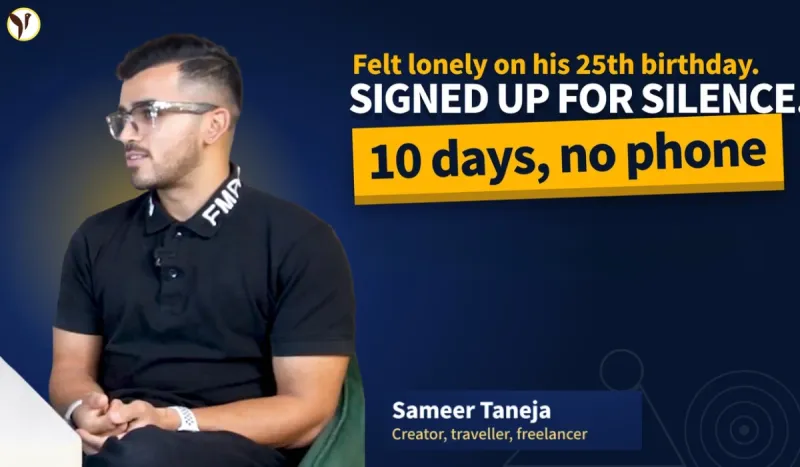
He loves his birthdays. Friends, cake, chaos. His 25th was none of those things everyone was busy, nobody could show up, and he was coming off the 75 Hard challenge feeling flat. A reel about Vipassana rolled past on his phone. He signed up on impulse, got the dates, and walked in.
Ten days. No phone. No laptop. No pen. No speaking.
“It was hell. I was suffering every single day.” But he came out of it changed in a way he could feel. He stopped reacting. Started responding. The anger he used to throw at colleagues and family went quieter. “There’s only so much you can download into your brain. After that you have to process it. And that only happens in silence.”
Where he is now
Content on the side. Freelance work with two startups one in AI sales, one a D2C brand. Six countries travelled. Most of India covered. A next goal already picked out: an Ironman.
Eight years out of his parents’ house. Still, by his own measure, early in it.
He didn’t rush any of it. He just didn’t quit.