Vishal Started in Amazon as a Data Associate. The Real Climb Was Everything After
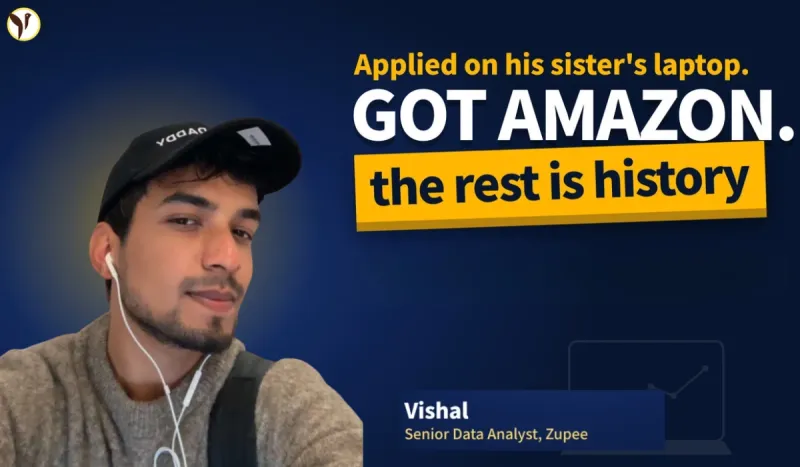
Vishal applied to Amazon on his sister’s laptop with no degree completed yet. Four companies, one layoff scare and a book later, he’s a Senior Data Analyst at Zupee.

- Published
- Reading time
- 11 minutes
Most people who end up in a data career had a plan. Vishal didn’t.
He was sitting with his sister’s laptop one evening, researching something unrelated, when he spotted a role Amazon was hiring for. He hadn’t even finished his degree. He didn’t have the experience the listing described. But something in him said just apply.
A month later Amazon called back. The assessment was clear. The interviews cleared next. And a boy who hadn’t quite expected it was now part of one of the biggest tech companies in the world.
That was the beginning. Everything hard about his journey came after.
The job that looked like data but wasn’t
Vishal joined Amazon as an ML Data Associate on the Alexa team. The work had the word “data” in the title, and it even looked technical from the outside. His job was to make Alexa better at understanding what people were actually saying.
He annotated huge batches of audio data to tell Alexa when it should respond and when it shouldn’t. If a child said something that sounded like “Alexa” by accident, the device shouldn’t light up. If an ad on TV said the word, same rule. Vishal and his team sent that feedback back into the model so Alexa would get it right the next time.
He even worked on the beta release of Alexa’s Amitabh Bachchan voice skill in India.
But the deeper he went, the more he realised something uncomfortable.
He wasn’t really a data analyst. The engineering teams were. Vishal was feeding their models with manual judgement calls. The reports he was producing lived in Google Sheets, not SQL queries. The actual data work was happening upstream.
“That made me curious,” he says. “I wanted to be a real data analyst.”
The hardest year: six months inside, six months outside
Vishal didn’t quit the day he figured this out. He did something smarter. He gave himself six months to prepare, built a portfolio, upgraded his skills, and then started talking to his manager and the leadership about switching into a real analytics role within Amazon itself.
Nothing came through.
A couple of smaller opportunities arrived, but none of them actually moved him up the ladder. After investing two years at Amazon, he wanted the next step to feel like a step, not a sideways shuffle. So he started looking outside.
That didn’t go smoothly either. The first three months of applying outside produced nothing.
“The process was tough,” he recalls. “I got rejection after rejection because I didn’t have hands-on experience in this domain. People were reluctant. When they asked what work I did at Amazon, it was impressive, but it wasn’t directly aligned with the data domain. I had to convince them a lot.”
So he did something quietly effective. He shadowed his own friends.
He asked teammates and friends across other companies about the projects they were working on, how real analytics actually looked day to day, what tools they used, what mistakes they made. He wasn’t trying to copy them. He was trying to build the vocabulary of a real analyst so his interviews stopped sounding like a hopeful outsider’s.
Six months of that preparation changed the outcome. Call-backs started arriving. Three companies believed him. One of them was a Dubai-based e-commerce company called Noon.
Dubai, SQL, and the first real analytics role
Vishal joined Noon as a Business Analyst, but his actual work was mostly in the data domain. For the first three months he was deep in BigQuery, working directly with SQL queries across huge, unfamiliar tables.
He was scared, honestly. He had never worked at that scale.
“My practice and the time I provided in making myself better came in there,” he says. He got through the first three months doing good work, and the company moved him into the Planning team. There he started doing real dashboarding, real reporting, building a few Power BI dashboards himself.
For the first time, Vishal was holding the thing he had chased for a year. He was a real data analyst, with real queries, feeding real decisions.
The layoff that shook everything, and the switch that saved it
Just as Noon was becoming home, the ground moved. Layoffs started. Downsizing. Teams around him were going. His own team was in the zone.
Instead of waiting to find out, Vishal moved first. He saw a PhonePe post on LinkedIn, applied through the attached form, and within a single week the entire interview process was done and he had the offer.
PhonePe is where his career crossed a threshold.
He joined as a Senior Data Analyst, hired primarily for his Excel skills and his judgment on business problems. The interview itself was telling. In the first round, the HR asked him to rate his own Excel ability. He didn’t claim “advanced”, because advanced to him meant VBA and macros, and he was honest about where he actually sat.
“I’m not in that advanced category. I’m in the intermediate category. I’m very proficient at VLOOKUP, INDEX MATCH, XLOOKUP.”
That honesty is what moved him forward. She trusted him for not oversellling.
The second round was a case study with a senior manager, and the third round was more pointed. The interviewer tested his communication intensely, because the role would require him to lead the weekly business review in front of 70 to 100 people on a call, including senior leadership.
He got in. Then came day fifteen.
The microphone, and the mentor who left him on it
Vishal’s manager at PhonePe became his mentor. She trained him for the first three months, taught him how PhonePe actually worked, prepared him for the kinds of calls he’d have to lead.
In his third week, she decided he was ready. Vishal didn’t agree.
“I was very hesitant. I was scared. What if I mess up?”
She listened to his hesitation. Then she walked into the weekly review call with him. The room filled up with senior managers and VPs. She logged in, picked up her mic, and said one line:
“I’m leaving. You have to take over.”
Vishal felt the rush. He couldn’t mess it up. He had done his research. He knew the numbers. He just hadn’t believed he was ready to speak.
He spoke. He got through it. His mentor jumped back in when she saw him wobble, but by then something had changed in him. The fear of the microphone was gone.
Over the months that followed, Vishal became fluent in the exact thing that had scared him. He learned PhonePe’s full delivery chain. He learned MIS (Management Information Systems) deeply enough to start building them himself. He got exposed to Python scripting and automation. One recurring 2.5-hour reporting task that was eating his week, he automated down to half an hour.
That is Vishal’s defining instinct. Make the work easier for yourself, and you make it easier for the company at the same time.
He calls it over-delivering.
“Even if I don’t get the chance, I know I’m successful at my job. I made the work easier. Automate it. Be proactive.”
Why top companies are different, and why he refuses to settle again
Vishal has now worked across a startup, an MNC, a Dubai e-commerce company, a fintech, and a consulting-style setup. He has a clear view of what separates them.
“The top organisations are not just about the business they make. It’s also about the culture they have.”
Mid-sized and smaller companies, in his experience, give you a task to complete and leave your development to you. The top ones give you independence. They let you pick up problems that aren’t in your job description. They don’t ask why you spent two hours on something outside your project. They understand that if you grow, the company grows.
That is why he refused the shortcut offers that only paid more but taught less. He is willing to take the long road if the long road builds him.
The second life: the author, the trainer, the teacher
Somewhere in the middle of all this, Vishal realised he wasn’t just a working data professional. He was a teacher.
He wrote a book Advanced Machine Learning Algorithms because he loved simplifying things. He started training alongside his full-time role, because he saw a gap between what colleges teach and what the industry actually needs. He visits colleges to deliver sessions. He mentors students one-on-one.
Ask him who he really is, and he answers plainly.
“If I’m asked who I am exactly, I am more inclined towards teaching, towards training. I like simplifying things.”
Zupee, where he currently works as Senior Data Analyst for Finance and Strategy, is just the day job on top of a larger life he’s building.
Three lessons he’d give the version of himself from five years ago
Vishal is sharp about the mistakes most young professionals make, because he nearly made all of them. If he could go back and talk to the Vishal who was sitting at his sister’s laptop in 2020, he would say three things.
One: don’t self-reject. This is his most repeated warning. Most candidates don’t even try to apply for roles they think they’re underqualified for.
“If you see you have the right skills and complete about 60% to 70% of the description, you are eligible. I would say go ahead and apply. Don’t self-reject beforehand.”
Two: focus on the problem, not the tool. Vishal has watched too many students chase SQL, Power BI, Python like trophies, without ever asking why those tools exist.
“Tools and technologies will help you implement your logic, but the main thing in data is not the tools. It’s logic building. It’s the problem-solving skill. Students need to change their approach. Don’t make the target ‘I have to learn Power BI and SQL’. Make the target ‘I want to solve a problem’.”
Three: find a mentor, and build real-world projects. On the project side, he is especially sharp. Picking a random dataset from Kaggle and running some functions on it is not a portfolio. It is net practice.
“Data professionals are like doctors. You need to find a patient. You need a problem statement. You need to say: this is the patient, this is their problem, this is what I did, this is the outcome. If you take a random Kaggle dataset and do random visualisations on it, you can’t communicate it in an interview.”
He now shares actual case studies from Zupee, Ola, and others with his mentees so they understand what a real end-to-end data project looks like.
On AI, and the thing people are getting wrong about it
Vishal is unimpressed by the panic.
“AI will kill your jobs. I don’t believe that is the case. Whenever a new technology launches, the first fear is always: it will take jobs. Same with computers in the 90s. Same with the internet. Didn’t happen.”
What will change, he says, is the way you work. If you’re a developer, you no longer spend an hour digging through Stack Overflow to find a bug. You paste the code into ChatGPT and have the fix in two minutes.
“It’s like one guy delivering food on a bicycle, and another guy delivering food on a bike. Obviously the one on the bike will deliver more orders. It’s more about productivity.”
The real risk, he says, isn’t AI. It is being too lazy or too scared to learn it.
“You are in threat if you don’t upgrade yourself over time. Jump on new technologies. Don’t stay back in the old.”
What his story actually proves
Vishal’s career looks like a straight line on LinkedIn: Amazon, Noon, PhonePe, Zupee. Each step bigger than the one before. Each role more analytical than the one before.
The straight line is a lie.
The straight line hides a year of trying to switch and failing. It hides a boy who didn’t know if he could speak to a VP without his voice shaking. It hides a mentor who literally handed him a microphone and walked away so he would finally believe in himself. It hides a layoff wave that nearly swallowed him. It hides the quiet discipline of asking friends what their projects looked like because he was too embarrassed to admit how far behind he felt.
Vishal climbed each of those steps the hard way, and that is why his advice lands. He didn’t get into Amazon with a plan. He got in by refusing to self-reject. He got out of the Alexa team by refusing to accept a title that didn’t match the work. He got to PhonePe by refusing to stay somewhere he was going to be downsized. He got to Zupee by refusing to settle.
And now, when a student messages him on LinkedIn asking him to find them a job, he gently tells them no. He hands them the method instead. Because the method is the whole lesson.
“Communication is directly proportional to the visibility you’re having. And the more visible you are, the better growth you’ll be getting.”
That, in one sentence, is the career Vishal has built. He kept showing up. He kept speaking. He kept over-delivering. The world kept noticing.