Ashwani Chaitanya lied about college. Eight years later, he’s still filming
Ashwani Chaitanya built an 8-year content career in Agra lied to his father about college, paid for his own shoots for 4 years, and now has 3 million followers and 6 real friends.

- Published
- Reading time
- 7 minutes
Ashwani Chaitanya has over three million followers across his social accounts. On his last birthday, six people showed up. That gap between the Vinny the internet knows and the Ashwani who sits at home afterwards is the whole story of what eight years of being a content creator actually looks like. He has been lied to by his closest friends, mocked by his own classmates while filming, and told to his face that he was ruining his life. He also drove home a brand-new car at twenty-something and parked it outside his father’s house without warning. Both of those are true. He doesn’t pretend the second one cancels out the first.
The school stage, and the silence that followed
Growing up, Ashwani was the acting kid in school. The teachers knew him. His classmates knew him. When he was on stage, people watched.
Then school ended, and so did the stage.
He didn’t quite know what to do with that silence, so he picked up his mother’s phone and started making short videos on the apps that were around at the time Musically, Dubsmash, the pre-TikTok era. “Mujhe isme maza aata tha,” he says. There was no career to chase. The field didn’t exist yet. He was just a boy with a hobby that nobody was paying for.
The lie about college
He got admission into IMT after school a serious, expensive college. His parents didn’t say anything about the fees, but he could tell. PG alone was ten thousand rupees a month there, on top of the actual course fees.
So he went home one day and told his father a straight-faced lie. “Papa, mera St John’s mein list aa gayi hai.” His father, cautious, asked the only question that mattered: how much per month? Ashwani said fifteen thousand a year. His father, visibly lighter, agreed.
St John’s hadn’t actually admitted him. He hadn’t applied anywhere else that had worked out either. He simply dropped out of IMT, went back to Agra, and started making videos full-time telling the whole house he was now at a cheaper college that didn’t exist in his admit letter.
A few months later, by what Ashwani still calls “sheer timing”, St John’s final list did come out and his name was on it. He joined. He graduated from there in BA. The lie that was never meant to come true, in the end, did.
Four years of putting money in, not knowing if any was coming out
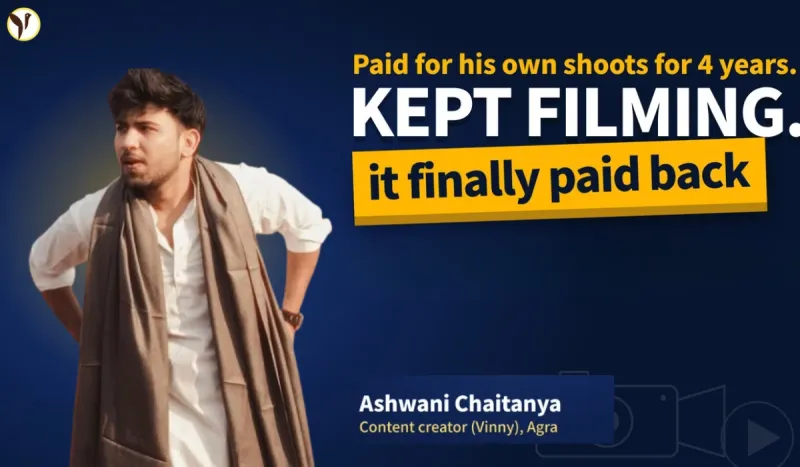
The first four years of content creation were loss-making in the most literal sense. He paid for the shoots. He bought his friends food. He was the one driving everyone around in the heat. No sponsorships. No brand deals. No clarity on whether this would ever return a single rupee.
“Mujhe khud nahi pata tha ki jo main kar raha hoon uska future kya hai,” he says plainly. The only thing he had going for him was that his father, who had expected very little from the backbencher he saw in school, was also not pressuring him to do anything in particular. “Shayad isi wajah se ho gaya,” Ashwani says. “Mere upar koi pressure nahi tha.”
Meanwhile, his own friends were already measuring him and finding him short. CS coaching, CA coaching, UPSC those were the respectable timelines. He was the odd one out, and he knew it, because he overheard what people said behind his back. Not strangers. His own friends. “Yaar ye kiske saath rehta hai.” “Ye to barbaad ho jayega.”
He kept filming.
The father who didn’t know who “Vinny” was
The moment his father actually realised what his son was doing wasn’t a conversation. It was a series of strangers at the door.
Ashwani had started going by the stage name Vinny online. Girls began showing up at the house asking for him “Vinny se milna hai.” His father, confused, kept turning them away. “Yahaan koi Vinny nahi rehta.” It took a few of these awkward visits before the pieces fit together, and his father realised, through other people’s children, that his own son had quietly become someone the city knew.
The real turning point came the day Ashwani walked into a car showroom with his friends, picked a car without consulting anyone at home, and drove it back to his father’s house. For an Indian family, he says, that’s the moment a career becomes real. “Jab tak nokri nahi lag jaati, tab tak parents ko lagta hai nahi yaar kuch toh karna chahiye.” He skipped the job and went straight to the car. His father, finally, stopped worrying.
Today, Ashwani says, his father quietly brags about him behind his back. Never to his face. That’s enough.
The business he actually runs
Eight years in, Ashwani is clear-eyed about the shape of this field in a way most new creators aren’t.
Going viral, he says, is easy. Making money is the actual job. He has watched creators with three or four lakh followers earn in lakhs every month, and creators with millions of followers struggle to make fifteen or twenty thousand. The difference is almost always category. Funny content gets reach — people are tired, scrolling at their desks, forwarding reels to friends because they need the laugh. Fashion is where the real money sits — brands look for creators who’ll actually move product, and a well-shot fashion creator with one lakh views can out-earn a comedy page with three million.
His one standing instruction to younger creators is uncomfortable but direct: your followers are not your family. They are your customers. The day you stop feeding them content, they will stop coming back. You are not Shah Rukh or Salman. Nobody will remember you a month after you go quiet. Treat the relationship with the respect that a business relationship deserves, and don’t ever cheat the people who gave you the numbers in the first place especially not by promoting products you yourself wouldn’t use.
The friends he lost on the way up
Ask him what the hardest part of the last eight years was, and he doesn’t say money. He doesn’t say family. He says friends.
The ones he grew up with, the ones who were there before any of this started, drifted. One, his closest, began sitting with the people who were running him down. Ashwani found out later. He doesn’t name the person. He also doesn’t call him a bad man. “Jab vo mera dost tha, tab vo bahut acha tha. Baad mein cheezein bigdi.”
What he does hold on to is a view his father taught him that if you really want to know a person’s character, don’t look at them. Look at how old their friends are. The longer they’ve managed to keep the same people around, the more real they are. “Naya rakhna sabko easy hai. Purane ko sambhal ke rakhna har kisi ke bas ki baat nahi.”
His own team today is three or four people. Most of them were his friends before they were his crew. His videographer is the oldest friend he has left eight years, give or take. When he calls, they come. That’s how he knows which ones were the real ones.
Three million followers. Six people at the party.
On his last birthday, with over thirty lakh followers across his accounts, exactly six or seven people turned up. Not an exaggeration. He said it out loud on the podcast and didn’t flinch.
That gap, he says, is the part nobody is honest about. Creators are social on social media; they are not social in life. The feed is a performance of a life, not the life itself. “Sabko lagta hai,” he says, “oh bhai, kya zindagi hai. Mujhe bhi chahiye.” The real one, he knows, sits at a quieter table.
What he’s still here for
He has thought about what comes next and keeps arriving at the same answer: nothing comes next. He will make videos until the last day. “Jab tak saans chalegi, tab tak video banaata rahunga.” If he could choose a parallel career it would be DOP he loves cameras, loves shoot days, and will probably keep doing that work on the side anyway.
What he has, really, is the rarest version of a career: the thing he would be doing for free turned out to be the thing people pay him for.
He doesn’t rush it. He doesn’t quit it. He keeps showing up for the camera, for the handful of people who were there before any of this started, and for the version of himself at fifteen, filming alone, in a room with four classmates walking past and laughing.