GBU-43/B and Iran: The Report, the Truce, the Timing
CNN reports the US military is weighing the GBU-43/B MOAB for potential future strikes on Iran. No decision has been made. Trump said last week there would be no strikes before 3 November.

- Published
- Reading time
- 5 minutes
The US military is weighing the use of its largest conventional bomb, the GBU-43/B MOAB, in potential future strikes on Iran, CNN reported on Thursday, citing sources. No decision has been announced. The report comes a week after President Donald Trump said publicly that the United States would not attack Iran before the 3 November midterm elections.
Those two facts are not in conflict, and the relationship between them is the story.
What was actually reported, and what was not
CNN's reporting, picked up by Reuters and others, is that the weapon is under consideration for strikes that are potential and future. That is the whole of the claim. There is no reported decision, no reported target list, no reported timetable, and no attributed official confirmation.
It is worth being firm about this because the framing is already drifting. At least one outlet has headlined the same reporting as the Pentagon "planning" a strike. Weighing an option is what military staffs do continuously, including for contingencies that never happen. A report that an option is on a table is a meaningful signal about where planning has got to. It is not a report that anything has been ordered.
The pledge, and the date attached to it
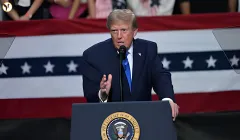
On 8 October, Trump wrote on Truth Social that the United States "will not be attacking Iran at any time prior to the Midterm Elections" on 3 November. He cited "productive conversations" with Iran without giving specifics, and said the US naval blockade of Iranian ports "will remain in full force and effect."
That post followed reporting, including by The Atlantic, that the White House had asked the Pentagon for strike options. Trump has also told TIME that he might order strikes after the election.
So the pledge was about timing, not about intent and it carried an expiry date. Read alongside this week's report, the sequence suggests planning for a window that opens on 4 November rather than a change of course. That is the single most useful thing a reader can take from the day's news, and it requires no speculation about targets.
Where the talks actually stand
The diplomatic track is live, slow, and stuck on one issue.
Iranian Foreign Minister Abbas Araghchi said on 8 October that talks continue through intermediaries, and that Iran was reviewing the US response to its own "seven-day plan" and would reply within a few days. Iranian President Masoud Pezeshkian was reported by AFP to have described negotiations as "meaningless" earlier that week the two positions coexisting in the way they often do in a government under pressure.
A senior Iranian official told Reuters on 7 October that American ideas on the nuclear file are "at odds with Iran's demands," and that enrichment is a red line on which Iran "will not show flexibility." The same official said the US must first meet Iran's conditions, including lifting the blockade of its ports.
From the American side, Vice President JD Vance said Iran should "do something meaningful on their enrichment capacity." Secretary of State Marco Rubio said Iran has "lost complete control" of the Strait of Hormuz. A White House official said Trump "holds all the cards" and that Iran's economy is "collapsing."
Vladimir Putin said on 8 October that Iran had made "real efforts to end the war" and offered to help reach a settlement.
Hormuz, meanwhile, remains restricted. An IRGC adviser, Brig. Gen. Mohammad Reza Naqdi, said on 7 October that the strait stays closed until Iran's "legitimate demands" are met.
The GBU-43/B MOAB, known as the “Mother of All Bombs,” is seen detonating in Afghanistan on April 13, 2017, during its only known combat use. The 21,600-pound conventional bomb was dropped on an ISIS-K cave complex in Nangarhar Province, targeting tunnels and hideouts used by Islamic State Khorasan Province militants.
— War Monitor (@WarMonitors0) October 15, 2026
Eight months, and a truce that never quite held
The war began on 28 February, when Trump ordered Operation Epic Fury and CENTCOM announced strikes on Iran alongside Israeli operations that killed Supreme Leader Ali Khamenei. Mojtaba Khamenei was subsequently elected to replace him. Iran fired ballistic missiles at Israel and at several Gulf states in response, hitting energy infrastructure in Qatar, Saudi Arabia and Bahrain, and Hezbollah entered the conflict in Lebanon.
A ceasefire took effect on 8 April, mediated by Pakistan negotiated among army chief Asim Munir, Vance, envoy Steve Witkoff and Araghchi, with Chinese involvement. Talks in Islamabad on 11 and 12 April ended without agreement, after which the US imposed its naval blockade. A further 60-day framework was agreed in June and extended by a memorandum signed by both presidents.
It has not held cleanly at any point. Both sides have been repeatedly accused of violations, strikes have continued intermittently, and the Strait of Hormuz has stayed largely closed. Thursday was day 229.
The weapon, at the level the public record establishes
The GBU-43/B is formally the Massive Ordnance Air Blast, and is universally known by the backronym "Mother of All Bombs." It is the largest conventional that is, non-nuclear bomb in the United States arsenal, in the 21,000-pound class, and is delivered from a cargo aircraft rather than a bomber.
It has been used operationally once, in Afghanistan in April 2017.
This article does not go further than that, deliberately. Detail about what such a weapon does to particular kinds of target is of no use to a reader trying to understand a diplomatic standoff, and is of obvious use to other people. The questions that matter here are political: whether strikes resume, when, and whether the negotiation produces anything before they do.
What to watch
Three things, in order of how soon they will tell you something.
Iran's reply to the US response on its seven-day plan, which Araghchi said was days away as of 8 October. Whether the blockade is lifted or eased, which Tehran has made a precondition and Washington has said will stay. And 3 November, the date Trump attached to his own pledge, after which, by his own account, the position changes.
Nothing in this week's reporting says a strike has been ordered. What it says is that the option being considered has got larger.
Questions readers ask
Has the US decided to use the MOAB against Iran?
No. CNN reported on Thursday, citing sources, that the US military is weighing the weapon for potential future strikes. There is no reported decision, no reported target list and no reported timetable, and no official has confirmed it on the record. At least one outlet has headlined the same reporting as the Pentagon "planning" a strike, which overstates what has been reported.
What did Trump say about attacking Iran before the midterms?
On 8 October he posted on Truth Social that the United States "will not be attacking Iran at any time prior to the Midterm Elections" on 3 November, citing "productive conversations" with Iran. He added that the US naval blockade of Iranian ports "will remain in full force and effect." He has separately told TIME that he might order strikes after the election, so the pledge concerns timing rather than intent.
What is the GBU-43/B MOAB?
The GBU-43/B is formally the Massive Ordnance Air Blast, widely known as the "Mother of All Bombs." It is the largest conventional — non-nuclear — bomb in the US arsenal, in the 21,000-pound class, and is delivered from a cargo aircraft rather than a bomber. It has been used operationally once, in Afghanistan in April 2017.
Where do the US–Iran negotiations stand?
Talks are continuing through intermediaries. Foreign Minister Abbas Araghchi said on 8 October that Iran was reviewing the US response to its "seven-day plan" and would reply within days. A senior Iranian official told Reuters that American positions are "at odds with Iran's demands" and that enrichment is a red line, and that the US must first lift the blockade of Iranian ports. Vice President JD Vance has said Iran should "do something meaningful on their enrichment capacity." President Vladimir Putin has offered to help reach a settlement.
Is there a ceasefire, and is the Strait of Hormuz open?
A ceasefire brokered by Pakistan took effect on 8 April and has since been extended, including by a memorandum signed by both presidents in June, but it has not held cleanly — both sides have been repeatedly accused of violations and strikes have continued intermittently. The Strait of Hormuz remains restricted. An IRGC adviser said on 7 October that it stays closed until Iran's demands are met, and Secretary of State Marco Rubio said Iran has "lost complete control" of it.