Paying by UPI After Diwali? Check Which Transactions May Face Extra Charges
UPI charges after Diwali explained. Check the proposed MDR on select merchant payments above ₹2,000, what remains free and whether customers must pay extra.

- Published
- Reading time
- 6 minutes
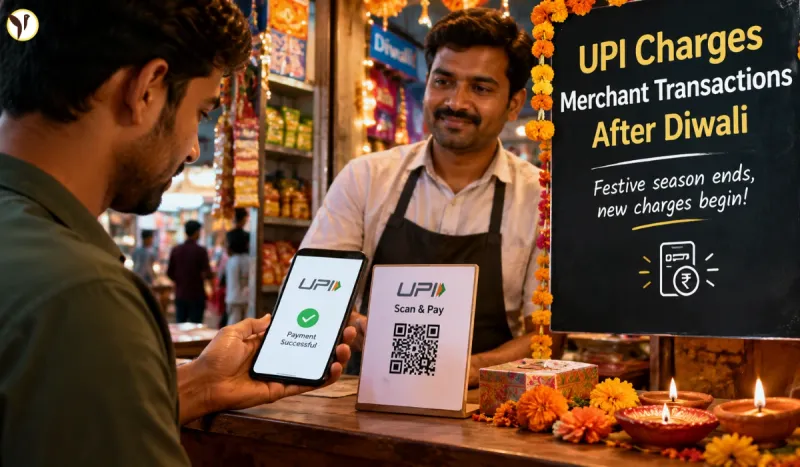
Millions of Indians use UPI every day to pay at shops, restaurants, supermarkets and online stores. But from after Diwali 2026, some merchant transactions may come under a new payment charge framework.
The National Payments Corporation of India (NPCI) has postponed the planned implementation of Merchant Discount Rate (MDR) charges on certain high-value UPI merchant payments. The change was initially scheduled to begin on October 15, but the rollout has now been deferred until after Diwali, which falls on November 8, 2026. A specific new implementation date has not yet been announced in the reports available on October 13.
The key point for users is that the proposed MDR is a charge on eligible merchants, not a fee that customers should automatically have to pay for making a UPI payment. The Finance Ministry has said person-to-person transfers will remain free, regardless of the amount sent.
UPI Charges After Diwali: What Is Changing?
The proposed framework concerns selected person-to-merchant (P2M) transactions. These are payments made by customers to businesses, such as when someone scans a shop's QR code to pay for groceries, clothing, food or other goods.
Under the reported framework, an MDR of 0.4% may apply to eligible merchant transactions above ₹2,000, subject to the applicable rules and exemptions. The reported cap is ₹300 per transaction.
MDR stands for Merchant Discount Rate. It is a payment-processing charge associated with accepting digital payments. It is different from a tax collected by the government.
The implementation has been postponed until after Diwali to avoid introducing the change during the busy festive shopping period. The final start date should be confirmed through official updates.
Which UPI Transactions May Face Charges?
Not every UPI transaction is covered by the proposed MDR framework. The type of payment and the merchant's eligibility are important.
|
|
|
|
|
|
|
|
|
|
|
|
|
|
|
|
|
|
The Finance Ministry has said that approximately 96% of merchant transactions will remain unaffected. The proposed charges are limited to specified merchant payments above the threshold and do not apply to all UPI users.
Will You Pay Extra When Using Google Pay, PhonePe or Paytm?
For ordinary users, the important question is whether an app will deduct an extra fee when they scan a QR code or transfer money.
The Finance Ministry has clarified that customers will not be charged for making UPI payments under this framework. It has also said that banks should ensure merchants do not pass MDR charges on to customers. UPI app providers are not permitted to impose platform fees or hidden charges under the announced rules.
This means that customers should not assume that a payment of ₹2,500 through Google Pay, PhonePe or Paytm will automatically attract a separate fee. The reported MDR is a merchant-side charge for eligible transactions, not an automatic customer fee.
If a shopkeeper asks you to pay an extra amount specifically because you are using UPI, check the explanation carefully and refer to the latest official guidance. A merchant's own pricing decision is different from an officially permitted UPI customer transaction fee.
What Is MDR and Why Is It Being Introduced?
MDR stands for Merchant Discount Rate. It is a fee associated with processing a payment accepted by a merchant.
A digital payment involves several participants, including banks, payment service providers and payment applications. Maintaining these systems requires technology, security, fraud prevention and other operational spending.
The new framework has been presented as a way to support the long-term sustainability of the UPI payment ecosystem while keeping everyday transactions free for customers and small merchants.
The Finance Ministry has also clarified that MDR is not a government tax. The money is distributed among participants in the payment ecosystem under the applicable arrangements.
Will Small Shopkeepers Also Pay UPI Charges?
The framework includes protection for qualifying small merchants.
According to the Finance Ministry's September 15 clarification, merchants covered by the zero-MDR framework, including qualifying small businesses receiving up to ₹1 lakh per month through UPI QR codes under the relevant category, will continue to receive payments without MDR.
This matters for neighbourhood shops, street vendors and other small businesses that depend on digital payments. The exemption depends on the merchant meeting the applicable eligibility conditions; it should not be assumed that every business is automatically exempt.
The government says the framework is designed to limit the impact on small businesses while applying charges only to a relatively small share of merchant transactions.
Why Has the UPI Charge Rollout Been Delayed Until After Diwali?
Diwali is one of India's busiest shopping periods. Consumers make payments for clothes, gifts, electronics, sweets, travel and household purchases, while businesses handle a large number of transactions.
The rollout was initially planned for October 15, shortly before the festive period. NPCI's decision to defer implementation until after Diwali gives payment companies and merchants more time before the new framework takes effect.
The delay provides temporary relief during the festive shopping season. However, it does not mean that the proposed framework has been cancelled. The specific implementation date after Diwali should be confirmed through official announcements.
What Should UPI Users Do Before Making Payments?
Most users do not need to change their normal payment habits because of this announcement. However, a few precautions can help avoid confusion.
- Check official updates: Follow announcements from NPCI, the Finance Ministry and your bank for the final implementation date and any revised rules.
- Understand the transaction type: Sending money to another person is different from paying a business.
- Do not assume a fee applies to every payment above ₹2,000: The proposed MDR applies only to specified merchant transactions, subject to exemptions.
- Review any fee shown in an app: Read the payment details before confirming a transaction, and do not approve an unexplained charge.
- Be careful with viral messages: Do not forward claims that UPI will become paid for every user. Check them against official information.
Does the New Framework Mean UPI Is No Longer Free?
No. The announcement does not mean that all UPI payments are becoming chargeable.
Person-to-person transfers will remain free regardless of the amount. Merchant payments up to ₹2,000 and payments covered by the zero-MDR framework for small merchants will also remain free under the announced rules.
The proposed MDR applies only to selected merchant transactions above the threshold. The government has said that approximately 96% of merchant transactions will remain unaffected.
Will UPI Cost More After Diwali?
The proposed MDR framework may change payment-processing costs for some eligible merchants, but it does not mean that ordinary customers will automatically have to pay extra for UPI.
The rollout, originally scheduled for October 15, has been deferred until after Diwali. A specific revised date has not yet been announced in the latest reports available on October 13, 2026.
For now, users should remember three things: person-to-person UPI transfers remain free, merchant-side MDR applies only to specified transactions, and customers should check official updates rather than relying on viral claims.
You can continue using UPI for everyday payments. Check the final official rules after Diwali, but do not assume that every payment above ₹2,000 will carry a customer fee.
Questions readers ask
Will UPI payments become chargeable after Diwali 2026?
No, UPI will not become chargeable for every user. The announced framework covers selected merchant transactions, while person-to-person transfers remain free.
Will UPI payments above ₹2,000 attract extra charges?
Eligible merchant payments above ₹2,000 may attract MDR under the announced framework. This is a merchant-side charge, not an automatic fee for the customer.
When will the new UPI charges start?
The rollout planned for October 15, 2026, has been postponed until after Diwali. A specific revised implementation date has not yet been announced in the latest reports available on October 13.
Will Google Pay and PhonePe charge users for UPI payments?
Under the announced framework, customers should not be charged an additional UPI transaction fee. The proposed MDR applies to eligible merchant transactions and is intended to be borne by merchants.
Will sending money to friends or family attract a fee?
No. Person-to-person UPI transfers remain free, regardless of the amount transferred.
Will small shopkeepers have to pay MDR?
Qualifying small merchants covered by the zero-MDR framework will remain exempt. Eligibility depends on the applicable conditions.