The Florida Learjet's Last Radio Calls Describe a Dive. They Do Not Yet Explain It
All nine aboard a Learjet 60 died when it came down in Palm Beach County on Sunday. The pilot's radio calls describe an overspeed dive. The NTSB has yet to establish why.

- Published
- Reading time
- 5 minutes
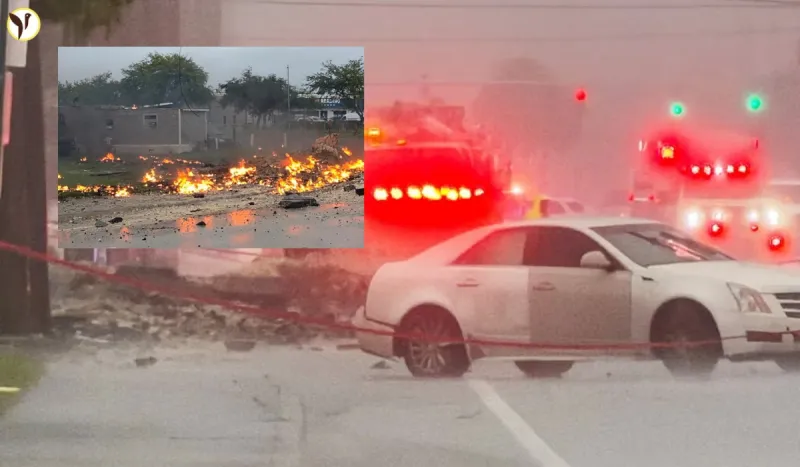
All nine people aboard a Learjet 60 were killed when the aircraft came down in a residential part of Palm Beach County, Florida, on Sunday afternoon, striking near a busy road. Florida's governor said there were no immediate reports of casualties on the ground. The jet had left Austin bound for the Bahamas. The NTSB is investigating.
Unusually for the first day after a crash, there is a detailed public record of what the aircraft did. There is still nothing establishing why.
What happened
The jet went down at about 12:50pm local time on Sunday 1 November, in a residential area of Palm Beach County reported variously as near Greenacres, about seven miles south-west of West Palm Beach, and near Cresthaven.
It struck near a busy road, leaving a crater in the road surface ringed with broken pavement. It came down close to homes and passing vehicles.
Nine people were on board and all nine died, confirmed by US Transportation Secretary Sean Duffy. Governor Ron DeSantis, speaking at the scene, said there were no immediate reports of anyone on the ground being injured or killed though that was an early assessment, not a final count.
The aircraft had taken off from Austin-Bergstrom International Airport in Texas and was flying to North Eleuthera Airport in the Bahamas. A spokesperson for Austin-Bergstrom, Jim Reynolds, described it as a private aircraft. No operator has been named and no registration has been published.
DeSantis described what he saw bluntly: "It was a cataclysmic plane crash." He added: "It looked like a missile going down and left a big crater on the side of the road." Duffy called it "a horrific tragedy."
What the radio calls establish
This is the part worth understanding properly, because it is the only hard evidence in public and it is already being misread.
Air traffic control recordings and tracking data describe this sequence:
- The jet was heading east at 35,000 feet.
- The pilots reported turbulence and icing and requested a climb of 2,000 feet.
- The pilot characterised the conditions as survivable: "We have light, clear ice that is manageable and moderate turbulence."
- Turbulence was reportedly jolting the aircraft by as much as 700 feet.
- Then came the emergency call: "We're descending 8,000 mayday, mayday we're descending 10,000 feet per minute."
- Then: "We are in an over-speed condition descending 20,000 feet per minute."
- The aircraft banked sharply right and descended steeply to impact.
ABC separately reports the dive reached up to 30,000 feet per minute, beyond the aircraft's design limits a figure that appears to come from tracking data rather than the radio, and which is higher than anything the pilot called out.
Two technical terms are doing a lot of work there. An overspeed condition means the aircraft has exceeded the maximum speed it is certified to fly at, which brings its own structural and control problems. And a descent rate called out in the tens of thousands of feet per minute is not a descent in any ordinary sense it is a dive.
Taken together, the transmissions describe an aircraft that stopped doing what its crew intended it to do, at cruise altitude, within a very short span of time.
What they do not establish
The pilot mentioned ice. By tomorrow a great many people will have concluded that ice brought the aircraft down.
That conclusion is not available yet, and it is worth saying why.
A pilot's in-flight report describes conditions as the crew perceived them and this crew described the ice as "manageable." It is a data point for investigators, not a finding. Icing, turbulence, a mechanical or structural failure, a systems problem, a control issue, or some combination could each produce an overspeed dive from cruise, and separating them is precisely what an accident investigation is for.
The National Transportation Safety Board is leading the investigation, with the Federal Aviation Administration sending a team to support it. Until they report, the honest description of the cause is that it is unknown.
Pilot’s final cockpit audio leaks: “Look outside Jack… holy f*ck we’re out of time” as Learjet plummets 27,000 feet in one minute and crashes in Florida. https://t.co/9b1kqQ8Mu3
— Chris Ripa (@CHRISsW0RLD) November 1, 2026
The 600 people whose street this happened on
Largely missing from the coverage is what Sunday did to the neighbourhood it landed in.
Palm Beach County authorities evacuated about 600 people from a nearby mobile home community while federal investigators worked the site. The road was closed until further notice.
An accident site is a controlled scene for as long as investigators need it. Wreckage has to be documented in position before it is moved, and that process does not accommodate anyone's commute or anyone's wish to go home. For several hundred people, the practical consequence of Sunday is an indefinite displacement and a closed road, with no published timetable for either.
If you live in the affected area, Palm Beach County authorities and the local sheriff's office are the source for re-entry, road reopening and any assistance available. Those details change by the hour and are not something a news article can keep current.
When there will actually be answers
Worth setting expectations, because the gap between public appetite and investigative pace is where misinformation grows.
- The FAA typically publishes a preliminary accident notice within about a business day. It is a brief factual record, not an explanation.
- The NTSB usually issues a preliminary report within roughly 30 days. It sets out established facts and carries no conclusions about cause.
- The NTSB's final report, which does determine probable cause, typically takes a year or more.
So the first substantive public document is weeks away and the answer is likely a year out. Anything circulating before then that claims to know why this happened is speculating, however confidently it is phrased.
The victims had not been publicly identified at the time of writing, and no operator had been named.
Questions readers ask
How many people died, and was anyone on the ground killed?
Nine people were aboard the Learjet 60 and all nine were killed, according to US Transportation Secretary Sean Duffy. Florida Governor Ron DeSantis said there were no immediate reports of anyone on the ground being injured or killed. That was an early assessment rather than a final count. The victims had not been publicly identified at the time of writing.
Where exactly did the plane crash?
In a residential area of Palm Beach County, Florida, at about 12:50pm local time on Sunday 1 November 2026. The location has been reported as near Greenacres, roughly seven miles south-west of West Palm Beach, and near Cresthaven. The aircraft struck near a busy road, leaving a crater in the road surface, and came down close to homes and passing vehicles.
What did the pilot report before the crash?
Air traffic control recordings capture the jet heading east at 35,000 feet, with the pilots reporting turbulence and icing and requesting a climb of 2,000 feet. The pilot described conditions as "light, clear ice that is manageable and moderate turbulence." Shortly afterwards he declared an emergency, radioing "we're descending 10,000 feet per minute" and then that the aircraft was "in an over-speed condition descending 20,000 feet per minute." ABC separately reports the dive reached up to 30,000 feet per minute, beyond the aircraft's design limits.
Did icing cause the crash?
No cause has been established and it would be wrong to assume one. The pilot's mention of ice is a report of conditions as the crew perceived them, and they described the ice as manageable. Icing, turbulence, mechanical or structural failure, a systems problem or a control issue could each contribute to an overspeed dive from cruise altitude, and separating them is what an accident investigation does. The NTSB is leading the investigation with FAA support.
When will we know what happened?
The FAA typically publishes a brief preliminary accident notice within about a business day, which records facts rather than explaining them. The NTSB usually issues a preliminary report within around 30 days, again without conclusions about cause. The NTSB's final report, which determines probable cause, normally takes a year or more. Anything claiming to explain the crash before those documents appear is speculation.