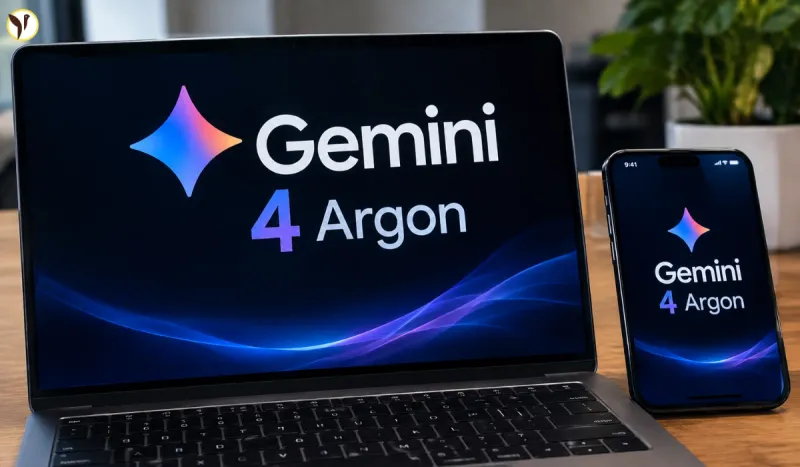
Google Gemini 4 Argon Is Finally Here: 5 Things You Need to Know
Google has launched Gemini 4 Argon, its latest AI model for coding, research and complex tasks. Check its top 5 features, pricing and availability.

- Published
- Reading time
- 9 minutes
New Delhi, October 14, 2026: Google has launched Gemini 4 Argon, a new artificial intelligence model designed to handle complex tasks that require deeper reasoning, coding, research and analysis. The model was announced on October 13 and is aimed at developers, businesses, scientists and selected users of Google's AI services.
Unlike a tool designed only to answer everyday questions, Gemini 4 Argon focuses on longer and more demanding work. It can help with software development, financial analysis, legal research, cybersecurity defence and scientific problem-solving.
Google says the model can work through multi-step tasks, understand different types of information and help users complete complicated projects. However, its performance can vary depending on the task, and AI-generated results still need human review.
The launch also brings questions about access and cost. While developers and businesses can use the model through Google's paid developer services, access through consumer products depends on the subscription plan.
Here are five important things to know about Google Gemini 4 Argon.
Gemini 4 Argon Is Built for Complex Tasks
The first major feature is its focus on tasks that require more than a short answer.
Google says Gemini 4 Argon is designed to handle complex workflows in areas such as coding, finance, law, cybersecurity and science. It can help users examine information, connect details from different sources and work through problems in multiple steps.
For example, a software developer could use it to understand a large codebase, identify possible improvements and prepare code changes. A researcher could use it to analyse documents and organise findings. A business team could use it to examine financial information or prepare an initial analysis.
These capabilities could save time on some tasks, but they do not remove the need for human expertise. Users should verify important calculations, citations, code changes and professional recommendations before relying on them.
Google describes Argon as its latest frontier model for demanding real-world work. Its actual usefulness will depend on the quality of the task, the available information and how carefully the output is checked.
It Offers a 1 Million-Token Context Window
The second important feature is its large context window.
According to Google's developer documentation, Gemini 4 Argon supports a unified input-and-output token context window of up to 1 million tokens. In simple terms, this gives the model room to work with a large amount of information in a single workflow.
This may be useful when analysing lengthy documents, reviewing large software projects or connecting details across several files.
For example, a researcher may need to compare information from multiple reports. A developer may need to understand how different parts of a large application work together. A legal or business team may need to review a long collection of documents.
A large context window can help the model consider more information at once, but it does not guarantee that every detail will be understood correctly. Users should still check important findings and confirm that the model has not missed or misinterpreted key information.
Gemini 4 Argon Can Help With Coding and Software Development
The third feature is its focus on software engineering and coding.
Google says Argon can assist with complicated programming tasks, including understanding large codebases, finding performance improvements and preparing changes across multiple files.
The company has also shared examples from its own engineering teams. According to Google, use of Argon through its Antigravity coding environment helped increase agentic code submissions by more than 35% and reduce code rollbacks by nearly one-third in the reported internal work.
These are Google's own reported results, not a guarantee that every developer will achieve the same improvement.
For programmers, a model like Argon could help with tasks such as:
-
Understanding unfamiliar code and explaining how it works.
-
Finding possible bugs or performance problems.
-
Suggesting code improvements and refactoring options.
-
Creating prototypes and helping test ideas.
-
Supporting multi-step development workflows.
However, developers should review generated code, run appropriate tests and follow security practices before using it in production. AI tools can make mistakes, introduce bugs or suggest changes that do not fit a project's requirements.
It Targets Finance, Legal Work, Science and Cybersecurity
Gemini 4 Argon is not limited to coding. Google says the model is designed to support professional work across several industries.
Finance: It can help analyse financial information, compare figures and organise complex business data. Financial calculations and investment-related conclusions should still be independently verified.
Legal work: It can assist with document review, research and drafting. It should not replace a qualified lawyer or be treated as a final authority on legal questions.
Science and research: The model can help researchers analyse large collections of information, explore hypotheses and work with complex scientific material. Experimental findings require proper scientific validation.
Cybersecurity: Google says Argon can help authorised security teams identify software weaknesses and investigate potential vulnerabilities. Such work must be conducted within legal permissions and appropriate security controls.
Google has also announced an expansion of its Fairwind Program to provide additional vetted cybersecurity defenders with access to a version of the model without its usual cyber guardrails. This access is intended for selected defenders, not unrestricted public use.
These examples show the model's intended range. They do not mean it can independently perform every professional task accurately or safely.
Gemini 4 Argon Price and Availability
The fifth thing users should know is where they can access the model and how much it costs.
Google announced global availability for Gemini 4 Argon on October 13, 2026, across several of its AI products and services. However, access depends on how a person wants to use it.
Where can you use Gemini 4 Argon?
-
Developers: Through the Gemini API and Google AI Studio on the paid tier.
-
Businesses and enterprises: Through Google's supported enterprise AI services and API options.
-
Consumers: Through the Gemini app and AI Mode in Search for Google AI Pro and Ultra subscribers, according to Google's launch announcement.
-
Coding users: Google AI Ultra subscribers can also access Argon through Google Antigravity.
Availability may differ by product, subscription, account and region, so users should check the relevant Google service before upgrading.
How much does Gemini 4 Argon cost?
Google announced the following introductory API prices:
|
|
|
|
|
|
|
|
|
These are API token prices, not a monthly consumer subscription fee. The actual cost depends on how much input and output a developer's application uses.
Google says the introductory pricing is available through November 30, 2026. After that, the listed prices are scheduled to rise to $4 per million input tokens and $20 per million output tokens. Cached input tokens have a separate discount under Google's pricing terms.
Users should check the official developer documentation for the latest prices and applicable conditions before using the API.
How Is Gemini 4 Argon Different From a Basic AI Chatbot?
A basic chatbot is often used for short questions, summaries, writing help and general explanations. Gemini 4 Argon is positioned for more demanding workflows that may involve large amounts of information, complex reasoning and several connected steps.
For example, instead of simply explaining a piece of code, a developer may ask Argon to inspect a larger project, identify possible problems and suggest a structured set of changes.
Similarly, a business user may use it to analyse a collection of documents rather than summarising just one file.
The main difference is the type of work the model is designed to support. However, a more advanced model is not automatically the best option for every user. Simple tasks may not require a specialised model, and API use can create costs depending on usage.
Is Gemini 4 Argon Better Than Other AI Models?
Google has published benchmark results that place Argon among the leading models for selected coding, knowledge-work and reasoning tasks. The company also says the model performed strongly on its internal engineering evaluations.
However, no single benchmark proves that one AI model is best for every purpose. Results depend on the benchmark, the task, the evaluation method and the version of each model being tested.
Some models may perform better on specific coding challenges, scientific problems, computer-use tasks or other specialised work. Independent testing and real-world use are important when comparing them.
Users should choose a model based on their needs, including accuracy, speed, cost, privacy, available tools and ease of use, rather than relying on one headline ranking.
What Are the Limitations of Gemini 4 Argon?
Despite its advanced features, Gemini 4 Argon is still an AI model and can make mistakes.
Google's model information acknowledges that it may produce incorrect or misleading answers, a problem commonly known as hallucination. The company also notes that users may sometimes experience slow responses or timeouts.
There are several practical precautions users should follow:
-
Verify important facts, figures and references.
-
Review code and test it before deployment.
-
Avoid uploading confidential information unless the service's privacy and data-handling terms are suitable.
-
Check professional advice with qualified experts.
-
Confirm API pricing and subscription requirements before committing to a paid service.
For high-stakes work, human oversight remains important even when an AI model appears confident.
What Does Gemini 4 Argon Mean for Everyday Users?
For ordinary users, the launch is another sign that AI tools are moving beyond simple question-and-answer conversations.
More capable models may help people organise research, understand complex documents, plan projects and develop software with less manual effort. Students and professionals may also use them to learn new concepts and explore ideas.
However, the availability of a powerful model does not mean every feature is free or accessible to every account. Some uses require a paid subscription or API access.
Users should also remember that AI can support learning and productivity, but it should not replace independent thinking, fact-checking or professional judgement.
Is Gemini 4 Argon Worth Watching?
Google Gemini 4 Argon is an important new launch for people who use AI for complex coding, research, professional analysis and multi-step tasks.
Its 1 million-token context window, coding capabilities and support for several professional fields are among its main features. Google has also announced API pricing and access through selected consumer and developer products.
The model's real value will depend on how well it performs on individual tasks, how much it costs to use and whether its results can be trusted after verification.
Gemini 4 Argon is built for demanding AI work, not just everyday chat. Before paying for it, check whether your Google account has access, compare the available plans and test the model on the tasks you actually need it to perform.
Questions readers ask
What is Google Gemini 4 Argon?
Google Gemini 4 Argon is an AI model launched on October 13, 2026. It is designed for complex tasks involving coding, research, finance, legal analysis, science and cybersecurity.
When was Gemini 4 Argon launched?
Google announced Gemini 4 Argon on October 13, 2026, with availability across supported Google AI products and developer services.
What are the top five features of Gemini 4 Argon?
Its main features include advanced reasoning for complex tasks, a 1 million-token context window, coding assistance, support for professional work and availability through Google's AI services.
Is Gemini 4 Argon free to use?
API access is available through the paid tier. Access through the Gemini app and AI Mode in Search requires an eligible Google AI Pro or Ultra subscription, according to Google's announcement. Availability and terms may vary.
What is the price of Gemini 4 Argon?
The introductory API price is $2 per million input tokens and $10 per million output tokens through November 30, 2026. The listed prices are scheduled to increase to $4 and $20 respectively after that date.