Behind the Quad Summit: How Minerals, Chips and Oil Shape Global Power
The Quad is strengthening its strategic ties as China gains leverage over rare earths, chip supply chains and global trade, putting India's balancing act in focus.

- Published
- Reading time
- 4 minutes
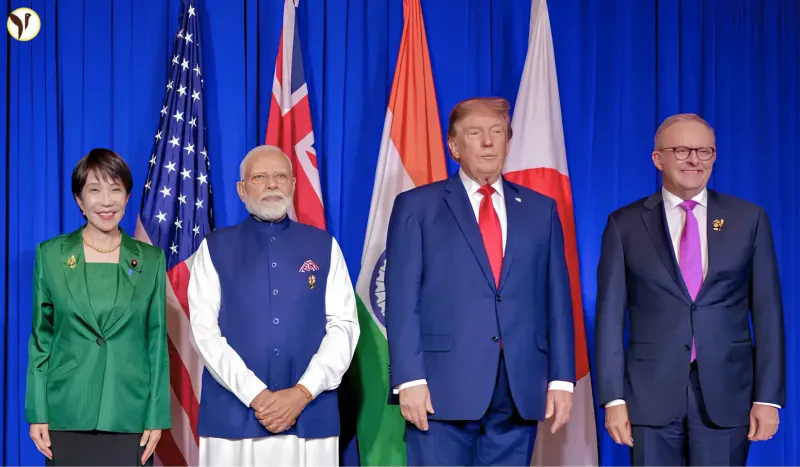
India, the United States, Japan and Australia met in Manila on November 17 for the first Quad leaders' summit in over two years. Two days later, US President Donald Trump met Chinese President Xi Jinping and Russian President Vladimir Putin in Shenzhen. The meetings exposed a contradiction: Washington is strengthening partnerships concerned about China's influence while negotiating with Beijing on trade, technology and energy. Minerals, chips, oil and undersea cables now shape economic security, leaving India to protect its interests while working with competing powers.
The Quad's Agenda Goes Beyond Military Cooperation
The summit announced a Business Leaders' Forum in Mumbai in early 2027, counterterrorism cooperation, maritime surveillance, submarine cable resilience and closer cybersecurity ties. A planned exercise involving the four countries' P-8 and P-3C patrol aircraft is among its most concrete initiatives. The joint statement opposed changing the regional status quo by force and criticised economic coercion without naming China. The Mumbai forum and patrol exercise will test whether these commitments become practical cooperation.
China's Rare-Earth Dominance Gives It Leverage
The International Energy Agency says China controls about 60% of mined magnet rare earths and 91% of refined output. These materials are essential for electric vehicles, wind turbines and advanced manufacturing. The Quad wants to combine Australia's mineral resources, Japan's recycling capabilities, US expertise and India's manufacturing base. For India, this could attract investment and reduce import dependence. But diversification takes time. China paused rare-earth export curbs for two months on November 9, while the US-China trade truce expires on January 10, 2027. Renewed restrictions could raise costs and delay supplies.
Japan Shows How Trade Pressure Spreads
Japan shows how dependence can become political leverage. Relations with China worsened after Prime Minister Sanae Takaichi's November 2025 remarks about a Taiwan crisis threatening Japan's security. Beijing responded with measures affecting seafood imports, tourism and exports of certain dual-use materials and rare earths. US manufacturers relying on Japanese magnets have also faced difficulties, Bloomberg reported. For India, the lesson is that domestic capacity and alternative suppliers are matters of economic security.
US Chip Controls Send Mixed Signals
On November 16, Washington tightened licensing requirements for advanced AI chips used by data centres in Indonesia, Malaysia, Singapore, Thailand and Brazil, especially where Chinese firms could gain remote access. The rules take effect after 90 days. Epoch AI estimates that 290,000 to 1.6 million advanced chips reached China in violation of controls last year, showing how difficult enforcement is. Yet Trump expressed interest in cooperating with Xi on superintelligence in Shenzhen, while US officials said export controls were not negotiable. This mixed message creates uncertainty for allies investing in AI and semiconductors.
Shenzhen Left Major Disagreements Unresolved
Trump's November 19 meeting with Xi and Putin produced a four-point declaration on UN reform, refined petroleum products, immunity for state officials in international courts and nuclear-risk dialogue. It did not mention Ukraine or Iran, and disagreements over rare earths, chips and tariffs remained. For India, shifting US policy affects trade, energy and sanctions. Trump signed the Graham Act on September 18 but waived its tariffs and sanctions on October 16 before they began, citing national interest. India and the US still had no signed trade deal by November 3, according to the cited trade tracker. India's Russian oil trade therefore remains exposed to changing US calculations.
India Is Balancing Competing Partnerships
India has strengthened Quad cooperation while maintaining ties with Russia and other emerging economies. At September's BRICS summit, Prime Minister Narendra Modi stood alongside Xi and Putin; in November, India joined the Quad's security initiatives. India still sources a significant share of its military equipment from Russia. New Delhi said it had taken note of the Shenzhen meeting and would await details, reflecting its preference for diplomatic flexibility. Washington, too, is strengthening the Quad while negotiating with Beijing and Moscow.
Undersea Cables Are an Overlooked Security Risk
Submarine cables carry international internet traffic, financial transactions and communications. Damage can disrupt banks, businesses and governments. Reports of Chinese research vessels near cable routes around the Philippines, Taiwan and Japan have raised concerns, while earlier Red Sea cable disruptions affected connectivity across Asia and the Middle East. For India, these routes connect Southeast Asia with Indian networks. A major cut could affect digital payments, cloud services and businesses relying on international connectivity.
What India Should Watch Next
The Mumbai forum and maritime exercise in early 2027 will test the Quad's ability to deliver. Another key date is January 10, when the US-China trade truce expires. China's decision on rare-earth restrictions could affect manufacturers worldwide. Manila and Shenzhen show that global influence increasingly depends on minerals, chips, energy and infrastructure. India can attract investment and strengthen its position, but must manage dependence on foreign suppliers and unpredictable policies. The question is not simply which countries stand together at summits, but who controls the resources and networks the global economy needs.