Two Trains Collide In Spain, Killing 46: What Does The Report Reveal?
A report on Spain’s deadly Adamuz train crash points to a possible rail-weld fracture. Here is what investigators found and what remains unclear.

- Published
- Reading time
- 3 minutes
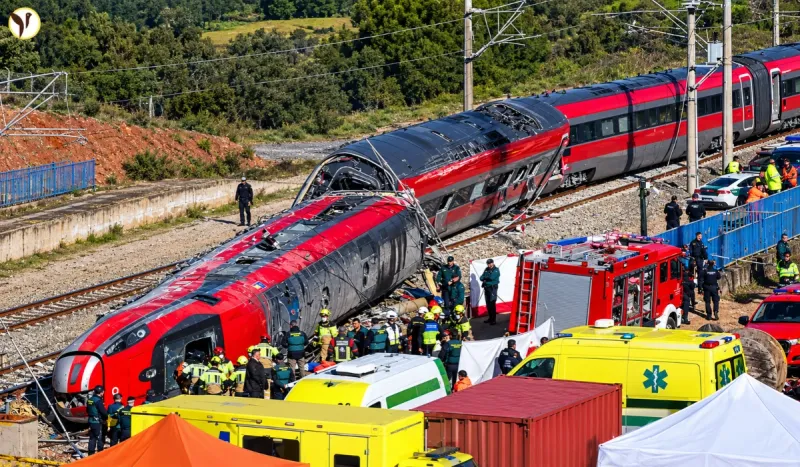
A major train disaster near Adamuz in southern Spain killed 46 people on January 18, 2026. The collision involved an Iryo high-speed train travelling from Málaga to Madrid and a Renfe Alvia train travelling from Madrid to Huelva.
The disaster raised serious questions about railway safety, track maintenance and the systems used to detect possible faults.
A report prepared by Spain’s Civil Guard found a complete fracture at a welded joint connecting two sections of rail manufactured decades apart. Investigators said the damaged area was an important clue in understanding how the accident began.
However, the exact chain of events and the responsibility for the crash remain matters for the ongoing investigation. The report’s findings should not be treated as a final judicial decision.
What Happened In The Adamuz Train Accident?
The accident took place near Adamuz in Córdoba province on January 18.
According to the initial investigation, the rear carriages of an Iryo train derailed and moved onto the neighbouring track. They then collided with a Renfe Alvia train travelling in the opposite direction.
The crash caused severe damage to both trains and led to a major emergency response. Forty-six people died, while more than 100 others were injured, according to official regional documentation.
What Did Investigators Find On The Railway Track?
One of the key findings was a fracture at a welded joint between two rail sections.
The older section carried a manufacturing mark from 1989, while the adjoining section was marked as having been manufactured in 2023.
Investigators identified the fracture at the point associated with the start of the derailment. The report also raised the possibility that fatigue in the material had developed before the rail broke.
These findings have strengthened the focus on the condition of the track and the weld. They do not, by themselves, establish every factor that contributed to the accident.
Did Railway Monitoring Systems Detect A Problem Before The Crash?
An earlier Civil Guard report said railway monitoring systems had recorded an unusual electrical change nearly 22 hours before the accident.
Investigators said the change could have been consistent with a possible rail fracture, but no automatic warning was triggered.
The infrastructure manager, Adif, has disputed the interpretation that the electrical change necessarily proved the track was broken. It said such a variation could have several possible explanations.
This disagreement is important. It means investigators must determine what the monitoring system detected, whether the information should have prompted action and whether any failure contributed to the disaster.
Has The Final Cause Of The Crash Been Confirmed?
Not completely.
The evidence has placed the rail and welded joint at the centre of the investigation. But technical experts still need to examine the track materials and determine how the fracture developed.
In October, Spain’s railway accident investigation authority informed the victims’ association that the technical investigation would take longer than the original 12-month period because of the exceptional complexity of the case.
Until the investigation is complete, it is important to distinguish between evidence identified by investigators and a final determination of responsibility.
Why Is This Report Important For Railway Safety?
The findings matter because they raise questions about several parts of railway safety:
- Track condition: How did the fracture develop at the welded joint?
- Maintenance: Were inspections sufficient to identify a developing problem?
- Monitoring systems: Could the recorded electrical change have helped identify a risk?
- Warnings: Should any alert have been triggered?
- Accountability: Did any technical or operational failure contribute to the disaster?
The answers could influence future safety measures. However, any changes or conclusions should be based on the completed investigation rather than assumptions about the cause.
Was There Another Train Collision In Spain On October 28?
Yes, a separate train collision occurred in Toledo province on October 28, 2026.
Early reports described a collision involving Renfe and Iryo services near Urda, with carriages derailing and emergency services responding. The Madrid–Andalusia high-speed line was suspended following the incident.
This was not the January Adamuz crash that killed 46 people. The two incidents happened at different locations and on different dates, and their casualty figures and investigations must be reported separately.
Questions readers ask
Where did the Spain train crash happen?
The accident happened near Adamuz in Córdoba province, southern Spain, on January 18, 2026.
How many people died in the Spain train crash?
The reported death toll reached 46 people.
Which trains were involved in the accident?
An Iryo high-speed train travelling from Málaga to Madrid and a Renfe Alvia train travelling from Madrid to Huelva were involved.
What does the investigation report reveal?
Preliminary findings point to a possible rail fracture or weld failure. Investigators are examining technical evidence to establish the cause.
Was a broken railway track confirmed as the cause?
Not in the preliminary findings cited here. A rail fracture or weld failure remained the main explanation under investigation.