Rejoin EU Poll: 49% Say Yes. 48.2% Say Keep Current Deal
A 11,461-person megapoll put rejoining the EU on 49%. Keeping the current relationship with fewer trade barriers polled 48.2%. The full findings and the caveats.

- Published
- Reading time
- 7 minutes
A megapoll of 11,461 people by the Messina Group found 49% support for the UK rejoining the European Union, against 28.5% opposed the most popular of seven options tested. But the second option, keeping the current relationship while cutting as many trade barriers as possible, which is already government policy, polled 48.2%. A customs union polled 47.1%, associate membership 45.5% and single market membership 45.1%. The six closer-ties options sit within about seven points of each other, which on a sample this size means the poll shows broad appetite for a closer relationship rather than a clear mandate for rejoining specifically. Only moving further from the EU was clearly rejected, on 27.9%.
All seven options, in full
This is the table that most coverage has not published, and it changes the story.
| Option | Support | Opposed |
|---|---|---|
| Rejoin the EU | 49% | 28.5% |
| Keep current relationship, cut trade barriers | 48.2% | 20.9% |
| Customs union | 47.1% | 20.7% |
| Associate membership | 45.5% | — |
| Single market | 45.1% | — |
| Keep existing relationship as is | 42% | — |
| Move further away from the EU | 27.9% | 41.2% |
Rejoin leads. It leads by 0.8 percentage points over an option the government is already pursuing.
On a sample of 11,461 that difference is not meaningful. Six of the seven options cluster between 42% and 49%, and the only one the public clearly rejects is moving further away, which is the sole option where opposition outweighs support.
Look at the opposition column as well, because it is arguably more revealing than the support column. Rejoining attracts 28.5% opposition. Cutting trade barriers attracts 20.9%, and a customs union 20.7%. The option that polls highest is also the one that generates the most resistance by roughly eight points over the alternatives.
What the poll demonstrates is that a large majority of British voters want a closer relationship with the European Union than they currently have. What it does not demonstrate is agreement on which closer relationship.
The methodology
The Messina Group polled 11,461 people between 12 and 24 September, weighted by referendum result.
That is a very large sample by polling standards, which is what makes it a megapoll, and weighting by how people voted in 2016 is a reasonable methodological choice for a question about Brexit.
One thing the reporting does not disclose is who commissioned the research. On EU membership polling in particular, that matters a poll funded by a campaign group is read differently from one commissioned independently and anyone citing these numbers should note the gap. The research is reported as expected to be shared with the Downing Street operation.
Why "half want to rejoin" is doing some work
The phrase appearing in headlines today is accurate and also slightly generous.
49% support. 28.5% opposed. That leaves roughly 22.5% who are undecided, don't know, or neither.
It is a plurality, not a majority. A referendum result of 49-28.5 is not a thing that can happen; the undecideds have to land somewhere, and where they land is the entire question.
The poll gives some indication. Asked about timing, 25.9% wanted to rejoin immediately, 22.9% within three years and 8.4% within a decade — but 23% said they did not want a closer relationship at all. That last figure is the hard floor of opposition, and it is a quarter of the electorate.
The Labour vote modelling, and its limitation
The Messina Group also tested political messaging for each option, modelling the effect on Labour's vote share. It found increases of between 4.3 and 7.4 percentage points across every scenario involving closer ties.
That is the number driving the political coverage. The caveat is in the same sentence of the findings, and it is substantial.
Most of those gains came from Green and Liberal Democrat voters.
That is vote consolidation on the left, not persuasion of people who voted Leave. Under first past the post, consolidating left-of-centre votes increases national vote share without necessarily winning seats, because those votes are concentrated in constituencies Labour already holds.
The seats where it would need to work are the Leave-voting ones. Two-thirds of the cabinet represent constituencies that backed Brexit, including the prime minister himself, first secretary Louise Haigh, chancellor John Healey and foreign secretary Ed Miliband, all of whom previously said they would respect the 2016 vote.
A seven-point national gain built on Green and Lib Dem switchers does not address that problem. It may not even touch it.
Where the politics sits
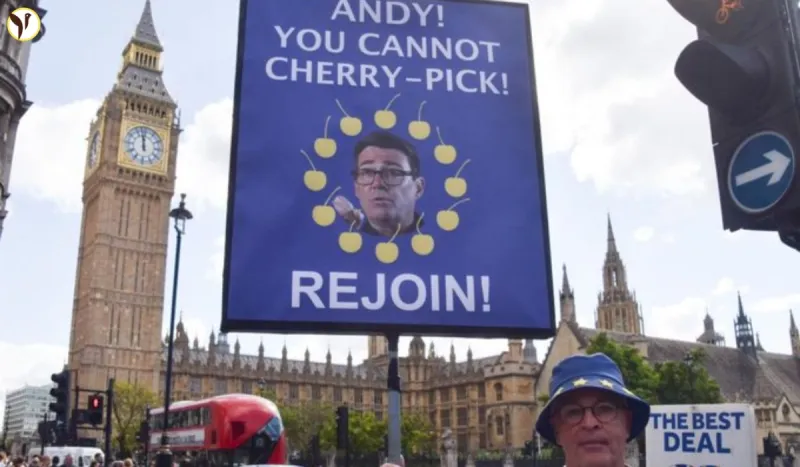
Andy Burnham used his first Labour conference speech as leader to announce a review of the options for Britain's future relationship with Europe, and subsequently said those should include rejoining entirely. He has said he wants to see re-entry "in his lifetime."
The cabinet is visibly split, and several ministers cautioned publicly before the speech.
Lucy Powell, the deputy leader, said that while the defence and security relationship could be better, going beyond the EU reset plans inherited from Keir Starmer was "not possible nor desirable."
Jonathan Reynolds, the trade secretary, said constitutional questions around the EU relationship were causing uncertainty for business.
Shabana Mahmood, the home secretary, said rejoining was "not a simple, straightforward thing" and that the costs might be unacceptable.
Cabinet ministers speaking anonymously to the Guardian were more equivocal than hostile. One said Brexit clearly had not worked and Burnham was right to open the question, but that he needed to proceed with caution to avoid restoking division. Another said security and trade cooperation had risen up the agenda but questioned whether that amounted to a real desire for big change in the population, adding that their constituents would be cautious. A third raised scepticism about the terms on which Britain would return and whether re-entry could resolve problems in people's lives, while accepting that a closer relationship with the EU was necessary.
Nigel Farage said on Thursday that Burnham had given him "the biggest boost in my career" by reviving the Brexit debate. Some inside Downing Street are nervous that promising to renegotiate entry could revive his political fortunes.
Ben Judah, a visiting fellow at Chatham House and former adviser to David Lammy, took the opposite view: "These polls are a massive validation of Andy Burnham's boldness on Europe. There is close to a national consensus that Brexit was not a success. Against this background these results show that Europe as an issue has a unique ability to unite the left and grow the Labour vote share among swing voters. The bolder the stance towards rejoin, the bigger Labour's reward."
Both positions are reported here as what those individuals said. The poll data is consistent with either reading, which is part of why the argument is happening.
Despite all the right wing media anti EU noise, including from the BBC, a majority of UK citizens want to #RejoinEU
— NeutRino #Resist #FBPE🇪🇺💙 🇺🇦 (@3d3dave) October 3, 2026
https://t.co/IZW3LPGa5J
How it would have to be done
The poll asked what process voters thought re-entry would require, and found no consensus there either.
Almost a third said an in-out referendum would be needed first. More than one in six thought a general election mandate would be sufficient. The same proportion thought parliament could simply decide.
Those three positions describe fundamentally different constitutional propositions, and the largest of them a referendum is the slowest and most contested route.
What else the poll found
Several findings have been largely overlooked and are worth recording.
On the Brexit verdict: 52.4% said leaving had been wrong against 29.7% who said it was right, with 17.9% unsure. On success or failure, 54.9% called it a failure, 12.2% a success, 23.2% neither and 9.7% did not know.
On trade priorities: more than two-thirds said trading with the EU mattered more than trading with the US or China, if a choice had to be made.
On the pound: four in five want to keep it. That is a significant constraint on any rejoin proposition, since new EU members are in principle expected to commit to eventual euro adoption.
On the ECHR: a majority want to remain, 53.4% against 24.2%.
And the arguments that won in 2016 have not disappeared. The poll found that Brexit arguments over immigration control and sovereignty still resonate.
The honest summary
A large majority of British voters now think leaving the EU was a mistake and want a closer relationship than they currently have.
They do not agree on which relationship, with six options polling within seven points of each other. They do not agree on how it should be decided, with three constitutional routes splitting the electorate. Four in five want to keep the pound. A quarter want no closer relationship at all. And the arguments that carried 2016 still land.
That is a more complicated finding than "half want to rejoin", and it is the one the data actually supports.
Questions readers ask
What did the Messina Group poll find on rejoining the EU?
49% supported rejoining the European Union, against 28.5% opposed, making it the most popular of seven options tested. The poll surveyed 11,461 people between 12 and 24 September, weighted by referendum result.
Was rejoining clearly the preferred option?
Only narrowly. Keeping the current relationship while cutting as many trade barriers as possible, which is already government policy, polled 48.2%. A customs union polled 47.1%, associate membership 45.5%, single market membership 45.1% and keeping the existing relationship 42%. Six options sit within about seven points of each other, a gap that is not meaningful on a sample of this size. Only moving further away from the EU was clearly rejected, supported by 27.9% with 41.2% opposed.
Which option attracted the most opposition?
Rejoining, at 28.5%. Cutting trade barriers within the current relationship attracted 20.9% opposition and a customs union 20.7%, meaning the most popular option is also the most contested by roughly eight points.
Do a majority of Britons want to rejoin the EU?
Not on these figures. 49% is a plurality rather than a majority, with 28.5% opposed and roughly 22.5% undecided or giving no preference. Asked about timing, 25.9% wanted to rejoin immediately, 22.9% within three years and 8.4% within a decade, while 23% said they did not want a closer relationship at all.
Would rejoining the EU boost Labour's vote share?
The polling modelled increases of between 4.3 and 7.4 percentage points across scenarios involving closer ties. However, most of those gains came from Green and Liberal Democrat voters, which represents consolidation of left-of-centre support rather than persuasion of Leave voters. Two-thirds of the cabinet represent constituencies that voted for Brexit.