Meta Employees Fear New AI Agent: Could It Be Watching Their Every Move?
Meta employees are raising privacy concerns over AI monitoring tools that track keystrokes, mouse movements and screen activity to train AI agents.

- Published
- Reading time
- 4 minutes
Meta is moving deeper into artificial intelligence, but its latest AI push has created serious privacy concerns among employees. The company has been working on AI agents that can perform everyday computer tasks with less human involvement. However, reports about employee monitoring have raised an important question: how much workplace activity should a company collect to train its AI systems?
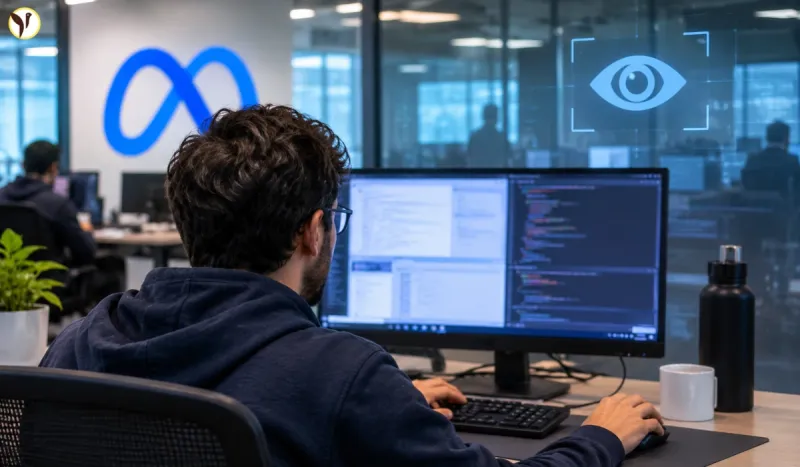
The controversy started after Meta introduced a monitoring tool that could record employees' keyboard activity, mouse movements, clicks and occasional screenshots on work computers. The information was intended to help train AI models to understand how people use computers.
The initiative quickly attracted criticism from employees who worried about their privacy and how their workplace data could be used.
According to reports, Meta later paused the monitoring programme following concerns about the handling and internal accessibility of collected employee data.
What Is Meta's AI Employee Monitoring Tool?
Meta introduced a workplace monitoring initiative called the Model Capability Initiative (MCI) in April 2026.
The programme was designed to collect examples of how employees interact with workplace applications and websites. This information could help AI models learn tasks that humans normally perform on computers.
For example, an employee may use a keyboard shortcut, select an option from a dropdown menu, open a document or move between different applications.
By collecting such activity, Meta wanted to teach its AI systems how to complete similar tasks independently.
The monitoring tool reportedly collected:
- Keyboard inputs and keystrokes.
- Mouse movements and clicks.
- Employee interactions with work applications.
- Occasional screenshots of computer screens.
The company said the data collection was intended to improve its AI capabilities and included safeguards for sensitive information.
Why Are Meta Employees Worried About AI Monitoring?
The biggest concern is employee privacy.
Workers were uncomfortable with the idea that their everyday computer activity could become training data for artificial intelligence systems.
Some employees feared that information displayed on their screens, workplace conversations and other sensitive details could be exposed or used beyond the original purpose.
The controversy also raised questions about whether employees had enough control over the information being collected.
Reports indicated that more than 1,600 employees signed a petition opposing the monitoring initiative.
Employees were particularly concerned about the security of the information collected through the programme.
Meta's Employee Tracking Programme Was Paused After Data Exposure Concerns
The controversy became more serious in June 2026.
According to reports, an internal security notice raised concerns that information collected through the MCI programme had become accessible more widely inside the company than intended.
The exposed information reportedly included employee activity records, prompts, transcripts and other workplace data.
Meta subsequently paused the programme while investigating the issue.
The company said it had no indication that employees had improperly accessed the information. Meta also acknowledged the need to address concerns about the programme's privacy safeguards.
How Could AI Agents Change the Future of Work?
Meta's larger goal is to develop AI agents that can perform tasks that traditionally require human employees.
These systems could eventually help with:
- Writing and editing documents.
- Managing workplace applications.
- Organising information.
- Completing repetitive computer tasks.
- Navigating websites and software.
The idea is to allow employees to focus more on supervising AI systems rather than completing every task manually.
However, this also creates concerns about job security. Some workers fear that the same information they provide to train AI systems could eventually help those systems perform parts of their jobs.
The development of AI agents is therefore creating a debate about productivity, employment and employee privacy.
Is Meta's AI Agent Actually Watching Employees?
It is important to understand the difference between an AI agent and an employee-monitoring tool.
Meta's MCI programme was designed to collect workplace activity to train AI systems. It was not simply an AI assistant secretly watching every employee.
The company said the initiative focused on work-related applications and included privacy safeguards. However, the reported data-access issue raised questions about whether those protections were sufficient.
There is also a separate development involving Meta's consumer AI agent, Muse.
In a November 18, 2026 investigation, Reuters reported that some Meta employees had raised concerns about unexpected messages and possible access to information from other applications through Muse. Meta described the reported incidents as isolated and said some apparent data leaks were AI-generated hallucinations. Reuters could not establish whether the sensitive account details mentioned in some messages were real or invented.
These developments highlight why privacy and security are becoming major challenges as AI agents gain access to computers, applications and personal information.
What Happens Next?
Meta's AI ambitions remain closely connected to its plans to automate more workplace activities.
However, the employee-monitoring controversy shows that collecting data for AI development can create serious trust issues if workers do not feel their information is protected.
Companies developing AI agents will need to balance innovation with transparency, data security and employee privacy.
For Meta, the challenge is not only building smarter AI systems but also convincing employees that their data will be handled responsibly.
The bigger question is whether the future of AI-powered workplaces will make employees more productive or leave them feeling constantly monitored.
Questions readers ask
Does Meta's AI monitoring tool capture employee screen activity?
Yes. The programme reportedly collected occasional screenshots along with keyboard and mouse activity on work computers.
Why did Meta pause its employee monitoring programme?
Meta paused the programme in June 2026 after concerns emerged that collected employee data had become accessible more widely inside the company than intended.
Can Meta AI agents replace human employees?
AI agents could automate several workplace tasks. However, the extent to which they will replace human workers remains uncertain.
Is Meta using employee data to train AI agents?
Yes. Meta introduced its MCI initiative to collect real examples of employee computer interactions to help train AI systems.
What is the biggest concern about AI workplace monitoring?
The biggest concerns include employee privacy, data security, transparency and the possibility of excessive workplace surveillance.