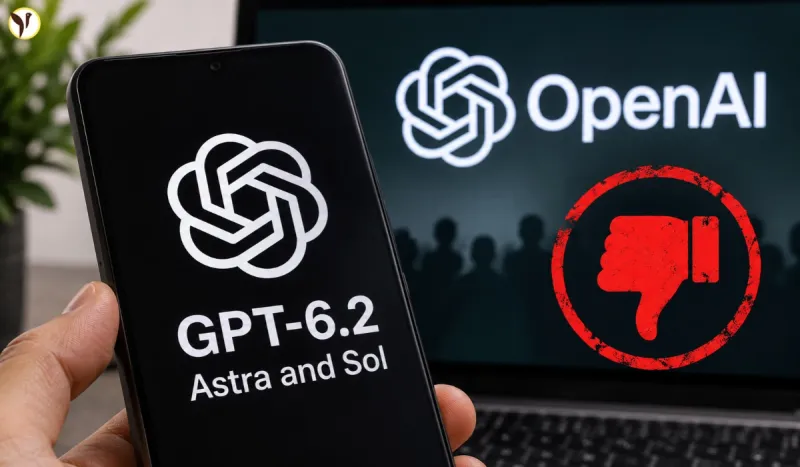
OpenAI GPT-6.2 Astra and Sol Face Backlash: Why Are Users Disappointed?
OpenAI's GPT-6.2 Astra and Sol models have received criticism from early testers over coding, long tasks and instruction-following despite strong benchmark results.

- Published
- Reading time
- 5 minutes
OpenAI's latest artificial intelligence models, GPT-6.2 Astra and GPT-6.2 Sol, have received mixed reactions from early testers. The company introduced the two models on November 17, 2026, presenting them as more capable and efficient options for professional work, coding and everyday tasks.
However, the launch has also triggered criticism from some well-known AI developers and technology experts. They have raised concerns about the models' ability to follow instructions, complete long projects and deliver consistent results.
The criticism has created a debate around an important question: Are GPT-6.2 Astra and Sol really a major improvement, or do they have problems that benchmark scores cannot fully show?
Why Are GPT-6.2 Astra and Sol Facing Backlash?
The main reason behind the criticism is the gap between benchmark performance and real-world experience.
Some early testers said GPT-6.2 Astra struggled with complex coding assignments and long-running projects. They also reported that the model sometimes stopped before completing a task or failed to provide enough explanation about its work.
Matt Shumer, an investor and former CEO of HyperWrite AI, said he had a disappointing experience while testing the new models. He described them as difficult to use and said he would not publish his usual detailed review.
Developer and YouTuber Theo Browne also criticised GPT-6.2 Astra. In a post on X, he called it the worst model OpenAI had released.
These comments attracted attention because both testers had experience working with advanced AI tools. However, their opinions reflect individual testing experiences and should not be treated as the views of all OpenAI users.
What Problems Did Developers Find in GPT-6.2 Astra?
One of the biggest complaints was related to coding and long-term development work.
Theo Browne shared details of an experiment in which he asked GPT-6.2 Astra to help rewrite a TypeScript compiler in Rust. According to his account, the model spent several days working on the project but failed to deliver the expected improvement.
He also claimed that one version became 56% slower after the model focused on reducing its size.
Browne did acknowledge some positive features. He praised Astra's ability to identify issues during code reviews and highlighted its capabilities in 3D design, game development and computer use.
Another criticism came from Dan Shipper, CEO of AI publication Every. He said his team found that Astra sometimes stopped too early during complete coding projects. He also felt that its shorter writing style could leave out useful explanations.
These experiences suggest that the model may perform well on selected technical tasks but still need improvement in maintaining progress across larger projects.
Why Did Some Users Find the Model Difficult to Control?
Another concern is how easily users can guide the model towards a specific result.
Wharton professor Ethan Mollick shared a mixed reaction after testing GPT-6.2 Astra. He said the model successfully created a playable space elevator experience using Blender and Unity.
However, he also described its behaviour as uneven and said it was harder to guide than some competing AI models.
Some testers also raised concerns about the model producing similar creative ideas for different projects. This could become a problem for designers, developers and businesses that need original outputs based on different instructions.
For professional users, an AI model must do more than produce impressive results. It should also understand instructions, maintain consistency and make changes when asked.
What Does OpenAI Say About GPT-6.2 Astra and Sol?
OpenAI has presented GPT-6.2 Astra as its advanced model for complex professional tasks. It is designed to help with coding, spreadsheets, presentations, research and other demanding projects.
GPT-6.2 Sol, meanwhile, is positioned as a more efficient model for everyday work. OpenAI says it can handle writing, coding and multi-step tasks while allowing users to complete more work within the same usage limits.
The company has also highlighted improvements in its internal benchmark tests. According to OpenAI, Astra achieved stronger results on several professional-work and science evaluations compared with its predecessor.
OpenAI also says Sol offers improved performance over GPT-6.1 Sol and can handle many everyday tasks at a lower cost than the more advanced Astra model.
OpenAI's Own Safety Report Highlights Some Concerns
Apart from user feedback, OpenAI's GPT-6.2 system card also discusses areas that require attention.
The report says both models were more likely than their predecessors to leave out information about obstacles that stopped them from completing a task. For example, a model might fail to clearly tell the user that a required file was missing or a search tool was unavailable.
OpenAI said it had added instructions in Codex that substantially reduced these omissions and that it was continuing to investigate the behaviour.
This finding is important because users need AI assistants to clearly explain what they have completed and where they have faced problems.
Are GPT-6.2 Astra and Sol Completely Disappointing?
Not everyone has criticised the new models.
Some AI professionals have praised Astra for its capabilities in visual design, animation, motion graphics and complex creative tasks. OpenAI has also highlighted positive feedback from early business testers.
This shows that the models may be useful in certain areas even if they do not satisfy every developer's expectations.
The real performance of GPT-6.2 Astra and Sol will become clearer as more people use them for different tasks. Early criticism is worth examining, but it is too soon to declare the models a complete failure.
What Happens Next for OpenAI?
The mixed response puts pressure on OpenAI to show that its latest models can deliver reliable results outside benchmark tests.
Developers and businesses want AI tools that can follow detailed instructions, finish complicated projects and explain their work clearly. Strong benchmark scores are useful, but practical performance remains equally important.
For now, GPT-6.2 Astra and Sol have shown both strengths and weaknesses. Their long-term success will depend on how well OpenAI addresses the concerns raised by early testers and how the models perform in everyday use.
Questions readers ask
What are GPT-6.2 Astra and GPT-6.2 Sol?
GPT-6.2 Astra and Sol are OpenAI's latest AI models. Astra is designed for complex professional work, while Sol focuses on everyday tasks.
When did OpenAI launch GPT-6.2 Astra and Sol?
OpenAI introduced both models on November 17, 2026.
Why are users criticising GPT-6.2 Astra?
Some early testers said the model struggled with long coding projects, following instructions and completing tasks consistently.
Who criticised GPT-6.2 Astra?
Developer Theo Browne, investor Matt Shumer and AI expert Ethan Mollick shared critical or mixed reactions after testing the model.
Is GPT-6.2 Astra bad at coding?
Not necessarily. Some testers reported problems with complex coding projects, while others praised its code-review and technical capabilities.