Meta Removes More Content in India: Why Have Restrictions Risen 131 Times?
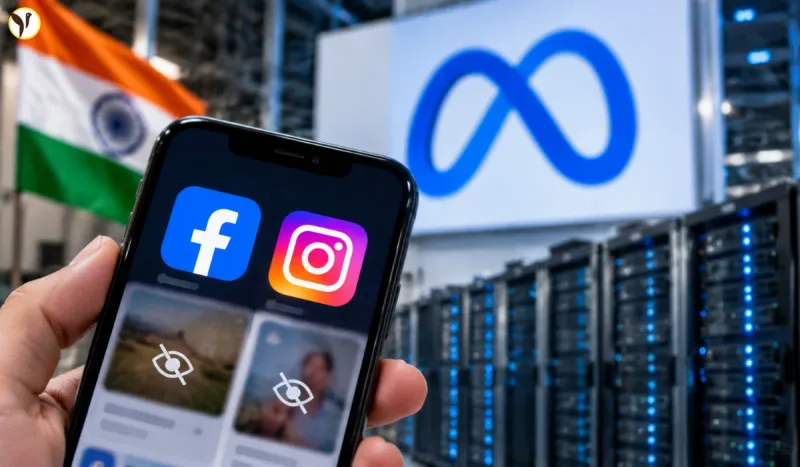
Meta restricted 5.44 million Facebook and Instagram items in India in the first half of 2026, a 131-fold rise. Know why restrictions increased.

- Published
- Reading time
- 5 minutes
According to Meta's latest transparency data, the company restricted more than 5.44 million items in India between January and June 2026 because of alleged violations of local laws. The number was around 131 times higher than the 41,400 items restricted during July-December 2025.
The sharp increase has placed India among the countries with the highest number of content restrictions under local laws. India ranked second globally, behind Indonesia, during the first half of 2026.
The development comes after the Indian government changed its IT Rules in February 2026, giving social media platforms less time to act on certain content removal notices.
Why Did Meta's Content Restrictions Rise 131 Times?
The biggest reason behind the increase is the change in India's Information Technology Rules.
In February 2026, the government introduced amendments that shortened the time available to social media platforms to act on certain government notices. The earlier 36-hour deadline for removing unlawful content after receiving a notice was reduced to three hours.
This change put additional pressure on platforms such as Facebook and Instagram to respond quickly to legal requests.
Meta's transparency data also showed a major increase in content restrictions after the new requirements came into effect. The company said that a large majority of the restricted items involved situations where it was required to proactively restrict content under local laws.
The increase does not necessarily mean that every item was permanently deleted worldwide. In many cases, access was restricted within India to comply with local legal requirements.
What Do the Latest Meta Numbers Reveal?
The latest figures show how sharply content restrictions increased in India.
|
|
|
|
|
|
|
|
|
|
|
|
|
|
|
|
|
|
|
|
|
India accounted for around one-fifth of the 27.1 million items restricted globally by Meta under local laws during the first half of 2026.
Indonesia ranked first with approximately 20.6 million restricted items, while South Korea was in third place with around 410,000.
These figures show that India has become one of the largest markets where Meta is restricting content in response to local legal requirements.
What Type of Content Was Restricted in India?
Meta's report identified several categories of content affected by the restrictions.
These included:
-
Content related to online gaming.
-
Synthetically generated content depicting prominent figures.
-
Material considered a threat to India's sovereignty and integrity.
-
Gender-based harassment.
-
Content promoting enmity between different groups.
Meta also said that some restrictions involved blocking identical copies of content at scale within a country, as required under local rules.
This means that restrictions were not limited to individual posts. The process also involved identifying and restricting repeated copies of certain content.
How Did India's New IT Rules Change the Process?
The February 2026 amendments changed the timeline for social media companies to respond to certain notices.
Earlier, platforms had up to 36 hours to remove unlawful content after receiving a relevant government notice. Under the revised rules, this period was reduced to three hours.
The time allowed for handling certain sensitive user complaints, including complaints involving nudity and impersonation, was also reduced from 24 hours to two hours.
The amendments also introduced new labelling and compliance requirements for synthetically generated content.
The government says such rules are intended to ensure faster action against unlawful online material. However, digital rights groups have raised concerns about whether platforms have enough time to review notices carefully before restricting content.
Why Are Content Restrictions Creating a Debate About Free Speech?
The increase has created a wider debate about the balance between online safety and freedom of expression.
The government says content is restricted when it violates Indian law or creates concerns related to public safety and national security.
Meta has also said that it restricts content in India to comply with local laws.
However, journalists, digital rights groups and some content creators have questioned how these decisions are made. They have raised concerns about limited explanations, automated restrictions and the difficulty of challenging blocked posts.
In October 2026, several journalists and creators reported that their posts or accounts had become unavailable in India. Some said they did not receive clear explanations for the restrictions.
Reporters Without Borders has also raised concerns about the increasing speed and lack of transparency around content takedowns.
Meta Faces Fresh Attention After Congress Protests
The issue has also become a political controversy.
On November 20, 2026, Youth Congress workers protested outside Meta offices in Mumbai and Hyderabad over the restriction of accounts belonging to party leaders and members. Reuters reported clashes involving protesters, police and security personnel.
The Congress group demanded the restoration of restricted accounts and accused Meta of limiting political voices. The ruling BJP criticised the protests, while the government has maintained that takedown orders are based on legal requirements.
Reuters reported that two accounts were restored after the protests, while other accounts remained restricted at the time of its report.
Meta has said that it restricts content in India to comply with local laws.
What Does This Mean for Facebook and Instagram Users?
The increase in restrictions could affect how users access certain posts, videos and accounts in India.
If a post is restricted under local law, users in India may not be able to view it even if it remains accessible in other countries.
Creators, journalists, news organisations and ordinary users may therefore want to understand why their content has been restricted and which options are available to challenge a decision.
Users should also remember that content being unavailable in India does not automatically prove that it was removed globally or that the account itself was permanently deleted.
Meta's transparency reporting is important because it provides information about how the company responds to legal requirements in different countries.
Conclusion
Meta's decision to restrict more than 5.44 million pieces of content in India during the first half of 2026 marks a major increase compared with the previous six-month period.
The 131-fold rise is closely linked to changes in India's IT Rules and the growing use of legal requests to restrict online material. While the government says faster action is necessary to control unlawful content, digital rights groups continue to question transparency and the impact on free speech.
The debate is likely to continue as India strengthens its digital regulations and social media platforms adjust their systems to meet local requirements.
Questions readers ask
Why did Meta's content restrictions increase 131 times in India?
The increase is linked mainly to India's amended IT Rules and requirements to restrict certain content under local laws.
How much content did Meta restrict in India in 2026?
Meta restricted more than 5.44 million items on Facebook and Instagram between January and June 2026.
What was the previous content restriction figure?
Meta restricted around 41,400 items in the second half of 2025.
Which country had the highest number of Meta content restrictions?
Indonesia ranked first, with around 20.6 million items restricted in the first half of 2026. India ranked second.
What are India's new IT Rules for content removal?
The February 2026 amendments reduced the deadline for platforms to act on certain unlawful-content notices from 36 hours to three hours.