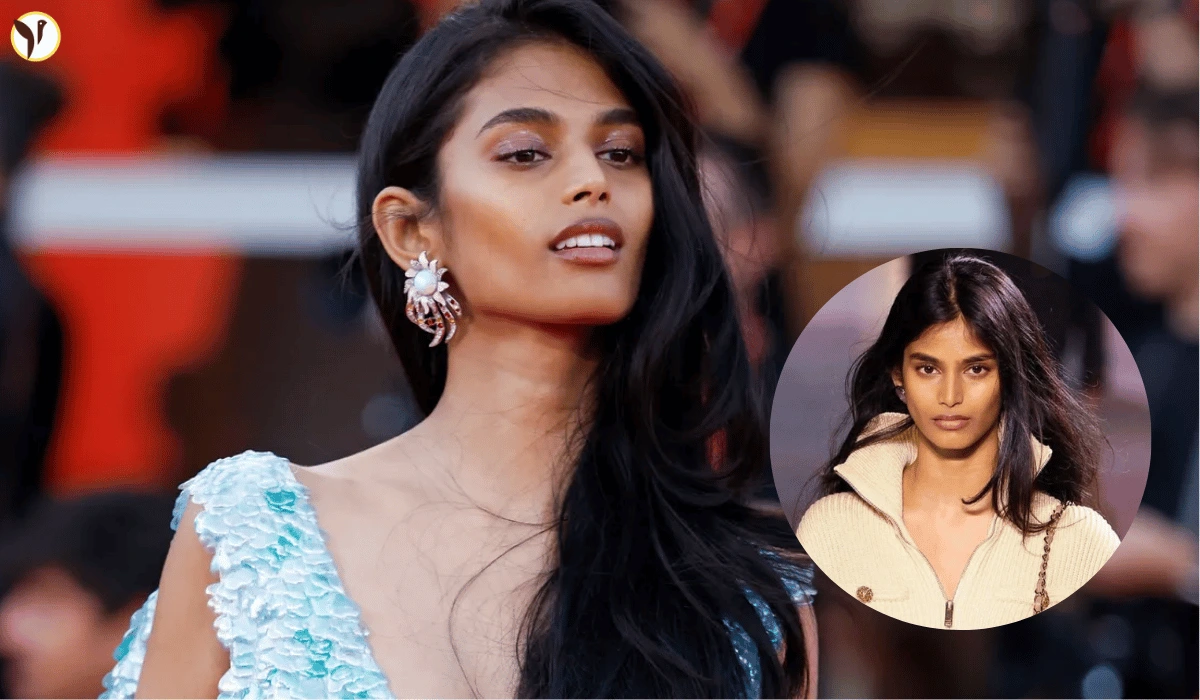


Bhavitha Mandava made her Venice Film Festival debut this week in a turquoise Chanel gown that took an atelier roughly 1,250 hours to embroider.
She wore it to the premiere of Shin'ya Tsukamoto's Mr Nelson, Did You Kill People? at the 83rd Venice International Film Festival. The dress was the closing look from Chanel's Resort 2027 collection, designed by the house's artistic director Matthieu Blazy, and it has a name: the mermaid dress.
The numbers behind it are worth sitting with. But they are not the most interesting thing about this.
What the dress actually is
The gown is built to look like something surfacing from water.
Its fitted body is covered in 30,000 domed, heart-shaped sequins, arranged in graduated shades running from iridescent sky blue through to deep turquoise, so the colour shifts as the wearer moves. The layered flounces at the waist, hips and hem carry a further 96,000 oval sequins, catching light at different angles to create the effect of scales.
That is 126,000 sequins on a single dress.
It is sleeveless, with an exaggerated V-neckline at the front and a deep open back framed by cascading ruffles. Mandava kept everything else quiet: gold-tone and red resin earrings, a blue-and-green sequined camellia brooch, sleek straight hair with a sharp centre parting, and almost no other intervention. When a garment is doing this much, the job of everything else is to get out of its way.
What 1,250 hours actually means
Fashion coverage throws hour counts around until they stop registering. So here is the arithmetic.
Twelve hundred and fifty hours is around 156 full eight-hour working days. If one person did nothing else, five days a week, that is close to seven months of work. On one dress. For one evening.
The embroidery is reported to have been done by Lesage, Chanel's embroidery house and that detail closes a loop that most of the coverage misses entirely. Lesage is one of the specialist craft ateliers Chanel owns and preserves under its Métiers d'Art umbrella, the whole purpose of which is to keep these dying handcraft skills commercially alive. Chanel stages an annual Métiers d'Art show specifically to showcase them.
Which matters here, because the Métiers d'Art show is where Bhavitha Mandava's story broke open.
The part nobody is leading with
In December 2025, Chanel staged its Métiers d'Art 2026 show on a subway platform at Manhattan's Bowery station.
Mandava opened it. She was the first Indian model ever to open a Chanel show.
Blazy did not put her in couture for it. He put her in a beige quarter-zip jumper and stonewashed jeans a deliberate recreation of the outfit she had been wearing on the day a modelling scout spotted her on the New York City subway.
So: a young woman is discovered underground on a train. A year or so later, she opens one of the most prestigious shows in fashion, in an underground station, wearing a copy of the clothes she was found in.
Blazy told British Vogue of that opening look: "That outfit wasn't only about Chanel, it was also about her."
She posted a video of her parents watching the livestream from their sofa in India her mother clapping and squealing, her father beaming quietly. It went viral within hours.
Nine months on from those jeans, she is in Venice in 126,000 sequins. That distance, travelled that fast, is the actual story.
Who Bhavitha Mandava is
She is 26, born in Hyderabad on 3 February 2000 into a Telugu family, and she did not set out to be a model.
She studied architecture at Jawaharlal Nehru Technological University, then went to New York University for a master's in integrated design and media. She graduated in May 2025 with both degrees a bachelor's in architecture and the master's having already walked for Bottega Veneta, Dior and Chanel while still studying.
The Bottega connection is how the Chanel one happened. In January 2025 she was cast as an exclusive model for Bottega Veneta's Spring/Summer 2025 show under Matthieu Blazy. When Blazy was appointed Chanel's artistic director in late 2024, Mandava followed him to the French house.
Since then: first Indian model to open a Chanel show, Chanel's first Indian house ambassador, a British Vogue cover in March 2026 photographed by Oliver Hadlee Pearch, a Met Gala debut, and now Venice. Her Met Gala look, incidentally, was also jeans and a three-quarter-zip she has made a habit of showing up to fashion's most formal rooms in the clothes she was found in.
The Vogue cover made her the first Indian woman on the cover of British Vogue since Priyanka Chopra.
Why this one lands
Red carpet stories are usually disposable. This one has a shape.
An architecture student from Hyderabad gets stopped on a New York train. The designer who casts her keeps casting her. When he takes over the most famous fashion house in the world, he brings her with him, opens his first major show with her, and dresses her in the clothes she was wearing the day she was discovered in the same kind of station where it happened.
Then he gives her a dress that took seven months of one person's working life to embroider, and sends her to Venice in it.
The sequin count is the headline. The subway is the story.