Alia Bhatt's Gold Banarasi Jacket: The Look, Decoded
Alia Bhatt wore a custom gold Banarasi kalidar jacket by Mayyur Girotra with tailored trousers. Here's what the look is made of, and how to get the silhouette without couture.

- Published
- Reading time
- 5 minutes
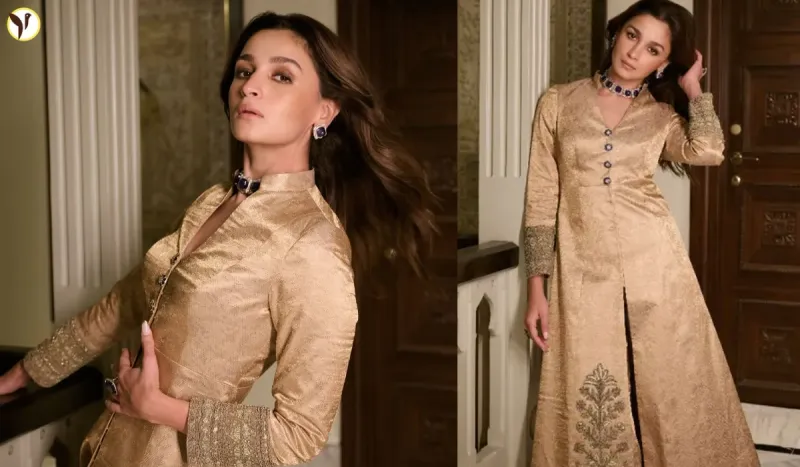
Alia Bhatt stepped out this festive season in a custom gold Banarasi kalidar jacket by Mayyur Girotra, worn over matching tailored trousers and gold woven mules, styled by Priyanka Kapadia Badani. There is no lehenga, no dupatta and very little surface embroidery the luxury sits in the woven fabric itself.
That last part is the interesting bit, and it is worth more than a scroll.
What she actually wore
The jacket is long and kalidar cut with vertical panels, called kalis, that flare from a fitted waist. It is the construction behind the classic anarkali, and it does something a straight-cut jacket cannot: it holds a column shape at the top and releases into movement at the bottom.
The details, as reported by Free Press Journal and CineBuster:
- Gold-woven Banarasi fabric, carrying the label's archival Mor Bagh Tree of Life motif
- A high collar, deep V-cut, fitted bodice and a front slit
- Kora work on the hem and cuffs
- Real enamel and diamond buttons
- Matching tailored gold trousers
- Pointed-toe gold woven mules
The jewellery was a single decision rather than a pile: a cabochon-gem choker set with diamonds by PC Totuka and Sons in sapphire blue, with matching sapphire studs and a solitaire ring. One cool-toned colour against all that gold, and nothing else competing.
Hair was mid-parted and waved. Makeup was a brown smoky eye with glossy nude lips over glowing skin. Priyanka Kapadia Badani styled the look.
Why the fabric is the flex
Here is the shift this outfit sits inside, and it is a real one.
For most of the last two decades, Indian festive dressing competed on surface sequins, zardozi, mirror work, thread embroidery, the heaviness of a lehenga being a reasonable proxy for what it cost. More decoration meant more money, and you could see it from across a room.
A gold Banarasi kalidar jacket makes the opposite argument. The value is in the weave, which means it is in the loom and the labour, not stitched on afterwards.
Banarasi brocade is woven in and around Varanasi, and it carries a Geographical Indication tag granted in 2009 under the registration "Banaras Brocades and Sarees", covering Varanasi and a handful of surrounding districts including Mirzapur and Azamgarh. The GI exists for a specific reason: to separate genuine handloom work from cheaper powerloom and imported imitations that look similar in a photograph and are not the same object at all.
So when a garment leads with the weave and keeps the embellishment to kora work at the hem and cuffs, it is making a quieter claim than a fully embroidered lehenga, and a more technical one. You have to know what you are looking at.
That is also why this reads as modern rather than traditional despite being made of one of India's oldest luxury textiles. The fabric is heritage; the kalidar jacket over tailored trousers is not.
The practical case for trousers
Separately from all of that, there is a reason this silhouette keeps appearing on people who have to get through a long evening.
A lehenga is a commitment. It is heavy, it needs managing on stairs and in car doors, the dupatta needs a hand or a pin for several hours, and by the fourth event of a week most people are quietly furious with it.
A jacket and trousers does none of that. You can sit, eat, drive and dance in it. It works at a mandir visit and at a late dinner without changing. And unlike a lehenga, the two halves come apart and go on living the jacket over a plain kurta or even over jeans, the trousers under something else entirely.
The anti-lehenga argument is not really about taste. It is about how many wears you get.
Getting the silhouette without the couture
Bhatt's jacket is custom, and no price was disclosed by any outlet covering it. Custom couture is not a shoppable item, so the useful question is what makes the look work and which parts you can actually reproduce.
Four things are doing the heavy lifting, and none of them requires a designer.
The column. Jacket and trousers in the same fabric or the same tone, so the eye reads one unbroken line instead of a top and a bottom. This is the single biggest reason the outfit looks expensive, and it costs nothing it is a matching decision.
The fit at the waist. The kalidar panels are fitted through the bodice before they flare. A loose brocade jacket over trousers reads as a kurta set; a fitted one reads as tailoring. If you buy one ready-made thing and alter it, alter the waist.
Restraint in the jewellery. One substantial piece in a contrasting cool tone, and then stop. Against gold brocade, a single choker or a single pair of statement earrings will always look better than a full set.
Shoes that disappear. A closed pointed toe in the same metallic family extends the leg line and keeps the column going. Visible contrast at the ankle cuts the whole thing in half.
On the fabric itself: if you are buying Banarasi, ask whether it is handloom and look for GI certification. Handloom Banarasi costs considerably more than powerloom brocade and it should you are paying for a weaver's time. If the budget does not reach it, a well-cut jacket in an honest powerloom brocade will serve you better than a badly cut one in handloom. Cut is visible at ten paces; thread count is not.
One caveat on what we actually know
Worth being straight about the gaps, because the coverage is thin on them.
No outlet has named the event. Free Press Journal frames the look around Diwali; CineBuster calls it a special appearance and names nothing. There is no confirmed occasion and no date attached to the appearance.
No price has been disclosed. Any figure circulating for this outfit should be checked carefully — there is a separate Banarasi silk look of Bhatt's from July 2026 that generated its own cost coverage, and the two are easy to confuse.
Neither the designer nor the stylist has commented publicly on the look that we can find. The styling guidance above is this publication's own reading, not theirs.
What is solid is the garment, the label, the stylist and the jewellery house. Which, for a fashion story, is most of what matters.
Questions readers ask
Who designed Alia Bhatt's gold Banarasi jacket?
Mayyur Girotra made the custom outfit. It is a long kalidar jacket in gold-woven Banarasi fabric carrying the label's archival Mor Bagh Tree of Life motif, with kora work on the hem and cuffs and real enamel and diamond buttons, worn with matching tailored gold trousers and pointed-toe gold woven mules. Priyanka Kapadia Badani styled the look.
What is a kalidar jacket?
A kalidar garment is cut with vertical panels, called kalis, that flare out from a fitted waist. It is the construction behind the classic anarkali. The effect is a close column through the bodice that releases into movement lower down, which is why a kalidar jacket reads as tailored rather than as a loose kurta.
What jewellery did Alia Bhatt wear with it?
A cabochon-gem choker set with diamonds by PC Totuka and Sons, in sapphire blue, with matching sapphire studs and a solitaire ring. The cool blue against gold brocade is a deliberate single accent rather than a full matched set.
How much did the outfit cost?
No price has been disclosed by any outlet covering the look, and the jacket was made custom. Be careful with figures circulating online — Alia Bhatt wore a different Banarasi silk outfit in July 2026 that generated its own cost coverage, and the two looks are easy to confuse.
How do I wear a Banarasi jacket instead of a lehenga?
Four things make the silhouette work. Keep the jacket and trousers in the same fabric or tone so the eye reads one unbroken column. Make sure the jacket is fitted at the waist before it flares — if you alter one thing, alter that. Wear a single substantial piece of jewellery in a contrasting cool tone rather than a full set. And choose a closed pointed-toe shoe in the same metallic family, since visible contrast at the ankle breaks the line. If you are buying Banarasi fabric, ask whether it is handloom and look for GI certification, which distinguishes genuine Varanasi weaving from powerloom imitations.