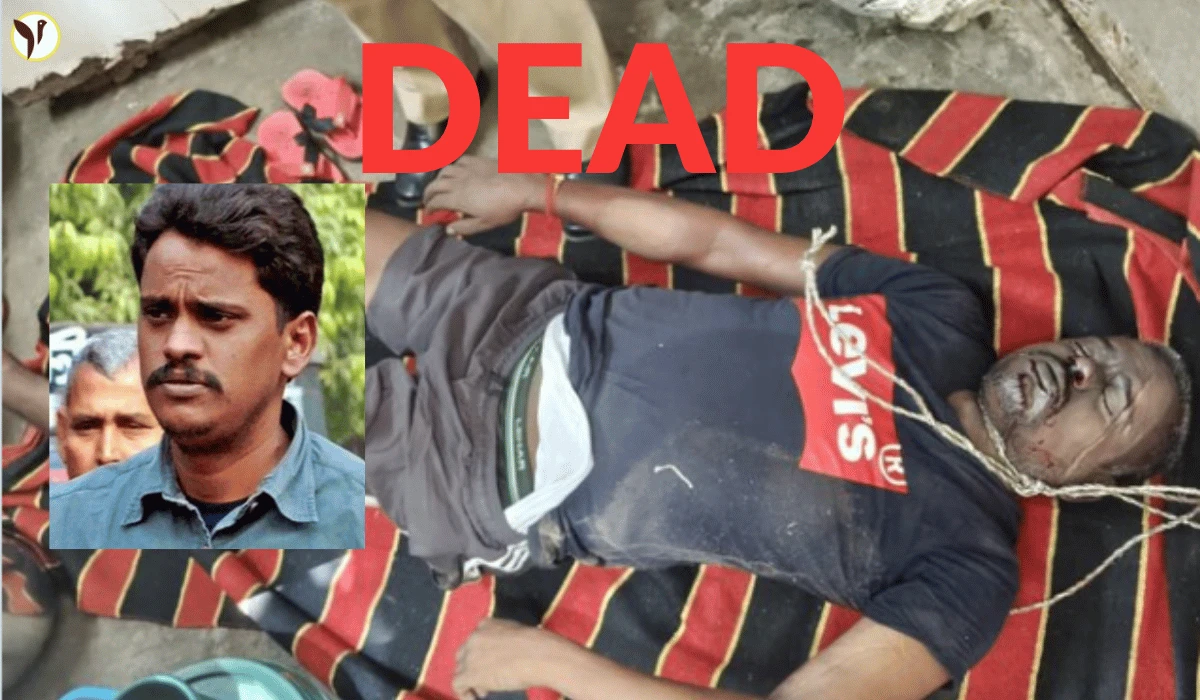


For the last few months, if you walked down Sapt Sarovar Road in Haridwar, you could have bought a cup of tea from him.
He was in his fifties. He had a small stall in the Bhupatwala area. Nothing about it would have told you anything, unless you recognised the face, and in India a great many people would have.
Surendra Koli had been out of prison for about ten months.
On Friday morning, police were called to the stall. They found him dead. An Aadhaar card recovered from the scene carried his name and a matching address. Haridwar City Circle Officer Shishupal Singh Negi said the death appeared prima facie to be suicide, and a forensic team was called in ahead of inquest proceedings and a panel post-mortem. His family has been informed.
He had walked free in November 2025 with nothing standing against him. Nineteen years in custody. Twelve death sentences, all of them set aside.
What those nineteen years were
Koli was 30 when police arrested him in December 2006.
He was a domestic worker at a bungalow in Sector 31, Noida, owned by a businessman named Moninder Singh Pandher. That month, skeletal remains of eight children were recovered from a drain behind the house. Children and young women had been disappearing from the neighbouring settlement of Nithari through 2005 and 2006, and the discovery detonated across the country.
The CBI eventually registered 16 cases out of 19, filing closure reports in three for want of evidence.
VIDEO | Haridwar, Uttarakhand: Surendra Koli, an accused in the Nithari case, was found dead in the Bhupatwala area. Police said he allegedly died by suicide.
— Press Trust of India (@PTI_News) September 18, 2026
Koli had reportedly been living in Bhupatwala and running a tea stall for the past few days.
Police reached the spot,… pic.twitter.com/9AYUkXh6Eb
Koli was convicted repeatedly. He was sentenced to death twelve times. He spent the bulk of his adult life in a cell waiting to be hanged, and came close enough that in 2015 the Allahabad High Court commuted one of those sentences to life imprisonment specifically because his mercy petition had sat undecided for so long.
That is the part worth pausing on. Between 2006 and 2024, as far as the Indian state was concerned, this matter was settled. A man had been condemned to death a dozen times over. There was no ambiguity in the public mind and very little in the courts.
Then it came apart.
The judgment that ended it
On 16 October 2024, a division bench of the Allahabad High Court acquitted Koli in twelve cases and Pandher in two.
The court found the prosecution had failed to prove guilt beyond reasonable doubt on the settled parameters applying to circumstantial evidence. Had it stopped there, it would have been a technical acquittal and the country could have carried on believing what it believed.
It did not stop there.
The bench described the investigation as botched. It went on to call it "nothing short of a betrayal of public trust by responsible agencies."
That is a High Court saying, in a judgment, that the agencies charged with solving the deaths of eight children failed so comprehensively that the failure itself was a breach of faith with the public.
The CBI and the Uttar Pradesh government challenged the acquittals in the Supreme Court. One conviction still stood against Koli, in a case concerning a victim named Rimpa Haldar. On 11 November 2025, the Supreme Court allowed his curative petition in that matter and set it aside.
After that there was nothing. He was a free man, legally innocent, roughly fifty years old, with nineteen years and no life to go back to.
What do you do the day after
There is no framework in India for what happens next to someone in that position.
There is no compensation as of right. No resettlement programme. No mechanism to restore a reputation, and certainly no mechanism to make a country stop believing what it spent eighteen years being told. He had no work history, no savings, no career, and a face that had been on television for most of two decades attached to one of the most repellent crimes in living memory.
He went to Haridwar and sold tea, under his own name, in a town full of pilgrims and strangers.
Ten months later he was dead.
Police are investigating the circumstances and the formal position will follow the post-mortem. What can be said without speculating is that a man acquitted by the highest court in the country lived free for under a year, and that nothing in the system that took those nineteen years from him was ever designed to give any of it back.
The question nobody is asking
Here is where this story stops being about Surendra Koli.
Eight children's remains came out of a drain in Noida in December 2006. More children and young women from Nithari had gone missing across the two years before that.
Nobody has been convicted of any of it.
Not Koli. Not Pandher, who was charged in six cases, cleared in three by a sessions court and acquitted in the rest, and who also lost years to a case that produced nothing. Nobody.
In the strict legal sense, the Nithari killings are an unsolved crime. Twenty years old, nationally infamous, and unsolved — and almost nobody is treating it that way, because the country long ago decided it had its answer and then quietly stopped paying attention when the courts took the answer away.
The families in Nithari are still there. Some of them fought the case themselves; the father of one victim took a challenge against an acquittal to the Supreme Court on his own. They have buried children whose deaths no court has ever attributed to anyone, and they have watched two decades of proceedings end in nothing.
Two failures, not one
It is possible to hold both of these at once, and any honest account of this week has to.
A man the courts cleared spent nineteen years in prison, most of it awaiting execution, and was dead within a year of walking out.
And eight children found in a drain have had no justice at all, because — in the words of the High Court itself — the agencies responsible betrayed the public's trust.
Neither fact cancels the other. The same system produced both, and it has now closed the file on the first without ever opening a real one on the second.
The tea stall on Sapt Sarovar Road is shut.
If you or someone you know is struggling, support is available. In India, the government's Tele-MANAS mental health helpline can be reached 24 hours a day on 14416. The KIRAN helpline is available on 1800-599-0019.