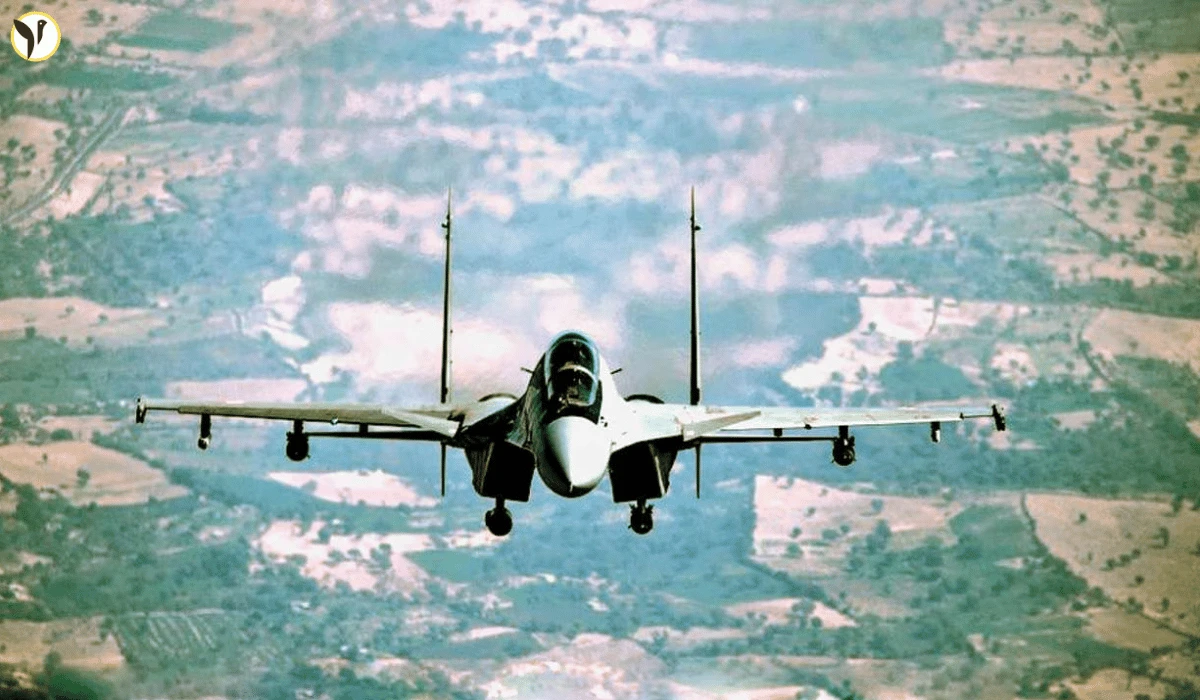


The RVV-BD from the Russian for long-range air-to-air missile is the export designation associated with Russia's R-37M family. Defence sources told news agency ANI the weapon can engage targets at around 300 kilometres. India operates more than 260 Su-30MKI aircraft, making the fleet the single most important element of the IAF's combat strength.
That is the story as it is being reported. Here is what most of the coverage is leaving out.
One: this is about hunting the aircraft that make air forces work
The RVV-BD is not a dogfighting weapon, and framing it as one misses the point entirely.
It is built to reach out and destroy the aircraft that sit behind a fighter formation and make it effective: airborne early warning and control platforms, aerial refuelling tankers, electronic warfare aircraft, reconnaissance jets.
An AEW&C aircraft is essentially a flying radar station and command post. It sees further than any fighter's own radar, tracks the airspace, and feeds targeting information to friendly aircraft. An air force that loses its AEW&C coverage does not just lose a plane. It loses situational awareness across an entire sector.
The value of a very-long-range missile is therefore as much about deterrence as destruction. If an opposing commander knows a support aircraft can be threatened from 200 or 300 kilometres away, that aircraft has to orbit further back and the further back it sits, the less useful it is. The missile can degrade an adversary's air picture without ever being fired.
This is what defence planners mean by counter-support warfare, and it is a different discipline from fighter-versus-fighter combat.
Two: the 300-kilometre figure needs an asterisk
The number in every headline is doing more work than it can bear.
ANI's sources cite around 300 km. Business Today notes that technical publications have reported substantially higher maximum figures under particular flight conditions. Other reference material places the maximum closer to 200 km.
All of these can be true at once, because air-to-air missile range is not a fixed property of the weapon. It depends on the altitude and speed of the launching aircraft, the altitude of the target, and crucially what the target does after launch. A missile's quoted maximum range is typically achieved against a large, non-manoeuvring target, launched from high altitude at high speed, in ideal conditions. A support aircraft that turns away and runs the moment it detects a launch is a considerably harder proposition than a brochure figure implies.
None of this makes the capability unimportant. It makes the specific number less meaningful than it looks. Treat 300 km as a headline figure rather than an operational guarantee, and be sceptical of any coverage that presents it as a fixed radius on a map.
Three: the timing is diplomatic as much as military
The DAC took this up days before Vladimir Putin is expected in India for the BRICS summit, where further defence agreements between the two countries are anticipated.
That sequencing is not accidental. Clearing a significant Russian-origin integration immediately before a Russian presidential visit is a signal about the direction of the defence relationship, delivered at a moment when it will be read in several capitals.
It also sits in a wider context. India has faced sustained Western pressure over the depth of its defence ties with Moscow, and every major Russian procurement decision now carries a diplomatic weight it would not have had two decades ago. New Delhi's consistent answer has been strategic autonomy that it buys from Russia, France, Israel and the United States according to its own requirements rather than anyone else's alignment. This proposal is that policy in practice, and the timing states it out loud.
What the DAC is actually approving
There is a distinction worth being precise about, and the coverage is blurring it.
The proposal on the table concerns modifying the aircraft not buying the missile. Fitting a weapon of this class to a fighter is not a matter of hanging it on a pylon. The Su-30MKI's weapons management system, avionics and software have to be able to talk to the missile, launch it and support it through an engagement, and the aircraft's radar and fire-control architecture have to hand it usable target information. That means engineering work, flight testing and software validation before anything becomes operational.
Some defence-focused outlets have reported that India separately contracted for around 300 of these missiles in July 2026, in a deal valued near $1.2 billion, with deliveries expected within 12 to 18 months. That reporting has not been confirmed by the Ministry of Defence and comes from outlets of variable reliability, so it should be treated as unverified. But if it is accurate, Monday's proposal is the second step rather than the first approving the wiring for weapons already ordered.
Either way, the practical timeline matters. An approval today does not produce a capability this year. Integration programmes of this kind typically run for years.
What it says about India's own missile programme
This is the uncomfortable part of the story, and it deserves stating plainly rather than avoiding.
The Defence Research and Development Organisation is actively working on longer-range variants of the indigenous Astra family, with targets reported above 300 kilometres. India has also ordered the French Meteor for its Rafale fleet. So the country is pursuing a very-long-range air-to-air capability through three separate channels simultaneously.
Two readings of that are available, and both have merit.
The favourable reading is that this is deliberate layering. Meteor, Astra and RVV-BD are built around different combinations of range, propulsion and manoeuvrability, and they suit different tasks. A serious air force wants a mixed inventory rather than a single weapon it can be countered on, and it wants to arm different platforms Astra and RVV-BD on the Su-30MKI, Meteor on the Rafale.
The less comfortable reading is that buying Russian signals the indigenous timeline is not moving fast enough. Astra's longer-range variants are in development, not in squadron service. If the requirement is urgent, an imported missile fills the gap now. One defence outlet described the acquisition frankly as a stop-gap.
Both readings can hold simultaneously, and the honest position is that this is a capability decision made under time pressure, in a programme where self-reliance remains the stated long-term goal rather than the present reality.
What to watch next
The DAC outcome and whether a cost emerges. Approval in principle is not a contract, and figures released later will say more than the announcement does.
Whether the July missile contract is confirmed. If the Ministry acknowledges it, the sequence of this story changes and so does the urgency behind it.
Putin's visit. Whatever is signed during the BRICS summit will indicate whether this was an isolated item or the opening of a larger package.
Astra's schedule. The real test of India's position is whether the long-range Astra variants reach squadrons on time. If they do, the RVV-BD is a bridge. If they slip, it becomes a dependency.