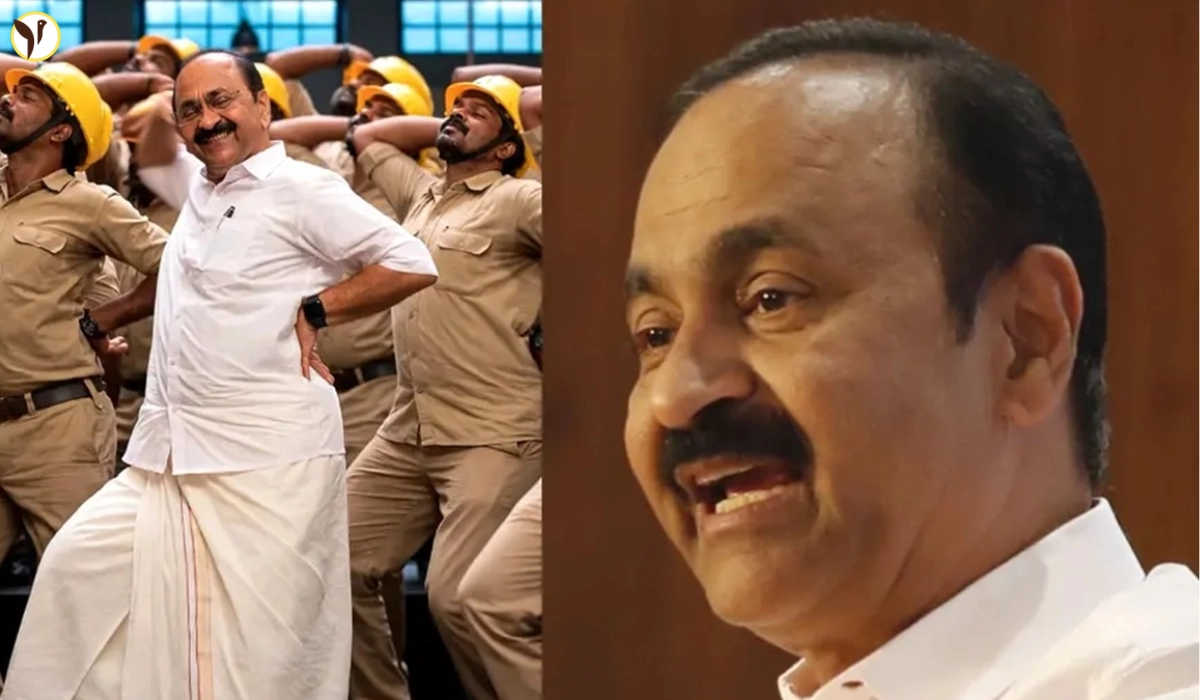


On Saturday, V.D. Satheesan told an audience that he had been stunned by a video of himself dancing.
The Chief Minister of Kerala had not danced. Artificial intelligence had put his face on a body performing an energetic routine alongside Kerala State Electricity Board employees, set to Anirudh Ravichander's "Ala Bolelo" from Jailer 2. It had been posted on Instagram the previous Thursday by a page called aikavala, and by Sunday it had drawn 1.78 crore views.
Satheesan's response was to enjoy it. He said the video had made him a better dancer than Mohanlal and than his friend, Tamil Nadu Chief Minister C. Joseph Vijay.
By Sunday, the video was restricted in India.
What happened, and what nobody knows
The page that posted it said Meta had limited access in India after complying with a legal request.
Who made that request has not been established.
Abhijith, who runs aikavala, told reporters he does not believe it came from the Chief Minister's side, pointing out that Satheesan had publicly appreciated the video only days earlier. "We don't know the reason," he said.
One technical detail is worth understanding, because it narrows the possibilities. The video has not been taken down globally. It remains viewable from outside India. That is the signature of a country-specific restriction the mechanism platforms use when responding to a legal demand from a particular jurisdiction rather than a removal for breaching Meta's own worldwide content policies. Had the video violated Instagram's rules on synthetic media or impersonation, it would be gone everywhere.
Meta has not publicly explained the restriction.
He praised it at a copyright seminar
The setting of Satheesan's remarks has gone largely unremarked, and it is the detail that gives the whole episode its shape.
He was speaking after inaugurating a three-day seminar jointly organised by the Kerala Judicial Academy and the National University of Advanced Legal Studies. Its subject was copyright protection in the film and music industries, and the challenges created by digital technology.
So a Chief Minister praised an unauthorised AI reconstruction of his own face and body, performing to a copyrighted film song, at a legal conference convened to examine exactly that problem.
He is unlikely to have missed the irony. But the episode illustrates the difficulty better than the seminar's agenda could have. Indian law provides for labelling of synthetic media and rapid takedowns, and courts have protected personality rights in individual cases. There is still no single statute governing the unauthorised cloning of a person's face, voice and movement, and no settled line between satire, impersonation and manipulation.
The video's creators attached a disclaimer saying it was not intended to insult or defame anyone and was purely for entertainment. Whether a disclaimer is sufficient protection is precisely what is unresolved.
The power cuts underneath the joke
None of this happened in a vacuum. The video landed in the middle of a genuine grievance.
Kerala has been dealing with a severe power crisis and sustained criticism of continuing electricity restrictions. Making the Chief Minister dance with the very employees responsible for keeping the lights on is a joke with a point, and the comment sections filled with people making it. Thousands used the video to criticise the electricity board.
The filmmaker and Bigg Boss contestant Akhil Marar captured the tone, commenting that "AI is in the Secretariat, but this is OG Pookki" a reference to the cuts. Earlier satire had circulated in the form of fabricated announcements dubbed "Pookki Cut" and "Indira Cut".
Electricity Minister Sunny Joseph has said the crisis cannot be resolved simply by switching something on or off, ruled out any instant solution, and attributed the situation in part to a sharp increase in night-time consumption.
Satire tends to track public anger fairly accurately. The scale of the video's reach ten million views within hours of posting says something about how widely that anger is felt.
It is not the first Kerala content Meta has removed
There is a precedent, and it is worth reporting carefully.
Meta previously removed news videos that were critical of the state government and of Satheesan. Satheesan denied that any request for removal had been made from his office. The Chief Minister's Office subsequently wrote to Meta seeking their reinstatement. Meta cited technical reasons for those removals.
That sequence and this one are separate events, and no link between them has been established. What they share is a pattern that ought to concern people regardless of political allegiance: content relating to Kerala politics disappearing from a dominant platform, with explanations that are either absent or unsatisfying, and no clear way for anyone outside the process to find out who asked for what.
In the earlier case, the government itself was asking for material to be put back. That is worth remembering before assuming where any request originates.
What to watch
Whether Meta explains. The company publishes transparency reports on government requests for content restriction, though typically well after the fact.
Whether anyone claims the request. Legal demands can come from courts, government departments, or private parties asserting personality or copyright rights. The song is copyrighted, and a music rights holder is as plausible an origin as any political actor.
Whether the video returns. Country-specific restrictions are sometimes reversed when a request is withdrawn or successfully challenged.
The power situation. The satire will continue as long as the cuts do, and the next video will test whether this restriction was a one-off or the start of something.