Gyanesh Kumar’s UP Visit Put Off: Is It Linked To The ECI Row?
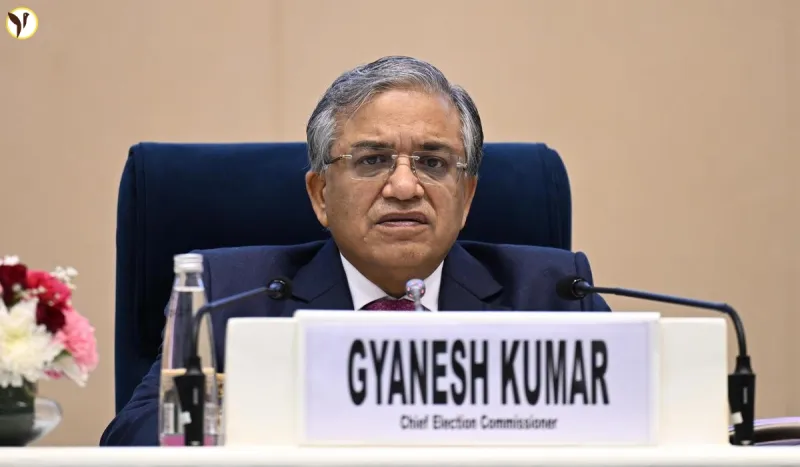
CEC Gyanesh Kumar’s planned Meerut and Varanasi visits have been postponed. Here is what the Election Commission said and why questions are being raised amid the ECI row.

- Published
- Reading time
- 8 minutes
Chief Election Commissioner (CEC) Gyanesh Kumar’s planned visit to Uttar Pradesh has been postponed, with his scheduled programmes in Meerut and Varanasi put on hold.
The development comes at a sensitive time for the Election Commission of India (ECI), after reports of internal objections by Election Commissioners Sukhbir Singh Sandhu and Vivek Joshi over several decisions related to electoral rolls and the Special Intensive Revision (SIR).
However, there is an important timeline to understand.
The Election Commission has said that the decision to postpone the two Uttar Pradesh programmes was taken on September 21, before the report about the internal objections became public on September 23.
So, is the UP visit connected to the ECI row?
At present, there is no official confirmation that the postponement was because of the controversy. The timing has raised questions, but the two developments should not be treated as directly connected without evidence.
What Was Gyanesh Kumar’s UP Programme?
Gyanesh Kumar was scheduled to visit Uttar Pradesh for programmes focused on electoral awareness and interaction with young voters.
The planned schedule included:
|
|
|
|
|
|
|
|
|
|
|
|
The Meerut programme was linked to the Electoral Literacy Clubs (ELC 2.0) and ECI-Net, with students and teachers from educational institutions expected to participate.
The broader purpose of such programmes is to increase awareness among young citizens about voter registration, elections, voting and the functioning of the Election Commission.
When Was The UP Visit Postponed?
This is one of the most important points in the story.
According to the Election Commission's clarification reported on September 25, the decision to postpone the Meerut and Varanasi programmes was taken on September 21.
The Commission said official communication regarding the postponement was also issued on the same day.
This means the programmes were already put on hold two days before the Indian Express report about internal objections within the Election Commission became public on September 23.
The Timeline
|
|
|
|
|
|
|
|
|
|
|
|
|
|
|
|
|
|
|
|
|
The timeline is important because it shows that the postponement decision predated the public disclosure of the ECI objections.
Why Is The Timing Raising Questions?
The timing has attracted attention because the postponement happened just before the internal ECI dispute became a major political issue.
The Indian Express reported on September 23 that Election Commissioners Sukhbir Singh Sandhu and Vivek Joshi had formally raised objections at least 14 times over a period of 10 months regarding decisions and orders they said were taken without their knowledge.
The reported objections involved issues such as voter registration and deletion, changes to Form 6 and the functioning of the Election Commission's voter database.
Because the UP programme was postponed on September 21, and the internal-objection report became public on September 23, questions naturally emerged about whether the two developments could be connected.
But the available information does not establish a direct connection.
What Has The Election Commission Said?
The Election Commission has rejected the suggestion that the reported internal notes represented a breakdown or split in the three-member poll panel.
The ECI said that members of a multi-member constitutional body can have different views, observations and suggestions during internal discussions.
According to the Commission, however, the final decisions were unanimous.
The Commission also said that focusing only on selected internal notes does not provide the complete picture of its decision-making process.
This is important because the controversy currently has two different parts:
- Reports about internal objections by two Election Commissioners.
- The ECI's position that these objections were part of normal internal deliberation and that final decisions were unanimous.
Both sides need to be kept separate while reporting the issue.
What Did The Report Say About The Internal ECI Row?
The Indian Express investigation reported that Sandhu and Joshi had recorded objections multiple times over decisions concerning electoral-roll management.
The reported issues included:
- Addition of new voters
- Deletion or restoration of names
- Changes related to Form 6
- Handling of voter data
- Certain aspects of the Special Intensive Revision
- Procedures followed while issuing orders in the name of the Commission
The report said some of these objections claimed that decisions were taken without the knowledge or approval of the two commissioners.
The ECI, however, disputed the interpretation that these internal notes meant the Commission's final decisions were not unanimous.
What Is The SIR Issue?
The Special Intensive Revision (SIR) is an exercise to review and update electoral rolls.
The process has become a major political issue because of questions around voter inclusion and deletion.
The Election Commission has maintained that electoral-roll revision is carried out under the Constitution, election laws and ECI instructions.
In Uttar Pradesh, the Commission has previously highlighted the role of Booth Level Officers and other election machinery in preparing electoral rolls. In an August statement, the ECI said more than 13.39 crore electors were included in the final electoral roll published in the state after the SIR exercise.
The SIR debate has also become politically sensitive in several states because voter-list changes can have a direct impact on citizens' ability to participate in elections.
Why Were The Meerut And Varanasi Events Important?
The programmes were not simply political rallies.
They were planned around electoral awareness and interaction with young citizens.
The Election Commission has been conducting ELC and ECINET conferences across different parts of the country.
Earlier regional conferences were held in places including Patna, Lucknow, Chennai, Margao and Ahmedabad. A September 11 ECI programme in Ahmedabad focused on strengthening electoral literacy and democratic awareness among students and teachers.
The proposed Meerut and Varanasi programmes were part of this broader outreach effort.
Was The Visit Cancelled Because Of Protest Fears?
There are reports suggesting that concerns about possible protests were considered.
Navbharat Times reported, citing sources, that intelligence inputs had indicated the possibility of opposition to Gyanesh Kumar during the Meerut programme. The report said this was one factor being discussed around the postponement. However, this is a reported explanation from sources, not an officially confirmed reason from the Election Commission.
Other reports have noted that the ECI has said programmes of this type can be postponed for routine administrative reasons, including scheduling and venue-related issues.
Therefore, it would be premature to state as a fact that the programme was cancelled because of expected protests.
Gyanesh Kumar was to address two youth focused voter awareness programmes in Meerut and Varanasi.
— Ruchira Chaturvedi (@RuchiraC) September 25, 2026
Both have now been cancelled.
Gyanesh has no other option - he must resign and become Approver. pic.twitter.com/itPYpm09H1
What Makes The September 21 Date Important?
The September 21 date is central to the entire story.
If the programme was postponed on September 21, then it happened before the public report about the internal objections on September 23.
This creates two possible ways of looking at the timeline:
View 1: Routine Administrative Decision
The ECI's explanation is that regional ELC programmes have been postponed or rescheduled in the past too. Therefore, the UP postponement may simply have been an administrative decision.
View 2: Questions About The Timing
The timing has nevertheless attracted attention because the postponement came shortly before the internal ECI dispute became public.
Some reports and political reactions have therefore questioned whether the two developments were connected.
At this stage, there is no public official evidence establishing that link.
What Is The Political Reaction?
The ECI controversy has triggered strong reactions from opposition parties.
Several opposition leaders have questioned the functioning of the Election Commission and demanded action against Gyanesh Kumar after the report about the internal objections.
Some leaders have called for his removal or resignation, while others have demanded further investigation into the reported objections.
The BJP and the Election Commission have defended the institutional process.
The BJP has argued that internal discussions and differences of opinion can be part of democratic decision-making, while the ECI has maintained that final decisions were unanimous.
These are political positions and should be distinguished from independently established facts.
Gyanesh Kumar’s Recent Focus On Young Voters
The UP programmes were also part of a wider effort by the Election Commission to reach young voters.
On September 11, the ECI organised a regional conference in Ahmedabad involving students and teachers from schools, colleges and universities.
Gyanesh Kumar said that students have an important role in the future of democracy and highlighted Electoral Literacy Clubs as a way to improve understanding of electoral processes.
The proposed Meerut and Varanasi events were expected to continue this outreach.
What Happens Next?
For now, the main question is whether the Election Commission will announce fresh dates for the Meerut and Varanasi programmes.
The bigger issue is the ongoing debate over how decisions are taken inside the three-member Election Commission.
The reported objections by Sandhu and Joshi have created questions about internal decision-making, while the ECI has maintained that differences during deliberations are normal and that its final decisions were unanimous.
The postponement of the UP programmes has added another layer of public interest because of its timing.
However, unless the Commission or another authoritative source provides evidence connecting the postponement directly to the ECI row, the two developments should be treated as separate events occurring close together in time.
Questions readers ask
Why was Gyanesh Kumar’s UP visit postponed?
The Election Commission said the decision to postpone the Meerut and Varanasi programmes was taken on September 21. It has not publicly confirmed that the decision was linked to the ongoing ECI controversy.
Which places was Gyanesh Kumar supposed to visit?
The CEC was scheduled to visit Meerut and Varanasi in Uttar Pradesh.
What was Gyanesh Kumar supposed to do in Meerut?
He was expected to interact with young people and participate in an electoral-literacy programme involving ELC 2.0 and ECI-Net.
What was planned in Varanasi?
A programme involving interaction with young citizens and Gen-Z was planned for September 28.
Is Gyanesh Kumar’s UP visit linked to the ECI row?
There is currently no official confirmation of a direct link. The important point is that the postponement decision was reportedly taken on September 21, while the report about internal objections became public on September 23.