Green Card Suspension: Infosys, TCS, Microsoft, H-1B Impact
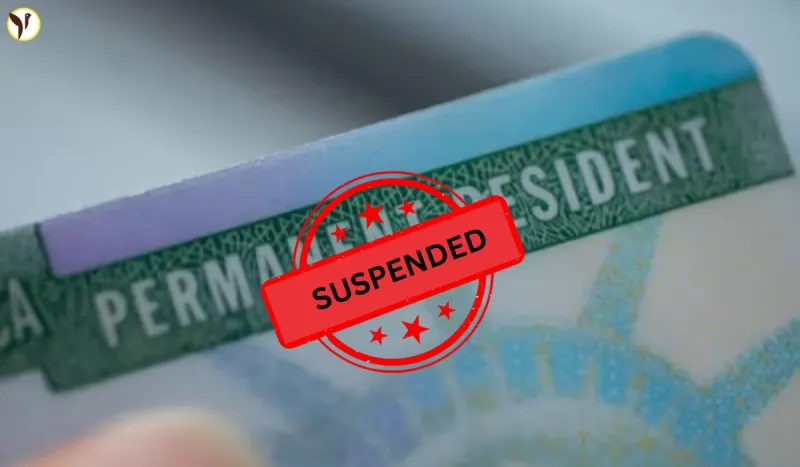
The US has suspended PERM green card filings for Infosys, TCS, Wipro, HCL, Cognizant, Capgemini, Microsoft and Adobe. Existing H-1B visas are not affected. What changes, and what does not.

- Published
- Reading time
- 7 minutes
The US Department of Labor has suspended processing of new and pending PERM green card applications for workers sponsored by eight firms-- Infosys, TCS, Wipro, HCL, Cognizant, Capgemini, Microsoft and Adobe. India's foreign ministry says existing H-1B visas and holders' status are not affected, but the green card process for eligible employees of those companies can be.
That distinction is doing a great deal of work, and it is worth slowing down on, because a lot of the coverage has collapsed it into "green card ban" and alarmed a much larger group of people than the measure actually touches.
What PERM is, and why the difference matters
PERM, the Program Electronic Review Management system is the labour certification stage of an employment-based green card. Before an employer can sponsor a worker for permanent residence in most categories, it has to obtain certification from the Labor Department that no qualified American worker is available for the role. It is the first door in a long corridor.
An H-1B is something else entirely: a temporary work visa, administered by a different agency, with its own validity period and its own rules.
So the suspension does not revoke anyone's visa, change anyone's immigration status, or stop anyone working. India's Ministry of External Affairs said so explicitly: the measure does not by itself affect existing H-1B visas or the status of those holding them. What it stops is the paperwork that turns a temporary stay into a permanent one for employees of those eight companies, both new filings and applications already in the queue.
For a worker several years into that queue, that is not a small distinction. It is the difference between losing your job and losing your timeline. But they are different losses, and only one of them is happening.
Who is on the list, and what they are accused of
Five of the eight are Indian or India-linked: Infosys, TCS, Wipro, HCL and Cognizant. Capgemini is French. Microsoft and Adobe are American — which is the detail that complicates the framing of this as a measure aimed at Indian outsourcing.
The Labor Department's stated basis is an allegation of fraudulent hiring practices. That is an accusation, not a finding. None of the eight companies has responded on the record in any account available at the time of writing, and no adjudication has taken place.
Labour Secretary Keith Sonderling put numbers to it: the eight have requested almost 3 million foreign workers since 2009, received more than 230,000 H-1B approvals and obtained over 100,000 permanent labour certifications. He said the administration was cutting off "the head of the snake."
Two things the announcement did not say, and which matter a great deal to anyone affected: how long the suspension lasts, and the legal authority it rests on. Neither has been stated in any source reachable here. Until they are, nobody can tell an employee mid-queue whether this is a pause of weeks or an indefinite stop, or what the route to challenge it would be.
The remark, and India's answer
At a news conference on visa fraud on Thursday, Vice President JD Vance described H-1B workers as "indentured servants." His formulation: "You bring in indentured servants from outside the country, you lay off American workers." He said H-1B holders earn $20,000 less than an American citizen in the same position, and that workers brought in by foreign outsourcing firms earn $48,000 less. He also said Microsoft laid off 6,000 American workers last year while benefiting from 6,300 H-1B visas and nearly 3,000 green cards.
India's response came on Friday, in a statement posted on X by MEA spokesperson Randhir Jaiswal. It called the remarks "unwarranted and deeply offensive," and said that "resorting to terminology that carries painful historical and colonial legacy connotations is deeply offensive." On the suspension itself, the ministry said the steps "do not advance the shared ambitions of both countries," and that it would continue monitoring developments.
The objection is specific rather than general. Indenture was a system under which labourers from India and elsewhere were transported across the British Empire under contracts that bound them for years. The MEA's complaint is about that history being invoked, not about the policy debate over wages.
The number that reframes the whole thing
Here is where the rhetoric and the arithmetic part company.
Vineet Nayar, the former chief executive of HCL Technologies one of the suspended firms pointed out on X that Indian IT companies accounted for fewer than 1,400 of the 117,849 PERM certifications issued last year. That is roughly 1.2% of the total.
If that figure holds, the direct corporate damage from a PERM suspension is modest. The sponsorship pipeline these firms rely on is overwhelmingly H-1B, which this measure does not touch, and their US green card volume is a rounding error in the national total. Nayar's own reading is that the restrictions may work against their stated aim: "The US may accelerate the movement of American work to India," he wrote, naming architecture, product engineering, cybersecurity and AI implementation as the categories most likely to move. He added a caution that applies regardless that AI may weaken the link between business growth and IT headcount, making capability rather than employee numbers the measure that matters.
Where the real cost sits, then, is not on balance sheets. It is on the individual employees of eight named companies whose permanent residence applications have stopped moving, and on the willingness of skilled workers to build a life around a process that can be switched off by employer name.
The response from the industry has a personal register
Zoho founder Sridhar Vembu put it bluntly on X: "Indians have made a major contribution to America's technological prowess. Yet, a big part of America no longer wants us." His call was direct "Come back, let's build India" though he also acknowledged what he was asking of people, noting that workers on visas face uprooting lives built over years of work.
Whether that becomes a trend or a sentiment is the open question. Reverse migration has been predicted in India after every US immigration tightening of the last two decades, and the pattern has usually been slower and more partial than the rhetoric around it.
The market read, and the wider context
The share reaction on 8 October was contained rather than dramatic. Infosys ADRs traded at $10.26, down 2.8%. Wipro ADRs were at $1.63, down 2.5%. Those are the moves of a market pricing a nuisance, not an existential threat — consistent with Nayar's arithmetic.
This also does not arrive in isolation. The $100,000 H-1B fee introduced last year has been blocked by the courts pending further review. The direction of policy is clear enough; what is not yet clear is how much of it survives contact with litigation.
What an affected employee can actually establish today
If you work for one of the eight, four things are known. Your H-1B and your current status are unaffected. A PERM application you have pending has stopped being processed. A new PERM filing by that employer will not be processed for now. And neither the duration of the suspension nor the authority behind it has been published.
Everything beyond that portability to another employer, priority date retention, whether a pending application is held or returned depends on specifics that the Labor Department has not yet set out and that vary by individual case. That is a question for an immigration attorney with your file in front of them, not for a news article.
This article explains a policy change and is not immigration or legal advice. Rules in this area are changing quickly and are subject to litigation. Anyone whose application is affected should consult a qualified immigration attorney about their own circumstances.
Questions readers ask
Does this suspension cancel my H-1B visa?
No. PERM and H-1B are separate programmes. India's Ministry of External Affairs said explicitly that the suspension does not by itself affect existing H-1B visas or the status of those holding them. What stops is the labour certification stage of the employment-based green card process, for new and pending applications sponsored by the eight named employers.
Which companies are affected?
Eight: Infosys, TCS, Wipro, HCL and Cognizant, France's Capgemini, and the US firms Microsoft and Adobe. The Department of Labor has alleged fraudulent hiring practices — an allegation, not a finding. None of the companies had responded on the record at the time of writing.
What is PERM, and how is it different from an H-1B?
PERM is the labour certification stage of most employment-based green card applications. Before sponsoring a worker for permanent residence, an employer must obtain certification from the Labor Department that no qualified American worker is available for the role. An H-1B is a separate, temporary work visa administered by a different agency with its own rules and validity period.
How long will the suspension last?
This has not been stated. Neither the duration of the suspension nor the legal authority it rests on has been published in any account available at the time of writing, which is why nobody can currently tell an affected employee whether this is a pause of weeks or an indefinite stop.
What did JD Vance say, and how did India respond?
At a news conference on visa fraud on Thursday, Vice President JD Vance described H-1B workers as "indentured servants," saying: "You bring in indentured servants from outside the country, you lay off American workers." He said H-1B holders earn $20,000 less than an American citizen in the same position, and $48,000 less where brought in by foreign outsourcing firms. India's Ministry of External Affairs, in a statement posted by spokesperson Randhir Jaiswal, called the remarks "unwarranted and deeply offensive" and said that "resorting to terminology that carries painful historical and colonial legacy connotations is deeply offensive."