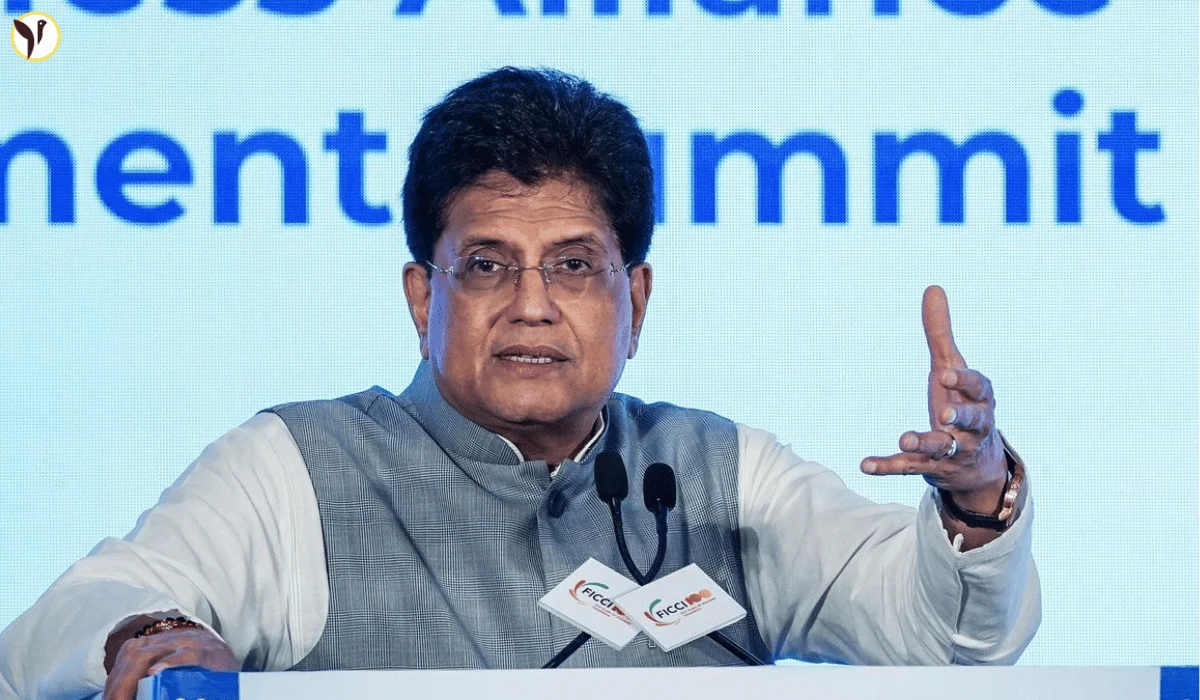


India's Commerce and Industry Minister told the BRICS Business Forum in New Delhi on Friday that member and partner countries should link their payment systems and trade in each other's local currencies.
"I would urge the BRICS member countries and partner countries to link our payment systems, trade in each other's local currencies, make digital trade global and build together for the future of emerging technologies," Piyush Goyal said.
Read that sentence again, because what is absent from it is as deliberate as what is in it.
What he proposed, and what he did not
Goyal called for two specific things: connecting instant payment systems, and settling bilateral trade in the currencies of the countries doing the trading.
He did not propose a common BRICS currency. He did not mention the US dollar. He did not frame any of it as reducing dependence on anyone.
That is not an accident of phrasing, and the distinction is the reason this speech is worth reading closely.
Settling trade bilaterally in local currencies is a plumbing question. If an Indian exporter and a Russian buyer transact in rupees and roubles, both avoid a conversion into a third currency and the exchange-rate risk that comes with it. It reduces transaction costs. It does not require anyone to hold fewer dollars.
A common BRICS currency is a different proposition entirely. It would require monetary coordination across economies with wildly different inflation rates, capital controls and central bank mandates, and it would be read universally as a challenge to the dollar's role.
India has consistently backed the first and rejected the second. External Affairs Minister S. Jaishankar has put it about as plainly as a diplomat can, saying that anyone who thinks India has targeted the dollar has confused it with someone else, and that doing so forms no part of India's economic, political or strategic policy. Reserve Bank of India Governor Shaktikanta Das has said no Indian measure has been taken with the specific aim of de-dollarising, explaining that local-currency arrangements exist to manage the risk of depending on any single currency.
Goyal's speech sat exactly inside that line.
Why the line matters this weekend
The BRICS Summit opens in New Delhi on Saturday, a two-day meeting under India's presidency, with the theme of building for resilience, innovation, cooperation and sustainability.
Russian President Vladimir Putin is in Delhi for it. So is Iranian President Masoud Pezeshkian. Both are scheduled to hold bilateral talks with Prime Minister Narendra Modi.
Russia and China have been the bloc's most vocal advocates of reducing reliance on the dollar, and for them the argument is explicitly strategic. For India, officials have framed local-currency settlement in narrower terms: diversification, resilience, and insulation from currency volatility.
Sitting over all of it is Washington. President Donald Trump has repeatedly threatened BRICS members with tariffs of up to 100% if the bloc moves to replace the dollar, saying the dollar is king and that the United States intends to keep it that way. Last year's BRICS declaration stopped short of naming the dollar at all, while calling for acceptable mechanisms of financing in local currencies — language that was widely read as threading exactly the same needle Goyal threaded on Friday.
India is now chairing a grouping in which two of its most significant partners want something India has publicly declined to endorse, while a third country that is among its largest trading partners has promised economic consequences if it does. The choice of words in Delhi this weekend is a diplomatic instrument, not a stylistic one.
The UPI argument
Goyal's concrete proposal was built on infrastructure India already has.
The Unified Payments Interface is now accepted in 11 countries, and Goyal suggested it could form a basis for wider cross-border cooperation among BRICS economies. Among the bloc's members, India has integrated UPI with the United Arab Emirates' instant payment system, Aani, and has explored local-currency trade settlement with Russia.
This is the least contentious part of the pitch and probably the most likely to produce something. Linking fast payment systems is a technical exercise between central banks and payment operators, it delivers visible benefits to travellers, migrant workers sending remittances and small exporters, and it carries none of the symbolism of a currency union.
It is also an area where India has something to export. Building payment rails is a capability, and offering it to the bloc positions India as the provider of the infrastructure rather than a participant in someone else's system.
The part of the speech nobody is quoting
Two other things Goyal said deserve more attention than they are getting, because they are asks rather than aspirations.
On non-tariff barriers. Goyal said non-tariff measures impose higher export costs than tariffs themselves for 88% of countries, and pressed members to simplify regulatory procedures and speed up clearance of consignments. This is a substantive complaint. Tariffs are visible and negotiable; testing requirements, certification regimes and customs delays are neither, and they are where a great deal of intra-BRICS trade actually gets stuck.
On market access and critical minerals. He called on members to open their markets to each other's products, specifically including raw materials and critical minerals, and said supply chains would be more resilient if they ran both ways.
That phrase — supply chains that run both ways — is doing quiet work. India's trade with the larger economies in the grouping is substantially unbalanced, and critical minerals are an area where access, not price, is the constraint. Framing it as resilience rather than as a grievance is diplomatic. The ask underneath it is not.
Russia, for its part, brought a proposal of its own: a BRICS Green Exchange, described as a unified trading platform on which producers, traders and buyers could transact directly, with feedback now being sought from partners at both public and private level.
What India says it wants from BRICS
Goyal described the bloc as an important market for India's manufactured exports, naming engineering goods, electronics and pharmaceuticals, and tied the engagement to India's stated goal of becoming a developed nation by 2047.
He also spent a portion of the speech on startups, saying more than 45% of India's 250,000 recognised startups have at least one woman partner or director, and urging member countries to include women-led enterprises in exhibitions and trade fairs. He proposed collaboration between agri-tech startups and closer links between national startup ecosystems.
None of that will make headlines. It is, however, a reasonable indication of what India actually expects to get out of hosting: market access, export growth and institutional links, rather than a rearrangement of the global monetary order.
What to watch
The declaration's language on currencies. Whether the summit communiqué names the dollar, avoids it as last year's did, or goes further will be the most reliable signal of where the bloc has landed.
Whether any payment-system linkage is actually announced. A concrete agreement between two or more members would be a real deliverable. Statements of intent would not be.
Washington's response. Coverage that reports this as a de-dollarisation push may draw a reaction regardless of what was said, and the reaction will be to the reporting as much as to the substance.
The Russia bilateral. Putin and Modi are meeting on the margins. Whatever emerges there will tell you more about the India-Russia economic relationship than the forum speeches will.