Thar OG: Same Price, Six Airbags, Intro Rate Ends 30 Nov, Full Details Here
The Mahindra Thar OG starts at Rs 10.32 lakh, unchanged, with six airbags instead of two. Full prices, the on-road gap, and why 30 November matters.

- Published
- Reading time
- 6 minutes
Mahindra has launched the Thar OG, the updated three-door Thar, at Rs 10.32 lakh to Rs 18.99 lakh ex-showroom with the entry price unchanged from the outgoing model despite six airbags replacing two, four-wheel disc brakes, a new platform and revised suspension. Deliveries begin on 11 October, and the introductory prices apply only to vehicles delivered by 30 November. On-road prices run considerably higher, with Mumbai figures reported between Rs 12.5 lakh and Rs 23.07 lakh. The base AXT variant is available only as a 1.5-litre diesel with rear-wheel drive and a manual gearbox.
The deadline nobody is leading with
Start here, because it has a date attached and the rest does not.
Deliveries of the Thar OG begin on 11 October. The introductory prices announced at launch apply to vehicles delivered until 30 November.
That is a window of roughly seven weeks. If you book late, or if your chosen variant has a long waiting period and your delivery slips into December, the price you pay may not be the price in the launch announcement.
Anyone seriously considering this car should be asking their dealer one question before anything else: what delivery date can you commit to in writing? Not "when can I book", but "when will the vehicle reach me". Those are different questions and only one of them protects the price.
From remote trails to city skylines, the Thar has always gone beyond the boundaries of the ordinary. Now, with a bold new interior, next-generation technology and a new level of refinement, it brings a more elevated experience to every journey. Built to carry forward everything… pic.twitter.com/DOymjL2td2
— Mahindra Thar (@Mahindra_Thar) September 23, 2026
What it costs
Ex-showroom, by variant:
| Variant | Starting price |
|---|---|
| AXT | Rs 10.32 lakh |
| LXT | Rs 12.99 lakh |
| ZXT | Rs 13.99 lakh |
Specific configurations reported at launch include:
2.2-litre diesel LXT 4WD manual at Rs 16.43 lakh, LXT rear-wheel-drive automatic at Rs 16.49 lakh, ZXT 4WD manual and ZXT rear-wheel-drive automatic at Rs 17.49 lakh, LXT 4WD automatic at Rs 18.00 lakh, and the range-topping ZXT 4WD automatic at Rs 18.99 lakh.
2.0-litre petrol from the LXT upward only, starting at Rs 14.77 lakh for the rear-wheel-drive automatic, Rs 15.60 lakh for the 4WD manual and Rs 17.23 lakh for the 4WD automatic. ZXT petrol runs from Rs 16.09 lakh to Rs 17.75 lakh.
The number that actually matters: on-road
This is where most buyers get caught, and it is worth stating plainly because it answers the question people are actually searching.
Every price above is ex-showroom. That is not what you pay.
On-road price adds registration, road tax, insurance, and usually accessories and handling. Reported on-road figures for Mumbai run from around Rs 12.5 lakh to Rs 23.07 lakh, against an ex-showroom range of Rs 10.32 lakh to Rs 18.99 lakh.
That is roughly Rs 2.2 lakh on the base variant and around Rs 4 lakh at the top.
On-road cost varies by state because road tax does. Maharashtra, Karnataka and Kerala are at the higher end; some states are meaningfully cheaper. Get an on-road quotation in writing for your own RTO before you budget, and do not plan around the ex-showroom figure.
What this means for you
If you were going to buy the outgoing Thar. You are getting a substantially better car at the same entry price. Six airbags instead of two, four-wheel disc brakes, a stiffer platform, better suspension and electric steering. There is no version of this where waiting for the old model makes sense.
If the Rs 10.32 lakh figure is what attracted you. Read the specification before you get attached. The AXT is 1.5-litre diesel, rear-wheel drive, manual only. It is not the four-wheel-drive Thar most people picture when they think of this car. If you want 4WD, you are starting from the LXT and the real entry point is nearer Rs 15-16 lakh ex-showroom, and well above Rs 18 lakh on road.
If you already own a recent Thar. The mechanical changes are real rather than cosmetic — a new platform, new rear suspension, electric steering, extra insulation. Whether that justifies changing cars depends on how much the ride quality of the old one bothered you, which for many owners was the main complaint.
If safety is what decides it. This is the clearest upgrade in the car. Two airbags to six, plus discs at all four wheels, is not a marketing line. On a tall, short-wheelbase, body-on-frame vehicle it matters more than it would on a hatchback.
If you drive mostly in the city. The changes aimed at you are the ones worth paying attention to: frequency dependent damping on the ZXT, the Pentalink rear suspension with Watts Link, electric power steering replacing the hydraulic unit, and added NVH insulation. The Thar's reputation for being hard work in traffic is precisely what this update targets.
If you actually go off-road. Mud, Sand and Snow terrain modes, an electronic locking differential on 4WD variants, and Terrain Assist on selected rear-wheel-drive versions. The modes alter traction control, throttle response, steering and, on automatics, transmission behaviour.
What has changed underneath
The Thar OG sits on Mahindra's new M_Glyde 4G platform, with increased stiffness over the outgoing structure.
The rear suspension switches to a Pentalink arrangement with a Watts Link. Frequency dependent damping is offered on the ZXT. Electric power steering replaces the previous hydraulic system, and Mahindra has added extra noise insulation.
Engines carry over in configuration but with more output from the larger units. The 2.2-litre diesel produces around 150bhp and 330Nm. The 1.5-litre diesel is unchanged at 117bhp and 300Nm. The 2.0-litre petrol is reported at around 160bhp, up roughly 10bhp, though figures vary between outlets. A six-speed manual is standard, with a six-speed automatic optional on the larger engines.
For the first time, the larger diesel is also offered in rear-wheel-drive form.
What has changed on the outside and inside
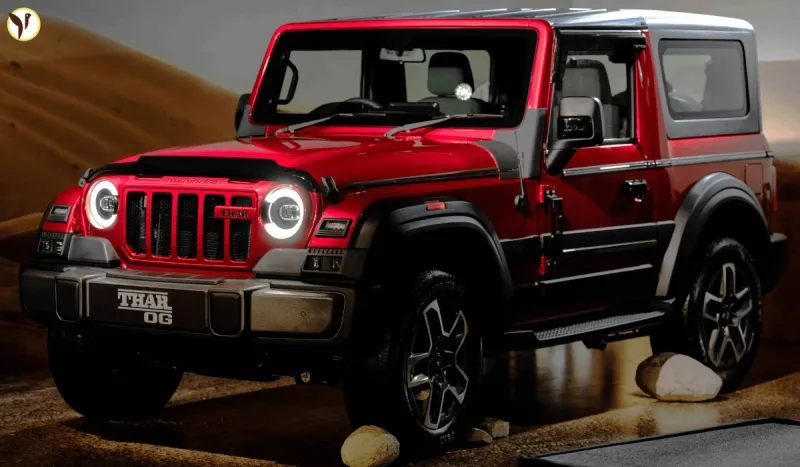
The front is where the update is visible. There is a new grille carrying a THAR wordmark, LED projector headlamps borrowed from the larger Thar Roxx, and LED fog lamps moved up to the fender. New 19-inch alloy wheels complete it. Eight colours are offered, two of them new.
Inside, brown leatherette upholstery, a 360-degree camera, an updated infotainment system, a combined analogue and digital instrument cluster, and rear armrests with cupholders. The upright dashboard, circular air vents and toggle switches carry over.
From the side, it still looks like a Thar. That is deliberate.
Where it sits against rivals
The Thar OG competes with the Force Gurkha and the Maruti Suzuki Jimny, and it now does so with a specification advantage it did not previously have.
The Jimny's case has always been size, ease and Suzuki's off-road pedigree. The Gurkha's is hardware and seriousness. The Thar's has always been that it is the one people actually want, and the 2026 update addresses its clearest weakness that it was unpleasant on the road, where almost all of these cars spend almost all of their time.
What to do before 30 November
Get a written on-road quotation for your state and your exact variant. Not ex-showroom.
Ask for a committed delivery date in writing. The introductory price depends on delivery, not booking.
Decide on 4WD before you decide on budget. It moves your entry point by several lakh and determines the variant, not the other way round.
Ask about the waiting period per variant. Some configurations will be longer than others, and a long wait on your chosen variant is the most likely way to miss the introductory window.
Confirm what the introductory price actually covers, and whether any accessories, extended warranty or handling charges quoted separately are affected.
Questions readers ask
What is the price of the Mahindra Thar OG?
Rs 10.32 lakh to Rs 18.99 lakh ex-showroom. The base AXT variant starts at Rs 10.32 lakh, LXT at Rs 12.99 lakh and the new top-spec ZXT at Rs 13.99 lakh, with the range-topping ZXT 4WD diesel automatic at Rs 18.99 lakh.
What is the Thar OG on-road price?
Considerably higher than ex-showroom. Reported on-road figures for Mumbai run from around Rs 12.5 lakh to Rs 23.07 lakh, which is roughly Rs 2.2 lakh more on the base variant and around Rs 4 lakh more at the top. On-road cost varies by state because road tax does, so buyers should obtain a written quotation for their own RTO.
When do Thar OG deliveries begin?
11 October 2026. The introductory prices announced at launch apply to vehicles delivered until 30 November 2026, so buyers whose delivery slips beyond that date may pay more.
What is new in the Thar OG compared with the old Thar?
The Thar OG moves to Mahindra's new M_Glyde 4G platform with increased stiffness, a Pentalink rear suspension with a Watts Link, frequency dependent damping on the ZXT, electric power steering replacing the hydraulic system, and extra noise insulation. Safety equipment rises to six airbags from two, with four-wheel disc brakes. It also gains Mud, Sand and Snow terrain modes and an electronic locking differential on four-wheel-drive variants.
How many airbags does the Thar OG have?
Six, as standard. The outgoing three-door Thar had two.
Does the base Thar OG variant have four-wheel drive?
No. The AXT at Rs 10.32 lakh is offered only with the 1.5-litre diesel engine, rear-wheel drive and a manual gearbox. Four-wheel drive is available from the LXT variant upward.
What engines does the Thar OG offer?
Three. A 1.5-litre diesel producing 117bhp and 300Nm, a 2.2-litre diesel producing around 150bhp and 330Nm, and a 2.0-litre turbo-petrol reported at around 160bhp. A six-speed manual is standard across the range, with a six-speed automatic optional on the larger engines. The larger diesel is now also offered in rear-wheel-drive form for the first time.
Which Thar OG variant should I choose?
That depends on whether you need four-wheel drive. If you do, your starting point is the LXT rather than the AXT, which moves the entry price to roughly Rs 15 lakh ex-showroom and above Rs 18 lakh on road. The ZXT adds frequency dependent damping and the fullest equipment list. Buyers who do not go off-road may find the rear-wheel-drive versions adequate.
What has changed in the Thar OG's design?
A new grille with a THAR wordmark, LED projector headlamps sourced from the Thar Roxx, LED fog lamps relocated to the fender, and new 19-inch alloy wheels. Eight colours are offered, two of them new. Inside there is brown leatherette upholstery, a 360-degree camera, an updated infotainment system, a combined analogue and digital instrument cluster, and rear armrests with cupholders.
What does the Thar OG compete with?
The Force Gurkha and the Maruti Suzuki Jimny.