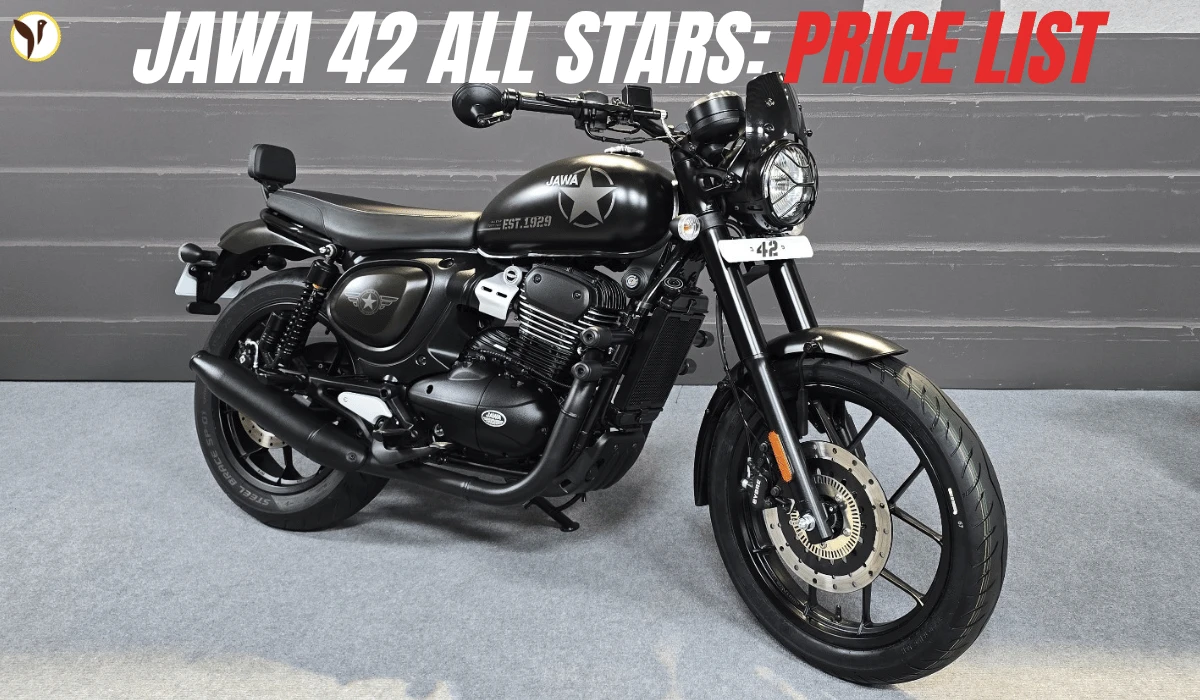


Classic Legends has launched the Jawa 42 All Stars, and the pricing needs unpicking before anything else, because it is being reported inconsistently.
Here is what each version actually costs, ex-showroom:
- Standard Jawa 42, Black and Ivory — Rs 1,79,942
- All Stars Ivory — Rs 1,84,942
- All Stars Nebula Blue — Rs 1,86,942
- All Stars Battle Green — Rs 1,86,942
- All Stars Moss Grey — Rs 1,86,942
- All Stars Black — Rs 1,89,942
The first line is the one causing confusion. The Black and Ivory dual-tone at Rs 1,79,942 is the standard Jawa 42, which Classic Legends continues to sell. It is not an All Stars bike, even though several outlets have listed it inside the All Stars price table.
The All Stars range starts at Rs 1,84,942 and tops out at Rs 1,89,942.
So if you have been searching specifically for the black one, note that it is the most expensive motorcycle in the range a full Rs 10,000 above the standard 42, and Rs 5,000 above the cheapest All Stars.
Deliveries begin on 14 September 2026. Bookings are open at dealerships nationwide.
Is this a real update, or a paint job?
This is the question worth asking about anything wearing a special-edition badge, and here the answer is genuinely interesting because Jawa has used the same badge to mean two different things within a fortnight.
On the 42, the changes go beyond cosmetics. Jawa claims more than 60 enhancements. The ones you can actually see and feel:
- New-design alloy wheels, fitted as standard
- A wider 150/70-17 rear tyre, up from the previous section, with a 100/90-18 at the front
- Tubeless tyres as standard
- An upswept twin exhaust, which Jawa says also improves water-wading ability
- Revised rear bodywork, including a wider rear fender
- Five new colours- All Stars Ivory, Nebula Blue, Moss Grey, Battle Green and Black
Now compare that with the Jawa 42 Bobber All Stars, launched days earlier. That bike is mechanically unchanged from the standard Bobber. It gets fresh colours, checkered tank graphics on some variants and All Stars badging, and nothing else. No hardware changes, and therefore no performance difference.
Same badge. Very different substance.
That is not a criticism of either bike, but it matters if you walk into a showroom assuming "All Stars" denotes a consistent level of upgrade across the range. It does not. On the 42, you are buying hardware. On the Bobber, you are buying paint.
What has not changed
The engine carries over untouched.
The Jawa 42 All Stars runs the 294.7cc single-cylinder, liquid-cooled DOHC engine that Jawa calls the J-Panther, producing roughly 27 PS at 7,950 rpm and around 26 Nm of torque at 6,000 rpm, with electronic fuel injection and a compression ratio of 11:1. It drives through a six-speed gearbox.
That is a perfectly competent motor and one of the things that has always distinguished the 42 from its most obvious rival, which is air-cooled and less powerful. But nobody upgrading from an older 42 should expect a different engine experience.
The rest of the hardware
The frame is a double cradle. Suspension is a 35 mm telescopic fork at the front and preload-adjustable twin shock absorbers at the rear.
Braking is a 280 mm disc at the front and a 240 mm disc at the rear, with dual-channel ABS as standard worth noting, since some rivals at this price still offer single-channel on lower variants.
Wheels are 18-inch front and 17-inch rear. Ground clearance is 173 mm, seat height 795 mm, and kerb weight around 175 kg.
The design carries over the familiar Jawa silhouette: the teardrop fuel tank, the round LED headlamp, the single-pod instrument console, flat handlebars and a single-piece bench seat, with twin exhausts flanking the rear wheel.
Where it now sits against the competition
At Rs 1.85 to Rs 1.90 lakh, the 42 All Stars lands squarely on the Royal Enfield Classic 350, and within reach of the Hunter 350, Honda CB350 and TVS Ronin.
That is a difficult neighbourhood, because the Classic 350 sells on brand and on a feel that Royal Enfield has spent decades building. Jawa's counter-arguments are specific: more power from a liquid-cooled engine, a lighter kerb weight, dual-channel ABS as standard, and a bike that looks less like everything else in the parking bay.
The All Stars changes sharpen exactly that pitch. Alloy wheels and tubeless tyres remove a genuine ownership annoyance a puncture on tube-type tyres away from a town is a considerably worse afternoon. The wider rear tyre and revised fender give the bike more visual presence, which matters in a segment where people buy with their eyes.
What none of it addresses is the thing Jawa has historically been judged on, which is not specification but consistency of build and after-sales experience. Sixty-plus changes on paper are worth what they turn out to be worth in ownership, and that is not something a launch article can tell you.
The All Stars family, for context
The 42 completes the range. Alongside it sit the Jawa 42 FJ All Stars at around Rs 2.02 lakh, running a larger 334cc engine, and the Jawa 42 Bobber All Stars, which starts at about Rs 2.09 lakh and rises to roughly Rs 2.20 lakh for the top Black Mirror finish.
So the 42 All Stars is the entry point to the All Stars badge, sitting some Rs 17,000 below the FJ and around Rs 24,000 below the Bobber.
Should you wait for the standard 42 to be discounted?
Worth considering, given Classic Legends is still selling it.
The standard Black and Ivory 42 remains on the price list at Rs 1,79,942, which is Rs 5,000 below the cheapest All Stars and Rs 10,000 below the black one. If the alloy wheels, tubeless tyres and wider rear tyre do not matter to you, that gap buys a reasonable amount of fuel.
If they do matter and tubeless tyres in particular are a real practical upgrade the All Stars premium is modest for what it includes. The colour you choose then decides another Rs 5,000 either way, which is a purely aesthetic tax.