Jaguar Type 01: Price, Specs and Range of the New Electric GT
Jaguar has revealed the Type 01, its first car of the electric-only era, at £130,000 with 1,030PS and up to 400 miles of range. Full specs, pricing and the backstory.

- Published
- Reading time
- 7 minutes
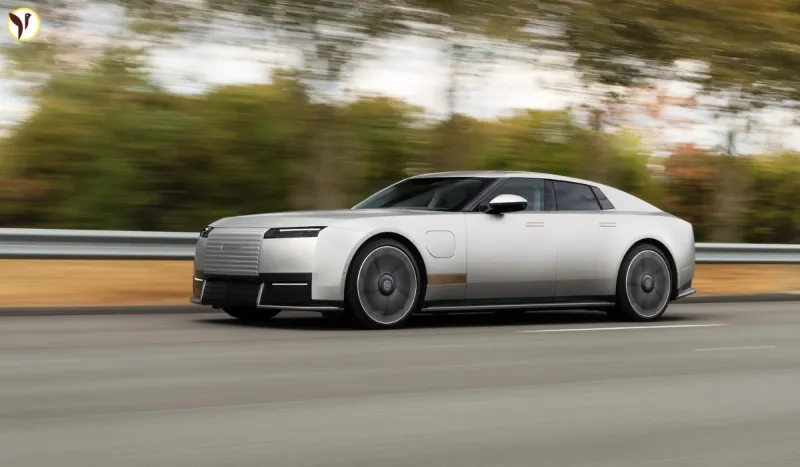
Jaguar has revealed the Type 01, the first production car of its electric-only era, at an event in New York. It is a four-door, four-seat grand tourer priced from £130,000 in the UK and $130,000 in North America, with three electric motors producing 1,030PS and 1,365Nm, 0-62mph in 3.2 seconds and an expected EPA range of up to 400 miles from a 118kWh usable battery. Built on Jaguar's new JEA platform and designed, engineered and manufactured in Britain, it arrives almost two years after a rebrand whose launch advert famously contained no car at all. Orders open in the coming months with deliveries in 2027.
The specification
| Price, UK | From £130,000 |
| Price, North America | From $130,000 |
| Power | Up to 1,030PS |
| Torque | 1,365Nm |
| Motors | Three |
| 0-62mph | 3.2 seconds |
| 62-112mph | 4.0 seconds |
| Battery | 118kWh usable |
| Architecture | 850 volts |
| Range | Up to 400 miles EPA |
| Motorway range | Up to 320 miles at sustained speed |
| Charging | 350kW peak, 200 miles in 13 minutes |
| Drag coefficient | 0.23 |
| Length | 5.2 metres |
| Wheels | 23-inch, standard |
| Platform | Jaguar Electric Architecture (JEA) |
| Orders | Coming months |
| Deliveries | 2027 |
Why you are seeing three different range figures
Because three are being quoted, and all of them are defensible.
400 miles is Jaguar's own figure, stated in its press release as an expected EPA range.
450 miles appears widely and is a WLTP figure.
478 miles was an earlier WLTP target quoted before the reveal.
EPA and WLTP are different test cycles. The American EPA procedure is consistently more conservative than Europe's WLTP, which is why the same car can honestly carry both numbers. Neither is a lie; they measure differently.
The most useful figure Jaguar has published is neither. It is the 320-mile sustained motorway range at a constant 75mph, because that is the condition in which a grand tourer actually gets used and the one where EVs typically disappoint. A car sold on crossing continents is better judged on that number than on a laboratory cycle.
British buyers pay considerably more
Here is a detail nobody is reporting, and it is worth doing the arithmetic.
The UK price is £130,000. The North American price is $130,000.
Those are not the same amount. £130,000 converts to roughly $172,000 at prevailing rates, meaning the headline numbers are symmetrical only in appearance.
Some of that gap is explained by tax convention. UK list prices include VAT at 20%, while US prices are quoted before state sales tax. Strip VAT out and £130,000 becomes roughly £108,000, or about $144,000 still meaningfully above the $130,000 American price, but not the $42,000 chasm the raw figures suggest.
The remainder reflects what it reflects for most imported luxury goods: different market positioning, different competitive sets, different expectations. It is worth knowing before anyone celebrates the apparent symmetry of the two numbers.
What it actually is
A four-door, four-seat grand tourer, 5.2 metres long and over two metres wide, riding on 23-inch wheels as standard.
Those dimensions put it beyond most things it will be compared with. It is longer than a Porsche Taycan and in Bentley Flying Spur territory, and reporting from the preview described the dominant impression as one of sheer scale and presence.
The engineering underneath is more interesting than the numbers suggest. Jaguar did not use the conventional EV "skateboard" layout, in which a flat battery floor pushes the cabin forward and shortens the bonnet — the reason so many electric cars share the same slightly bulbous proportions regardless of badge.
Instead the company engineered a bespoke structure to preserve classical GT proportions. The distance from the front axle to the door pillar measures 898mm, described as a 17% "prestige gap" deliberately mirroring the stance of the 1961 E-Type.
Whether that reads as heritage or as nostalgia dressed up in engineering language is a matter of taste. What is not in dispute is that it was a deliberate and expensive decision to avoid looking like everything else.
Jaguar says more than 360 patent applications went into the car, and describes it as its most technically advanced, most powerful and most aerodynamic road car.
Maybe a hot take, but I think the new all-electric Jaguar Type 01 looks pretty good. Their initial marketing strategy was terrible, but this production version looks good and somewhat cyberpunk like. Now the question is, will anybody buy it. Deliveries start in 2027. $130k starting price. 400-mile EPA range. A lot at stake for Jaguar with this vehicle. It's a make or break moment for them because they've bet the future of the company on this thing.
— Sawyer Merritt (@SawyerMerritt) October 7, 2026
Inside
The cabin is split into four individual spaces by a longitudinal central spine running the length of the interior, finished in brass-effect anodised aluminium.
This is the detail most likely to divide people. A spine down the centre of a four-seat car is not a packaging solution; it is a styling statement that costs usable space. Jaguar's argument is that it emphasises the car's scale and defines four distinct places to sit rather than a bench and two front chairs.
The audio system includes what Jaguar calls an automotive-first full-width Panoramic Soundbar, alongside its Immersive Sound System and Sensory Audio.
Built in Britain
Designed, engineered and built in the UK.
Electric drive units and battery packs come from Wolverhampton, body panels from Merseyside. For a company owned by India's Tata Motors, launching in New York, the British manufacturing base is being pushed deliberately — and it is one of the few parts of this story that is uncomplicated good news.
The thing everyone remembers
In November 2024, Jaguar launched a rebrand with a new logo, new typography and a campaign called Copy Nothing.
The launch film featured models in brightly coloured clothing. It did not feature a car.
The response was brutal and immediate. Elon Musk replied on X with "Do you sell cars?", a post that travelled further than the advert itself. Critics noted that a car company had made an advert without a car, at a moment when Jaguar had just halted all new car sales in the UK.
A month later the company showed the Type 00 concept in Miami, finished in a shade called Rhodon Rose and immediately nicknamed Miami Pink. It was a concept, and it stayed one.
In between, Jaguar stopped producing almost all its existing models and went quiet for the better part of two years while spending a reported £1.5 billion developing its electric range.
JLR's position throughout was that it needed to re-establish the brand at a completely different price point, and therefore had to act differently.
Today is the first day anyone can judge whether that worked, because today is the first day there is a product to judge.
The scale of the bet
It is worth being clear about how unusual this is.
Jaguar did not launch an electric car alongside its existing range. It discontinued almost everything, stopped selling cars in its home market, spent two years in near-silence, and is returning at roughly double its previous price point into a segment occupied by Porsche, Bentley and Mercedes brands that never went away.
Every customer Jaguar had at £40,000 has, by design, been left behind. The company is betting that a different customer exists at £130,000 and that the Type 01 is sufficiently striking to find them.
JLR chief executive PB Balaji called the unveiling the start of "an exciting new era" for Jaguar.
The reasoning behind all of it, stated plainly by the company, was that Jaguar had drifted into making handsome but dated cars for a shrinking market while Range Rover carried the group financially. That diagnosis was accurate. Whether this is the cure is a question with a two-year answer.
When you can have one
Orders open in the coming months, with customer deliveries beginning in 2027.
Jaguar has not detailed versions or options, and the £130,000 figure is a starting price. On a car of this type, personalisation and special editions typically add substantially, and the first deliveries will almost certainly be of considerably more expensive specifications.
Two further electric models are expected to follow.
Questions readers ask
How much does the Jaguar Type 01 cost?
From £130,000 in the UK and from $130,000 in North America. Jaguar has not detailed versions or options, and the figure is a starting price, with personalisation and special editions expected to add to it. Earlier reports of around £120,000 were pre-announcement estimates.
What is the range of the Jaguar Type 01?
Jaguar states an expected EPA range of up to 400 miles from its 118kWh usable battery, and a sustained highway range of up to 320 miles. Figures of 450 miles quoted elsewhere refer to the WLTP test cycle, which is less conservative than the American EPA procedure, so both can be accurate for the same car.
How powerful is the Jaguar Type 01?
Up to 1,030PS and 1,365Nm of torque from three electric motors, making it the most powerful Jaguar road car. It accelerates from 0-62mph in 3.2 seconds and from 62-112mph in 4.0 seconds.
How fast does the Jaguar Type 01 charge?
It uses an 850-volt architecture with a peak charging rate of 350kW, which Jaguar says adds 200 miles of range in 13 minutes.
When can I buy the Jaguar Type 01?
Orders open in the coming months, with customer deliveries beginning in 2027.