Srinagar's Young Robotics Founder Took on India's Hardest Industry With Jugaad
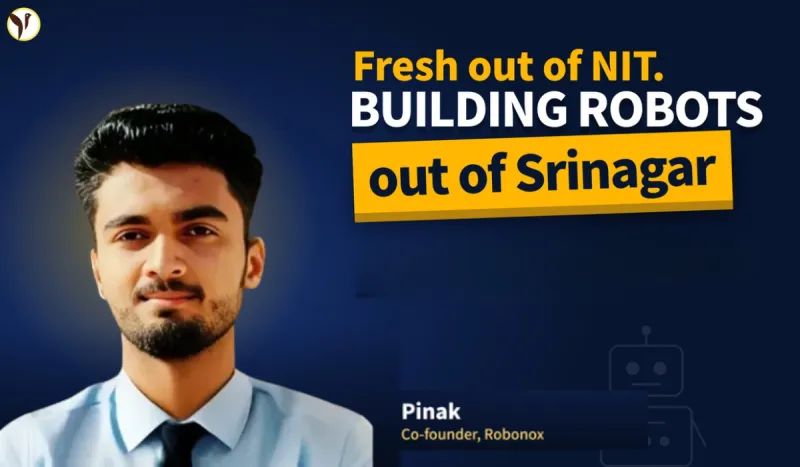
Pinak co-founded Robonox straight out of NIT Srinagar to build affordable robotics for Indian industries. His weapon: the oldest Indian idea in the book.

- Published
- Reading time
- 6 minutes
In a country obsessed with coding, a young engineer in Srinagar went looking for something else.
While most of his classmates at NIT Srinagar were headed into software, Pinak was pulled towards the harder, messier end of engineering. The side where you have to make physical things listen to code. The side nobody tells you how to break into if you don't have a lab, a budget, or a mentor nearby.
He went anyway. And out of a city not usually mentioned in India's tech story, he co-founded Robonox.
A different kind of curiosity
The pull showed up early. In his second year at NIT Srinagar, Pinak started drifting away from the well-paved road of pure software and towards something more hands-on.
"My interest lies somewhere between electronics, IoT (Internet of Things), and robotics," he explains.
He threw himself into microcontrollers, AI platforms and robotic systems, learning them with the kind of hunger that only comes from choosing a path nobody around you is picking. Software was crowded. Robotics was open. And for Pinak, open meant possible.
The moment at IIT Kanpur
Every founder has one memory where the vague feeling of "I think I love this" turns into "this is what I'm doing with my life." Pinak's came during a winter internship at IIT Kanpur, working on a DRDO project focused on UAV communication.
Suddenly the microcontrollers weren't a hobby anymore. They were the beginning of a career.
"That was the first time I truly felt this was my calling," he recalls. "I could envision my future in robotics."
Hands-on exposure to real drone technology, in a real research setting, closed the loop. He wasn't going to sit in an office writing someone else's code. He was going to build the hardware.
A name, a mission, a startup
Back from Kanpur, Pinak teamed up with a group of like-minded people and did the hardest thing a fresh graduate can do: he started a company. The spark for the name came from a robot called Robonox he had encountered during his research, and the name stuck because it captured what the team wanted to stand for pushing the boundaries of what was possible with Indian robotics.
The mission is as broad as the field itself. Robonox builds affordable, customised robotics solutions for industries most people never associate with robots in India: manufacturing, agriculture, healthcare, education. The team handles robot design and development, automation solutions, and robotics training programmes.
"We've completed numerous projects, delivering both routine and specialised solutions for various companies and industries," Pinak says.
The weapon no imported playbook can beat
Here is where Robonox stops looking like every other robotics startup and starts looking Indian.
Robotics, globally, is an expensive field. The components are costly, the research is capital-intensive, and most Indian startups try to replicate what the West has done, at Western budgets they do not have. Pinak and his team found a different path. They leaned on a word every Indian grows up with.
Jugaad.
"We discovered that we could achieve remarkable results with limited resources, often through unconventional methods," Pinak explains. "We call it jugaad."
That is the whole philosophy of the company condensed into a single word. By using locally available materials and components, by finding clever ways around expensive imports, by rethinking what "the right way" to build a robot even means, Robonox has been able to deliver cost-effective solutions that would be out of reach for most Indian businesses otherwise.
Pinak sees it as a national advantage, not a compromise.
"The best thing about India is our mindset. We're constantly developing and finding creative solutions. We can achieve a lot with less."
The quiet grind behind it
None of this came easily. Pinak was running a startup while finishing college, which meant discipline and long nights became non-negotiable.
"Gradually, I found ways to allocate time for my work. We often worked late into the night, sacrificing sleep to complete projects."
Then came the bigger problem. India's robotics ecosystem is still thin. There aren't enough mentors, not enough resources, not enough people who have already done what you are trying to do. Pinak and his team had to teach themselves by research, by experimentation, and by reaching out to anyone in the world who would answer.
"We reached out to people in Ireland who were working in robotics, and they were incredibly helpful."
That single detail says everything. A startup from Srinagar, learning its craft from engineers in Ireland. The internet makes that possible. The courage to ask makes it real.
What robotics is actually for
In a world where the robotics conversation often slides into fear are the robots going to take our jobs? — Pinak's view is calm and specific.
"Robotics is not about replacing humans. It's about augmenting human capabilities and improving our lives."
That is the lens through which Robonox picks the problems it solves. The team's work spans applications across industries that genuinely need help scaling: healthcare that is stretched thin, education that is uneven, agriculture that is labour-intensive, manufacturing that is still catching up. Alongside the client work, they run workshops and training programmes to spark the next wave of Indian builders.
That matters. The reason India doesn't have a bigger robotics industry today is partly that too few people grew up thinking it was possible. Robonox is quietly working to make sure the next generation doesn't have that excuse.
What he tells the next founder
Pinak's advice is simple, but earned.
"Follow your passion and don't be afraid to take risks. Surround yourself with a supportive team and never give up on your dreams."
And one more that comes from the specific nature of his field.
"The field of robotics is constantly evolving. You need to be a lifelong learner to stay ahead of the curve."
That is not advice for roboticists only. It is the quiet truth about any technical craft worth doing.
Why the story matters
The India you read about in tech headlines usually lives in a handful of cities. Robonox is proof that the next wave does not have to.
Pinak took the hardest end of engineering, in a city nobody expected to produce a robotics startup, with no deep ecosystem to lean on, and used the oldest Indian idea in the book to get it done. Jugaad is not a shortcut. It is a mindset that says: we will figure it out with what we have.
Robonox is figuring it out. And in the process, it is quietly showing other young Indians, including the ones in cities that still feel too far from the action, that the robotics revolution is not something they have to watch from the sidelines.
They can build it themselves.