Mandy Rellan started Akks in a servant quarter. She painted the polka dots herself
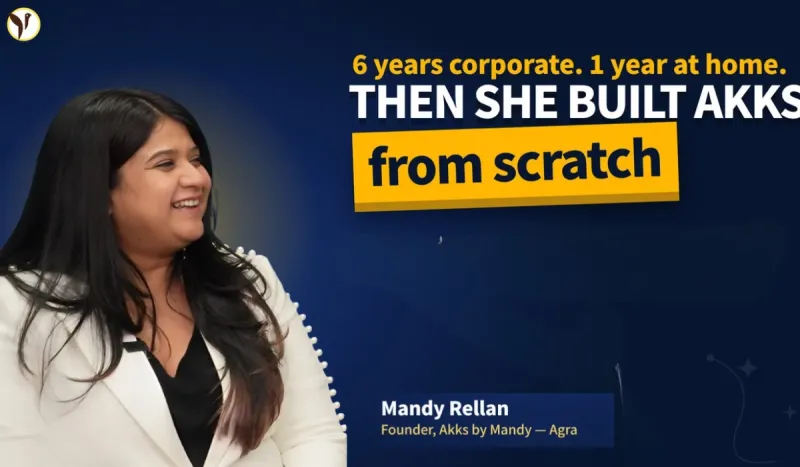
Mandy Rellan quit a 6-year corporate job, sat at home for a year, then opened Akks in a servant quarter in Agra one tailor, hand-painted polka dots, now 14 years and one men’s line in.

- Published
- Reading time
- 8 minutes
Mandy Rellan grew up changing her mind about what she wanted to be teacher, doctor, IAS officer and ended up spending six years in a corporate job before marriage, a baby and lockdown-like quiet forced her to sit still for the first time in her life. One year of sitting still was all she needed. In 2011, she rented a servant quarter in Agra, hired one tailor, painted polka dots on the walls herself because she couldn’t afford to pay a professional painter, and opened Akks. Fourteen years and one men’s line later, Akks by Mandy is Agra’s most celebrated fashion label and the woman who built it is still waking up at four in the morning to shoot her own campaigns.
The dreams that kept changing
For most of her childhood, Mandy was going to be a teacher. Then she grew a little older and she was going to be a doctor. Then she grew a little older still and she was going to clear the UPSC and become an IAS officer.
None of those three happened. What happened instead was a corporate job that she walked into straight out of college and stayed in for six years.
She got married inside those six years. She had a daughter inside those six years. And when her daughter was still very small, she looked at the whole arrangement the office, the baby, the hours and realised one of them was going to have to give. She quit her job.
Then she sat at home for almost a year.
The year that made her start
A year is a long time to sit still for someone who had never sat still before.
“Khaali maang shaitaan ka ghar,” she says, half-laughing. The quiet began to itch. She started looking around her for a problem she could solve not out of boredom but out of a very specific need to put her mind somewhere useful again. What she noticed was a gap: Agra had barely any contemporary, Western-leaning clothing options. The city shopped for weddings; nobody was dressing the city for everything else.
She took what she still calls a rational decision. In 2011, she opened Akks.
A servant quarter with hand-painted polka dots
Her first studio was a converted servant quarter. Half workshop, half showroom. She had one tailor, limited funds, and a very long list of people in the city telling her nobody would walk into a servant quarter to try clothes.
She did not have money for a painter.
So one night, Mandy and her best friend sat down with brushes and dot-stamps and hand-painted polka dots across the walls of what was about to become Akks. Black-and-white theme. Stripes. A visitor’s book on the counter. The biggest line-item in the opening budget was an air conditioner because, as she puts it, people wanted to try clothes, and the room needed to be bearable.
They came. Of course they came.
That servant quarter is the reason she still tells young entrepreneurs today the same two sentences: don’t overthink. If it’s in your heart, try it.
The men’s line that nobody thought she should launch
By 2018, Akks had been running for seven years as a women’s label. Mandy decided to add a menswear segment to it Akks Alpha. Agra had almost no serious contemporary menswear brands at the time, and the idea of a woman designer running a men’s line was still unusual enough to catch raised eyebrows.
She launched anyway. Alpha opened with Piyush as its face a model who has been part of every major Akks shoot since. Seven years later, Alpha’s tuxedo is one of the brand’s bestsellers.
The burnout she had the sense to name
What almost broke her, in the middle of all this, wasn’t the business. It was herself.
Mandy is a confessed workaholic. Years of running Akks at full speed caught up with her in a way she couldn’t quite describe a specific feeling of being wrong inside her own head that she had never felt before. A few friends told her to see a doctor. She didn’t know what seeing a doctor for feelings even meant. She went.
The doctor in Gurgaon told her she was in burnout. Within a month and a half, she was back on her feet.
That episode changed how she thinks about mental health permanently. “Agar aapko bukhaar hoga, aap doctor ke paas jaate ho. Yahi cheez mentally bhi hoti hai,” she says plainly. She now keeps a mentor on call for the days her head feels off. “Jab bhi I feel a little low, I just consult her.”
She says this as calmly as anyone has ever said it on an Agra podcast.
The standing ovation at India Fashion Week
In 2018, Akks walked at the Taj India Fashion Week. The world outside the ramp was in the middle of the #MeToo wave, and Mandy decided her show would carry that weight on its back.
She themed the entire set around women’s empowerment. Her showstopper dress was Lady in Flames Durga. The music she opened to was the Durga mantra. The music she closed on was Amitabh Bachchan’s monologue from Pink.
The hall gave her a standing ovation.
She still goes back to that memory when she needs to remind herself what the work is actually for. “Bohot proud mehsoos hua tha. Bohot acha sa feeling thi, bohot acha.”
Chamkeela, and why she was up at 4 AM
This year alone, Akks has run three campaigns Galaxy, SSS Sand Es Cube, and Chamkeela. The last one is the one everyone in Agra is still talking about.
Chamkeela came out of a single sentence Mandy wrote down for herself: everything around you can be dark and dingy, but there is something inside you that shines. The shoot location was an old oil mill the brand had quietly turned into a workshop. The styling was grand against grime. The call time was 6:30 AM; Mandy was up at 4.
She didn’t eat until 4 in the evening. Nobody did.
The campaign featured Tanya Dudhlani in a lavender lehenga Mandy would later admit was her favourite piece in the entire year’s output. Ellan Kapoor a TV actor Mandy has known as a friend for years wore the Alpha tuxedo. Piyush, Kanya and Muskaan were on the call sheet. The oil mill delivered.
A single couture piece from that collection took her craftsmen 15 days to put together. The tuxedo took seven. “A long process, but lovely,” she says, “when you see the whole product on yourself.”
Why Agra, and not Delhi
The question lands on her almost every month. Why not shift to Delhi? Why not shift to Bombay? Why run a serious contemporary label out of a city that most people associate with the Taj Mahal and shoes?
Mandy has a very specific answer, and she doesn’t dress it up.
“Agra talent se bhara pada hai. People are not able to find it. Aapko spot karna hai.”
Half the people in her campaigns are from Agra. Her tailors are from Agra. Her best friend who helped her paint the walls of her first studio is from Agra. The Dudhlanis, the Kapoors, the Piyushes who have been on her sets for years all of them are either from the city or already working from it, often invisible to the industry that keeps calling Mumbai first.
Her clients ask her the same thing from the shopping end. They tell her they’re flying to Delhi for their wedding wardrobe. She tells them, politely, that there’s no need. Six to eight months of Agra prep can match anything a Delhi karigar can offer. “Agra has amazing designers. Please shop here. Everything can be customised at one place.”
The mother she quietly disagrees with
The one voice in Mandy’s life she doesn’t take as instruction, somehow, is her mother’s.
Her mother tells her, with love, to focus on her career and not spread herself thin over the children. Mandy, with equal love, says no. “Nahi yaar, theek hai. It’s okay.”
Her studio is right next to her house. Her children can walk in. The team loves kids being around. The lines between her life and her work are deliberately blurred. “Lot of people struggle with that,” she says, “but I’m blessed. I don’t want to pick.”
What she tells women who are standing where she stood
Her advice, when she gives it, is as unpolished as her story.
Don’t overthink. If it’s in your heart, do it.
There will be a hundred voices telling you not to. There were a hundred telling her a servant quarter was no place for a boutique. They were wrong. The two people in her corner who mattered her husband, who treats her dreams as equal to his, and her father, who filled her head with so much confidence as a child that self-doubt genuinely never got a foot in are the only reason, she says, that any of this got off the ground.
“Choose your life partner well,” she says, almost in passing. “Someone who walks alongside you, not ahead of you, not behind. Sang.”
She doesn’t rush any of this. She doesn’t quit any of this. She just keeps building, from an oil mill, from a servant quarter, from a city that most people haven’t bothered to look at properly toward a plan that already has London and New York on its map, and probably has them pencilled in with an exact date Mandy isn’t yet ready to share.