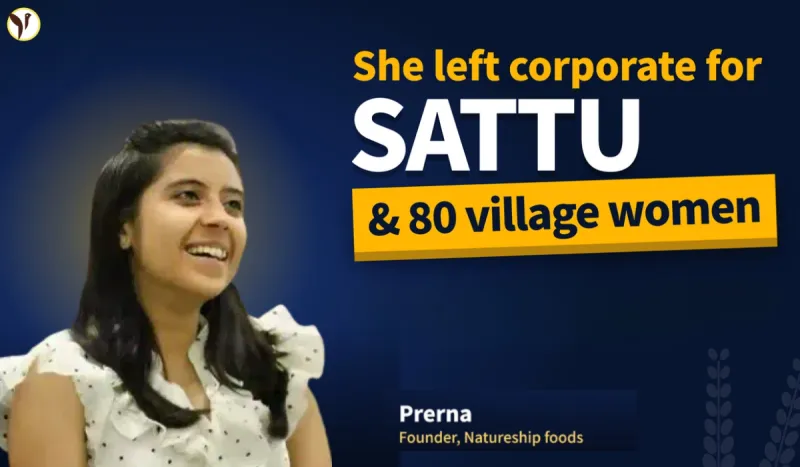
Prerna Left Her Corporate Job to Grind Sattu. Then 80 Village Women Joined Her
Prerna quit corporate life to build Natureship foods, a sattu brand made by 80 rural women in Jharkhand, and turned a workshop manager's life around in the process.

- Published
- Reading time
- 5 minutes
During the COVID-19 lockdown, when most of the country was trying to hold its own life together, Prerna went home to Jharkhand and saw something she couldn't unsee.
The village women around her, whose husbands had come home from cities as migrant labour, were suddenly the ones holding everything up. They didn't just feed their families. They carried an entire tradition of Indian food inside them, quietly, the kind of knowledge that goes back generations and doesn't turn up in any textbook.
"At that point of time, I started feeling this wasn't what they deserved," Prerna recalls. "They have so much knowledge, 100-year-old wisdom with them."
That sentence became a company.
Walking away from the corporate ladder
Prerna had a corporate career, the kind most people spend years trying to reach. She left it.
What replaced it was an idea and a conviction: that the same women whose skill and resilience she had watched during lockdown deserved a business built around them, not despite them. From that came Natureship foods, and her guiding line for how to run it.
"Lead by example, run smart, run well, and you will run far," Prerna says.
Building a company from the ground up
Most food brands buy ingredients from whoever's cheapest and slap a story on the label. Prerna built the opposite. Natureship foods sources directly from women farmers, through a network Prerna and her team have personally vetted.
"We procure from our own network...because they are verified by us," she says. That single decision means fair prices for the farmers and a supply she can actually trust. It also means the trust flows both ways.
The commitment doesn't stop at procurement. The women are involved at every stage: cleaning, roasting, and the slow, physical work of stone grinding that mass-market brands abandoned decades ago. "The entire process, from procuring to handing it over for delivery, is done by rural ladies," Prerna explains.
For the company's flagship product, sattu, that traditional method is the whole point. The world had moved on to faster, cheaper processing. Prerna refused.
"We don't want to lose our traditional processing techniques," she says. "It's okay to be modern, but it is also important to have some touch of where we came from."
The 80 women in a village workshop
The workshop itself is where the mission stops being abstract. Around 80 women work there today, and among them is the person Prerna calls her "personal favorite": Ambika Upadhyay, the workshop manager.
Ambika's own life had not been kind to her. She had gone through the trauma of divorce and the social stigma that still comes with it in many parts of the country. When she came to Natureship foods, she started with basic tasks. She had barely used a laptop.
Today she runs the entire workshop.
"She went from barely knowing how to use a laptop to running the entire operation," Prerna says, still amazed by it. Ambika's transformation has done more than change her own life. It has quietly shown every other woman in that workshop what is possible.
The test that told Prerna she was right
Real proof of a product usually comes from customers, not marketing. Prerna remembers one in particular who ran her own experiment. She compared Natureship's sattu with a mass-market brand by letting each settle in a glass of water. The mass-market powder dissolved completely and left nothing behind. Natureship's sattu had particles that settled at the bottom.
The customer's verdict landed hard. "That's when I understood that it's so pure, it's so fine," she told Prerna.
Word-of-mouth like that is what the company has grown on. Natureship foods is now stocked on major online platforms, and Prerna is planning digital marketing to widen the reach, but the engine has always been the same: customers who tried it, believed it, and told the next person.
The parts that don't fit on a poster
Prerna is honest about how hard the road has been. Food is one of the most regulated industries in India, and starting from a village workshop meant she had to get her paperwork right early. FSSAI licences, GST registration, all of it. "We had to start the process of documentation quite early on," she says.
She credits the mentorship and support of the IIM Ahmedabad incubation programme for helping her navigate this, and for putting a network of other entrepreneurs around her.
Her advice to other founders is not the usual "hustle harder." It's more mature than that. Balance passion with pragmatism. Move with direction, not just speed. Avoid burnout by thinking long-term. "Make a mental map," she says. "10 years, 20 years, how many years do you want to work?"
Two hands, and only two
Prerna's vision for Natureship foods is bigger, but never at the cost of the philosophy that started it. More women in the workshops. More farmers in the network. And the same short chain between the field and the customer that made everything work in the first place.
"There are no different hands," she says. "It's just two hands, the farmer's hand and their hand, and then it reaches the customer."
Why the story matters
Prerna's is not a story about leaving a job to chase a dream. It is a story about leaving a job to give one to eighty other people, and to preserve a tradition that would otherwise quietly disappear.
She saw women during a pandemic and refused to see them the way the world usually does. Everything else in Natureship foods flows from that moment.