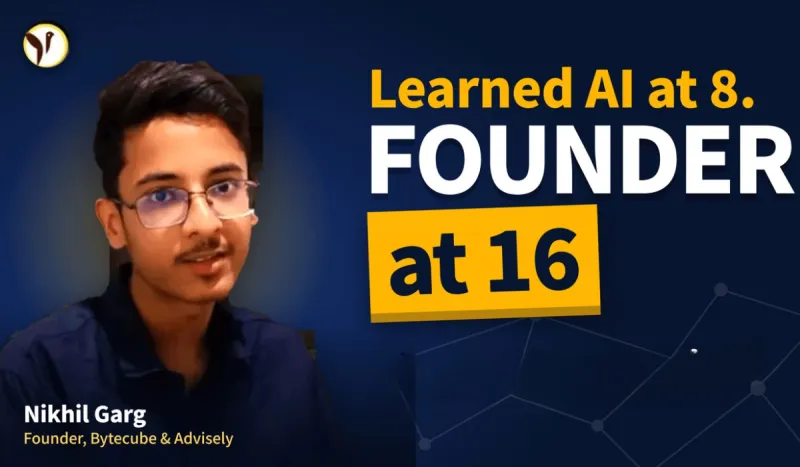
Nikhil Garg Started Learning AI at Eight. By Sixteen, He Was Running Two Companies
Nikhil Garg led a team of nine developers at 14, founded Bytecube at 15 and built the AI study-abroad platform Advisely by 16. This is how a teenager did it.

- Published
- Reading time
- 5 minutes
Most sixteen-year-olds are worrying about board exams. Nikhil Garg was worrying about payroll.
By the age most of us are still deciding what to study, he had already founded two companies, led a team of professional developers, and won a grant from a program that usually backs people twice his age. None of it came from a business school. It came from a curious eight-year-old who refused to wait for permission.
A child who wouldn't wait for school to catch up
The story doesn't begin with a startup idea. It begins with a boy of eight who stumbled onto machine learning and artificial intelligence and couldn't let go. There was no class for it, no syllabus, no teacher telling him what came next. So he taught himself. Programming languages, frameworks, whatever he could get his hands on, absorbed in the hours other kids spent on cartoons.
What separated Nikhil from a lot of gifted children was what he did with it. He didn't just learn. He wanted to build things that worked for real people, and he wanted to be paid for them. So while still in school, he started freelancing, taking on project after project, learning the discipline of delivering to a client on a deadline.
"I have a proven track record, this is the reason I started to work on Advisely," he says now. That track record was being built long before anyone knew his name.
Fourteen, and leading a team
In January 2022, Nikhil was fourteen. That same month, NorthStar Technologies offered him a Team Lead role, and put nine developers under him.
Think about what that means. A boy who could not yet legally drive was assigning work to grown professionals, reviewing their code and answering for their deadlines. It would have been easy to fail. He didn't. He learned how projects are actually run, how people are actually managed, and what it takes to keep a team moving.
He kept going, moving to Code Symphony LLP to go deeper into software development. But something was changing in how he saw the work.
"I was working directly with the Founder in that job room. So, I got everything, an idea of how these companies are working. So, I thought, 'If I can do it for someone else, why can't I set up my own company?'"
The leap
In October 2022, still only fifteen, Nikhil founded Bytecube.
The idea was to be the one place a startup or an entrepreneur could go to turn a digital idea into something real: software, websites, mobile apps, built end to end. In a short time, the company grew past 15 employees. A teenager was no longer just leading a team. He was employing one.
Then came the second bet, and it was a more personal one. Nikhil had watched how confusing and stressful the study-abroad process is for students, and how much rests on documents like Statements of Purpose and college essays. So he built Advisely, an AI-powered platform that helps student counselors craft those documents well, giving students a better shot at the universities they dream about.
He is not modest about where he wants it to go.
"My vision in 5 years is to make this company to at least a 30 million dollar valuation," he says.
The doors that opened
Talent alone doesn't get a teenager into rooms with serious founders. Nikhil understood early that his work had to be seen, and that when a door opened, he had to walk through it properly. His freelance and leadership work started drawing attention. He appeared on podcasts, including a YouTube feature that went viral, and each one pushed him further into the entrepreneurial community.
But he never treated those appearances as exposure for its own sake. He used them to build real relationships with founders and industry leaders, and those relationships changed everything.
The clearest sign came when he was selected for the Emergent Ventures program and awarded a $25,000 grant. The money mattered. What mattered more was what came with it: access to investors, mentors and experienced founders who took him seriously.
"The amount of network that I have got is insane," he says. "I am working directly with multiple established founders, I'm working directly with those who have built million-dollar companies and even venture founders."
What he learned about building
For someone so young, Nikhil talks about company-building with unusual clarity. He has one rule he keeps returning to.
"As a founder, one should focus on majorly 3 things: one, the people you hire; second, the technology; and third, the revenue."
On the first of those, he has a specific picture of the team he wants: "hustlers, hackers, and hipsters." The hacker builds the thing. The hustler sells it and gets it into customers' hands. The hipster understands what users actually feel and shapes the product around it. A company with only one of the three, in his view, is a company missing two-thirds of what it needs.
The question everyone asks
Surely investors and clients hesitated? Surely someone looked at a sixteen-year-old and wondered if he could really deliver?
Nikhil laughs at the question. In his experience, the reaction has mostly been the opposite.
"According to them, if I'm able to do this much at the age of 16, they would like to bet on me instead of betting on someone who's 30 or 35."
The thing the world expected to hold him back turned out to be his edge.
Beyond the screen
Here is the part that makes Nikhil harder to predict than most young founders. His ambitions do not stop at technology.
"At 25, I want to do ocean research. I want to run an off-shore sea company. That's my passion," he says. After the ocean, he plans to return to AI, carrying everything he will have learned from building companies in between. It is the same curiosity that pulled an eight-year-old toward machine learning, now pointed at the sea.
Underneath all of it sits a mantra that sounds simple until you see how far it has carried him: "Never Give Up."
What he'd tell you
Nikhil's advice to anyone thinking of starting up is not about being a prodigy. It's about doing the unglamorous work first: research your market properly, understand your customer deeply, and build a solid foundation before you try to scale.
He has done exactly that, twice, before turning eighteen. The rest of the story is still being written, and it is worth watching closely.