Neha Sharma: The Engineer Who Built a ₹3,000 Spot Welder and a Battery Company
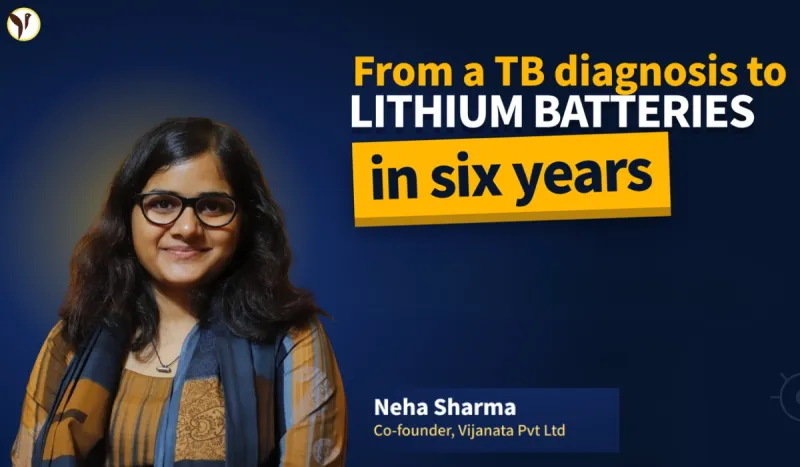
Neha Sharma had TB when she started Vijanata, built her first spot welder from AliExpress parts for ₹3,000, and now runs a Delhi-based lithium battery and electric bicycle company.

- Published
- Reading time
- 9 minutes
Most people would not start a company from a hospital bed.
Neha Sharma was close enough. In 2017, after five years of unexplained stomach illness, doctors finally diagnosed her with intestinal tuberculosis. She was put on a liquid diet for two months. She was sitting at home, recovering, taking medication, when her future business partner called with news of his own: the startup he had been working on with friends had just collapsed.
Out of that pair of setbacks, in February 2018, Vijanata Private Limited was born. Six years later, she makes lithium batteries and electric bicycles out of Delhi, and she still remembers the exact price of the scrap laptop batteries she used to build her first prototype.
Pulled into business, not pushed
Neha is upfront about one thing. She did not plan to be a founder.
"I happen to be in business not by choice but by chance," she says.
She is an Electronics and Communication Engineering graduate. Her co-founder, a mechanical engineer from the same college, had been in a separate startup partnership that didn't last. He was in Agra. She was in Agra, recovering. They lived near each other, and when his partnership broke down, the conversation naturally turned to what came next.
He suggested solar power plant installation. She agreed. That was the start.
Finding out solar wasn't it
The solar idea didn't survive first contact with reality. Two or three site visits in, they realised the work was deeply labour-intensive, not something a two-person team of fresh engineers could carry alone.
So they went back to research mode. What they wanted was something that fit the moment: a product that answered climate change, that was sustainable, and that they could actually build. The answer they kept coming back to was the electric bicycle.
They spent roughly one and a half years in product development on it. The very first prototype was a Jugaad: a normal cycle with an electric rickshaw kit retrofitted onto it. It worked. And then it was stolen from her business partner's house.
Most people would read that as a sign to stop. Her co-founder read it as a chance to build a better one.
"He always believes in upgrading the thing he's doing," Neha says. "He said, 'If I'm working on something, I will not make the other thing like I have done it before.'"
The second prototype was a proper electric bicycle. The battery inside it was lead acid, and it looked terrible, it was heavy, and the aesthetics were compromised.
So they moved to lithium.
The ₹3,000 spot welder from AliExpress
Switching to lithium batteries meant switching to a whole new industry. In 2018, in Agra, that industry was almost invisible. Lithium batteries weren't available locally. Buying them online was prohibitively expensive. Making them required a spot welding machine, cells, BMS boards and other equipment they didn't have.
The parents of two engineers were giving them a fixed monthly amount to live on. There was no budget for a ₹30,000–₹40,000 spot welder.
So Neha and her co-founder built one themselves.
"We checked on IndiaMart. The machine was very costly," Neha recalls. "So we ordered the board online from China, through AliExpress. Transformers are available in India. We made it into a spot welding machine in just around ₹3,000."
A ₹30,000 piece of equipment, rebuilt from a Chinese circuit board and an Indian transformer, for a tenth of the price. They did the same for cell capacity grading: built a prototype grading machine themselves for around ₹10,000.
And for the cells themselves, they went to Chippi Tola, the Agra scrap market, and bought discarded laptop batteries at ₹50-60 each. They extracted the usable cells, graded them for quality, wrapped them in plastic, and built India's first "Vijanata" prototype lithium battery out of e-waste.
The name came from Mehandipur Balaji
While the company was being registered, Neha was going through something else entirely. She had been taken to Mehandipur Balaji, the temple in Rajasthan, for what she describes as "spirit possession." Her co-founder called her mid-process asking her to suggest three names for the company.
"I said, 'I'm not in a position to recommend you any three names. I'm stuck in Mehandipur Balaji. You suggest your names, and whichever name comes through the registration, we'll move forward with that.'"
He liked Sanskrit names. He suggested three. Vijanata, meaning wisdom and knowledge, was unusual enough that the registration cleared it instantly.
A name chosen in the middle of a mother's prayer. The company itself became a kind of prayer answered.
The Delhi connection that changed everything
Having built the lithium battery was one thing. Getting paid for one was another. The breakthrough came from a connection they had in Delhi, a group already making solar street lights and sourcing their batteries from elsewhere.
The conversation was almost casual.
"They said, 'You have made a lithium battery. You can come to Delhi, and we will give you orders for the same.'"
That one sentence pivoted the whole company. They stopped working on the electric bicycle for a while and started making solar street light batteries. They expanded into both lithium chemistries active in the Indian market, lithium iron phosphate and lithium NMC, and started making batteries for scooters and power plants too.
Then COVID struck in January 2020, and everything paused.
Coming back to the cycle
When the dust settled, they went back to the thing they had set out to build in the first place. They launched the commercial model of their electric bicycle. The product line that started as a stolen prototype in Agra had become a proper vehicle sold through a dealer network across India.
The product itself runs in three modes: full throttle (like a scooter, 100% on battery, no pedalling), pedal only (human effort, no acceleration), or pedal-assist (the sensor reads the pedal and the battery powers the motor alongside, turning the cycle into a low-exercise vehicle). Government norms cap speed at 25 km/h and motor power at 250W. On a smooth road, a 75-kg rider gets 30-35 km in throttle mode on a single charge. A 120-kg rider gets 20-25 km. Pedal-assist can push the range up to 50 km.
Prices start at around ₹24,000-₹25,000 and climb to ₹1 lakh depending on features. The product sells mostly offline, because customers want to see and feel the cycle before buying. Vijanata plugs into India's existing ₹7,000 crore cycle dealer network to reach them.
Why she thinks the industry is still waiting to explode
Neha's clearest-eyed observation is about awareness. When they started selling in 2018, nobody knew electric bicycles even existed. Six years on, people know about electric scooters and cars but still think an electric bicycle is "just a normal cycle".
"In this industry, the biggest problem is still awareness," she says.
She frames it in a bigger context. Climate change, in her view, has stopped being a preference. It is now a responsibility.
"Transportation is no longer a choice or preference. It is a responsibility right now."
And within electric vehicles, the bicycle is the greenest of the lot. "Electric bicycle is the greenest mode of transportation. It accounts for very less carbon emission, even lesser than electric cars and lesser than electric scooters."
The engineer behind the founder
Being technical was the difference. Neha and her co-founder both had engineering degrees, which meant they could design, debug, prototype and iterate without hiring consultants they could not afford. The company has been in the market since 2018, which gives it a working understanding of how the industry has shifted, how batteries have been regulated, and why "unskilled companies" caused a wave of battery fires that pushed the government to tighten norms.
Vijanata survived that shakeout because its products were tested, certified and built on an actual understanding of what cells and chemistries do.
She has a sharp message for engineering students watching from the sidelines, especially those from mechanical and electrical backgrounds who worry about scope.
"There are only two industries I can look forward to that are going to grow by leaps and bounds in the future. One is AI. The other is climate change. Electric mobility and energy storage sit under the broader climate change spectrum."
What she tells anyone wanting to start up
Her advice is specific, and it's lived experience, not theory.
"If you are from an engineering background and looking forward to building a startup, first take some kind of course. Start small. Don't make large investments at one go. Learn the small things first. In two or three years, you will understand what you can do and what you can't."
She says the hard truth plainly: "In the past six years, all we have really learned is how a business runs."
A bootstrapped company, still growing
Vijanata today is a tight team. Two co-founders. A sales head. Production team leaders. It is still bootstrapped. The company is now rebranding and looking at collaborations and outside investment for the first time, having built its entire runway from zero to commercial product on its own.
What the name actually means
Neha ends the podcast with a line that lands harder once you know the backstory.
"Vijanata means wisdom and knowledge. The tagline we love to use with it is: 'The one who knows.'"
A company named in the middle of a crisis, built by two engineers who had just lost their first prototype to theft, their first partnership to collapse, and their first year to illness. They knew nothing about running a business when they started. They know a lot more now.
They are, quite literally, the ones who know.
Why the story matters
Neha Sharma's story is not about a breakthrough product or a viral moment. It is about what engineers can do when they refuse to let their circumstances decide for them. She was diagnosed with intestinal TB and used the two months of recovery to co-found a company. She did not have money for a ₹30,000 spot welder, so she built one for ₹3,000. She could not source lithium cells in Agra, so she went to the scrap market and extracted them from dead laptops.
Six years later, Vijanata is a Delhi-based lithium battery and electric bicycle company with Delhi orders, a national dealer network, and government certifications. It all started with a sick young engineer, a broken partnership, and a stolen cycle. And a Sanskrit word that came through on the first try at the registrar's office.