Kuldeep Singh Saw Gold in India's Garbage: Kabadi Techno Is How He's Mining It
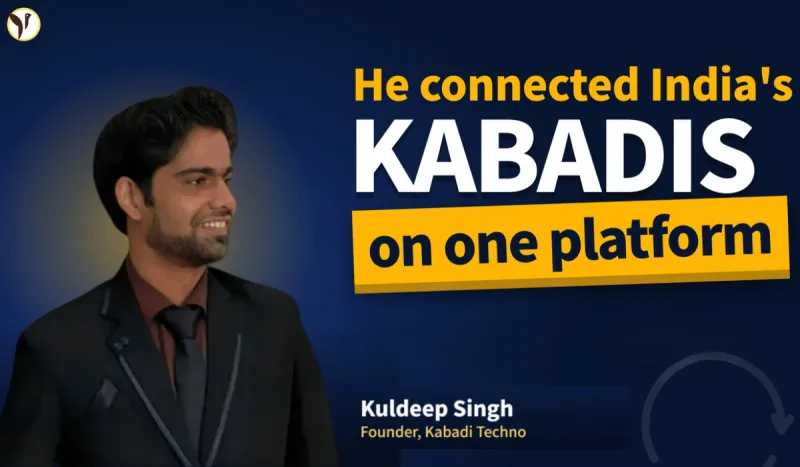
Kuldeep Singh built Kabadi Techno to connect India's kabadis, collectors and recyclers, and to recover the ₹8,000 crore of gold he says is dumped in landfills every year.

- Published
- Reading time
- 5 minutes
Nobody dreams of going into waste. It is the industry people look away from, the one that runs on the backs of workers most of us never think about, and the last place anyone expects to find the future.
Kuldeep Singh looked straight at it and saw something else entirely.
A curious student and a strange competition
It started in college, and it started with a habit rather than a plan. "I've always been curious about solving problems, creating something new," Kuldeep says. That curiosity led him into waste management competitions, the kind of thing most students do for a certificate and forget about.
Kuldeep didn't forget. Somewhere in those competitions, he noticed something that would take years to fully unfold: an entire industry, enormous and essential, that technology had barely touched. Everyone else saw a problem to avoid. He saw an industry waiting to be rebuilt.
Shouting into the wind
Having the idea was the easy part. Making anyone else believe it was another matter.
"The early days felt like shouting into the wind," Kuldeep admits. "Explaining my vision, convincing people to believe in it with me... that was the hardest part."
Then life added its own weight. In the middle of trying to build something from nothing, a personal health scare threatened to end the whole thing before it had properly begun. It is the kind of moment where most people quietly step back and choose the safer path.
Kuldeep did the opposite. He treated the struggle as fuel, and the resilience he found in that period became the foundation everything else was built on. Even his health struggles produced something: an early air purifier he developed during that time, now one of several patents in the pipeline.
Bringing a scattered industry together
Out of all that came Kabadi Techno. To understand why it matters, you have to understand how broken the system was.
"Kabadis, collectors, recyclers – everyone works in isolation," Kuldeep explains. "We bring them together, creating a smoother flow of waste."
Kabadi Techno is a platform that connects the people who have always worked apart. It streamlines the logistics, but its real power is data: real-time tracking and analytics that let everyone in the chain make better decisions, from a kabadi sorting materials in a yard to a large recycling facility. That data shows where the bottlenecks are, where the opportunities are, and how to make the whole system fairer and more transparent.
The people the system forgot
If efficiency were the whole point, this would be a good business story. What makes it more than that is who Kuldeep built it for.
"Kabadis are the unsung heroes of our environment," he says. "They work tirelessly in tough conditions, yet their labor is often undervalued."
So the platform isn't just tools. It carries training modules, safety information and market insights, the things that turn waste picking from a daily struggle for survival into a real, sustainable profession with dignity attached. Kuldeep puts the goal in one line: "I want them to feel pride in their work."
The gold nobody is looking for
Then there is the part of Kuldeep's vision that sounds unbelievable until you hear the numbers.
"It's not just about plastic," he says. "Every discarded phone and laptop contains precious metals like gold, along with toxic materials. Mountains of e-waste in landfills are both an environmental crisis and a missed economic opportunity."
How big an opportunity? "If I give you figures... every year, around 8000 crores worth of gold is dumped in landfills."
That figure is what drives the next chapter of Kabadi Techno: safe, responsible e-waste solutions, including a proprietary metal-extraction process Kuldeep has developed to recover what the rest of the country is throwing away. "Our land has a limited amount of precious metals like gold, silver, and copper," he says. "We need solutions for safe and efficient extraction from e-waste."
It sits alongside the rest of his inventions: AR/VR education tools built with his alma mater, and an IoT-powered waste collection vending machine, also headed for patent. The pattern is the same every time. Find a problem others have accepted, and refuse to accept it.
Six years, no shortcuts
Kabadi Techno was not built on a giant funding round. It has grown organically for six years, one convinced kabadi and one working partnership at a time, in an industry that was deeply sceptical of technology when he started.
"Changing an entire industry's mindset doesn't happen overnight," Kuldeep says. What it takes is constant dialogue, patience and, above all, results people can see.
He is proud of having done it the hard way. "We've shown that you can create impact without relying on massive investment. It's about dedication, perseverance, and unwavering belief in what you build."
What he tells the next founder
Kuldeep doesn't pretend the road is smooth. "There will be sleepless nights, moments when it feels like too much," he says. "But it's those challenges that make you stronger, more determined."
His ambition now reaches beyond his own company. He has become a vocal advocate for rethinking how India handles its waste altogether, pushing towards a circular economy where nothing valuable is thrown away and resources stay in use for as long as possible.
Why it matters
Kuldeep Singh took the industry everyone ignores and made it a place where technology, dignity and opportunity meet. He gave India's kabadis a platform and a reason to be proud. And he looked at a landfill and saw gold, not as a metaphor, but as a fact worth ₹8,000 crore a year.
The problems we walk past every day are still there, waiting. Kuldeep's story is proof of what happens when someone finally stops walking.