Dhanishta Was Told to Stop Clicking Food. Now Starbucks and Maggi Pay Her
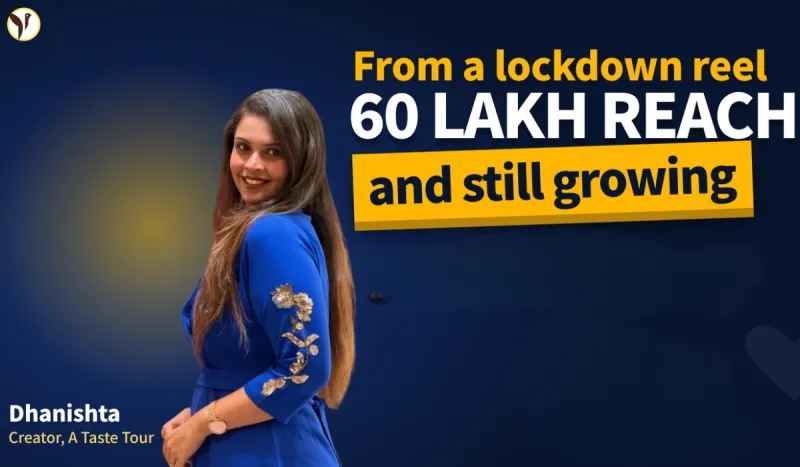
Dhanishta started her Instagram page in college because her friends got tired of her clicking food. Five years, one viral baba video and a 60 lakh reach later, she's one of Agra's top influencers.

- Published
- Reading time
- 9 minutes
Every young woman with a phone has heard it from her friends. "Bas kha le yaar, pictures hi khinchti rahegi?"
Dhanishta heard it too. The difference is, she didn't stop. Five years later, that habit is a page, a reach of 60 lakh, and brand deals with the names most Indian creators dream about.
A camera roll full of food
The story starts in college, in Delhi, with no plan at all. Dhanishta was doing her graduation, and had been obsessed with clicking photos of food since she was a child. Her friends used to beg her to just eat. She refused.
"Mere personal page pe abhi bhi highlights mein hongi vo pictures," she laughs. "I guess 50-60 ki maine highlights bana rakhi hain."
Food, food, food, and the occasional random shot. That was the whole archive. It was already a habit. It was not yet anything else.
The nudge that started a page
In college, she started meeting other bloggers. Through them came the first useful piece of advice.
"If you continuously post reviews on Zomato and your followers are decent, you can review for some selected restaurants."
So she tried it. And then one day, a free dish arrived. That was the moment her understanding of the whole industry shifted.
"Lagga, achha, isme free khaana bhi milta hai, we don't have to pay. Tab samajh mein aaya ki jo bloggers actually daalte the, vo khud se kam hi jaate the. Usually unhe bulaya jaata tha."
A door she hadn't realised existed had just opened.
Lockdown. Agra. And a viral baba.
Then COVID-19 happened. Dhanishta came home to Agra in her final year, and the whole world stopped. She started posting recipe videos instead.
One of them crossed 1 lakh views. Then 2 lakh.
But the real turning point wasn't a recipe. It was a man. Around the same time Baba ka Dhaba in Delhi was going viral and the whole country was watching, Dhanishta made a video about an old man selling kanji bade in Agra.
The response changed her life.
"Unko bhi hum logon ne around 40,000 ka donation collect kiya tha. 20k humne unhe diye the. And ek baba aur the, vo book seller the, vo viklaang the. Humne 20k unko diye."
The DM, the SP, the police, the newspapers, all of it followed. Her follower count jumped by 10,000-15,000 overnight. More than the numbers, something quieter had happened. She had found what her page could actually do.
The moment she stopped being a group blogger
Her first paid collaboration landed shortly after. And with it came a quiet, uncomfortable realisation.
"Mujhe laga, isme paise bhi milte hain, khaana bhi aur paise bhi. Then I realised my worth. Ki hum jo inhe, ye humein agar hazaar bhi pay kar rahe hain, toh hum 10,000 ka kaam de rahe hain aage."
She wasn't being paid for a meal. She was being paid for a video that would send 10, 15, 20 customers to a restaurant's door. The maths was not in her favour.
So, a year and a half in, she made a decision that cost her allies and earned her freedom. The food blogger groups she was part of weren't happy about it.
"Bahut ladaiyaan hui. 'You cannot do this, aap aise nahi kar sakte, hum aapko apni tastings bhi nahi bulayenge.' Maine kaha theek hai yaar, dekha jayega jo hoga. I will go with myself."
What she had figured out about those groups made it easy to walk away. They were quietly charging the restaurants and feeding the bloggers "free" meals they were actually being paid for. The bloggers didn't know. The restaurants did.
"Vo din hai aur aaj ka din hai. I'm really proud of my decision ki maine ye food groups chhod diye."
Refusing to be put in a box
The next lesson came the moment she started shooting things that weren't food. Travel. Lifestyle. Everyday reels from Delhi. Her page was called A Taste Tour, which read as food, and people kept asking her why she was posting other things.
"Fir maine socha ki nahi yaar, sab cheezon mein banayenge. Agar aaj food industry hai aur aap Agra mein agar din ke 10 restaurants khul rahe hain, 10 mein se ek bulayega. But aap roz-roz kya food ka kya hi dikhaoge?"
She was right. Over time the questions stopped. People scrolled past the page name and recognised her face instead.
"Ab vo naam nahi dekhte. Vo videos dekhte hain, scroll karke. Ki Dhanishta, Dhanishta naam se jaante hain vo."
That is the whole philosophy of her page in one line. She didn't want to be the food blogger from Agra. She wanted to be Dhanishta.
Starbucks, Maggi, and a Thailand run
Expanding the content turned out to be the smartest thing she ever did. Food brands like Maggi and Starbucks collaborate with her because they don't care where she is from. Global brands collaborate with her because an influencer, in her own words, cannot stay stuck in one place.
She has shot content in Thailand (7-8 videos, back to back). She shoots in Gurugram, where her full-time office is. She shoots everywhere she goes. Agra remains the base. Everywhere else is the map.
The job she hasn't quit (yet)
The thing most people don't know about Dhanishta is that she does all of this while holding down a full-time corporate job in Gurugram.
That life nearly came apart at the start. A surgery coincided with her joining date. The office gave her three or four months of work-from-home while she recovered, and she quietly shot content between physiotherapy and video calls. Then came the real schedule.
Three months of flying from Agra to Gurugram every week. Monday to Friday at the office. Friday back to Agra. All weekend shooting lineups with her mom (who films 70 per cent of her videos), her father, and her friends. Monday morning, back on the flight.
That is the part nobody sees. The part where your family becomes your crew because there is no other way to make the math work.
"Family is the biggest team."
Today her role is hybrid. Two days at the office. Three days at home. Weekends for shoots. Nights for editing.
The 60 lakh reach, and the honest truth about followers
Dhanishta's current reach is 60 lakh. Her follower count, in her own words, isn't growing at the same rate.
"Pehle Instagram pe itne influencers nahi the toh aapki reel viral bhi hoti thi, followers bhi bahut badhte the. Lekh literally 10K 20K bahut easily badh jaate the. But ab kya ho gaya hai, itne saare influencers ho gaye hain."
She is honest about the newer problem too. The copyright-claim loophole on Instagram, where a third party can flag a video that isn't even theirs. She's watched a few pages in Agra get shut down this way. Her advice is as clean as it gets: make your own content.
The iPhone and the ring light
Every aspiring creator wants to know what gear they need. Dhanishta's answer is one line.
"Ek acha phone zaroori hai."
She has used an iPhone since day one. Started with an XS Max, moved to the 11, and is now on the 13 Pro. She can tell the quality difference between editors on sight. She recommends a small ring light for anyone shooting in dim conditions. Beyond that, nothing.
How to actually land a brand deal
Her blueprint for a new influencer trying to pitch is specific. First, know your USP cold. Second, do not try to compete on price with someone the brand has already worked with. Third, offer something extra. Fourth, remember that initially, barter deals are fine, because the opportunity to work with a serious brand is itself worth more than a small fee. Charge later, once you've earned it.
And when the deal lands, do not become a yes-person.
"Kai log kya karte hain, nahi nahi sab accha hai sab accha hai karke, brand ko bhi hawa mein chadha dete hain, ki best hai, kuch nahi hai. But unhe bhi aapko bolna padega."
She has walked into brands and told them, to their face, that they need to improve. Because an influencer's goodwill is on the line too. People visit a place because of her face. If they are disappointed, they stop following her, not the brand.
The cafe at the end of the road
Ask Dhanishta where this is all going and the answer is quietly ambitious.
"Someday if, like, destiny mein hua, I'm planning to open a cafe in Agra. Basically street food se start kar lenge, ya directly cafe."
The influencer wants to become a business owner. The girl who filmed Agra's street food wants to serve it. And when the day comes to leave her corporate job, she already knows what she'll walk into.
Content creation itself, though, is not negotiable.
"Content creation is my life. It is full-time. Meri job aur content creation, both are full-time. And main content creation kisi ke liye bhi nahi chhodne wali. Never ever, till I die."
Two words she lives by
If you had to put one phrase next to Dhanishta's name, she already knows what it would be.
"Standard aur quality content."
Not a slogan. A rule. She treats every brand the same, every video the same, every location the same.
"Chahe main street food ki karoon ya brand collab ki, meri videos mein vo main try karti hoon vo difference kabhi bhi na aaye. Ki arre yaar, achhi jagah gayi hai toh achhi video bana li, buri jagah gayi hai buri video bana li. Vo kabhi bhi nahi hona chahiye. Treat everyone equal."
That is the real reason the page kept growing. Not the viral baba video. Not the Starbucks deals. Not the 60 lakh reach. The decision, five years ago, to treat her craft the same whether anyone was watching or not.
Why the story matters
Dhanishta didn't become an influencer because she wanted to be famous. She became one because she couldn't stop clicking pictures of food, and then she had the nerve to turn that habit into a career most people around her didn't yet believe was a career.
She said no to the groups that wanted to control her. She refused to be the food girl when she wanted to be the Dhanishta girl. She shot her own videos with her mother behind the camera, in a city that doesn't get the brand attention Delhi and Mumbai do. And she built an audience that scrolls past the page name and looks for her face.
Somewhere in Agra, a girl is being told to stop staring at her phone. One day, that girl might make Dhanishta's cafe her first stop.