
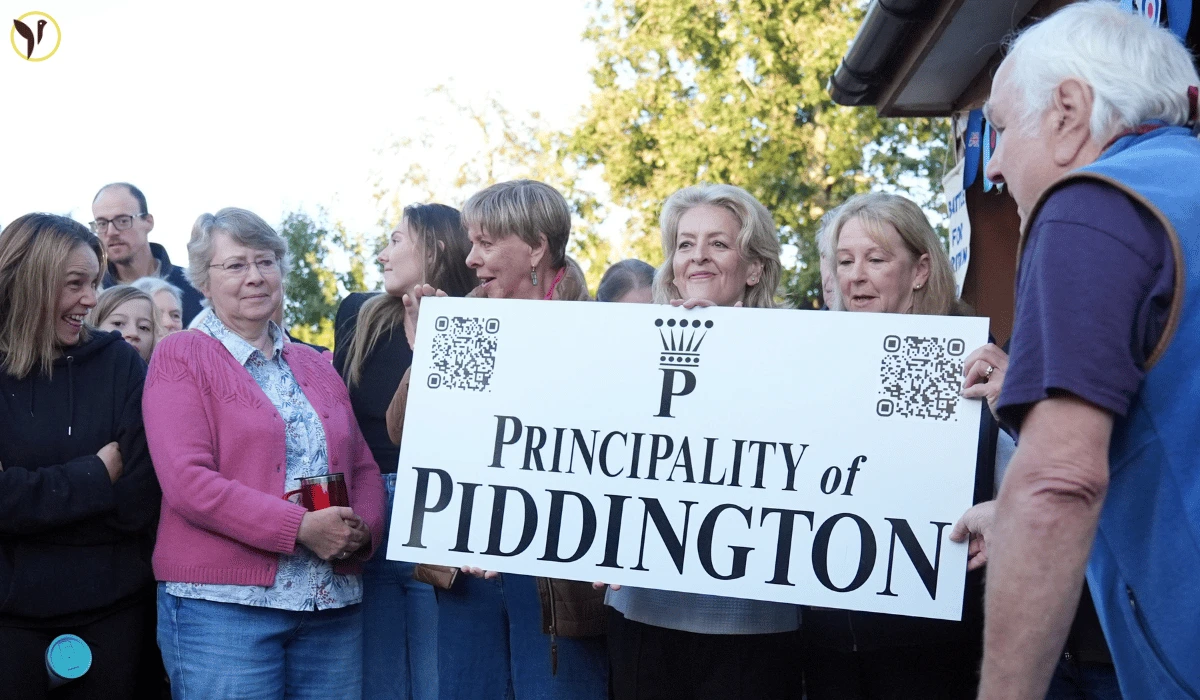


Piddington has left Britain.
Not really. But the Oxfordshire village of roughly 400 people held a referendum on seceding from the United Kingdom, and on Wednesday the result came in: more than 90% of the 300-plus residents who voted said yes.
The vote carries no legal force whatsoever. A parish council cannot remove a village from the United Kingdom, and everyone involved knows it. That is not the point.
The point is that a community of 400 people has decided the only way to get the government's attention is to declare independence from it and they have succeeded, because you are reading about a village in Oxfordshire.
They started this on the Fourth of July
The theatre has been deliberate from the beginning.
On 4 July 2026, American Independence Day, chosen for exactly the reason you think Piddington residents voted on whether to hold the referendum at all. That preliminary vote passed with 96% support. Some of the campaign's framing went further still, floating the idea of joining the United States, a proposition roughly as legally available as the secession itself.
Parish council chairman Tim McNally has been one of the leading voices behind the campaign.
None of this is a genuine attempt to redraw a border. It is a village using the only instrument available to a parish council a vote to manufacture enough noise that someone in Westminster has to answer a question.
Judged on that measure, it has worked better than a petition ever would have.
What they are actually protesting
Half a mile from the village sits Bicester Garrison, a former military site.
The Home Office plans to use it to accommodate male asylum seekers. Reports of the number vary between around 1,200 and 1,256; the local MP, Calum Miller of Bicester and Woodstock, has said the site could hold as many as 1,250 people.
Set that against a village of 400 residents. The accommodation site would hold roughly three times the population of the community next to it.
The villagers' stated objection is twofold. They say they were not adequately consulted before the plan was announced, and they object to the scale relative to the settlement. Residents interviewed during the campaign have put it more simply: they do not believe they are being heard.
"We aren't being heard," is how one summary of the local mood was put.
The part most coverage will leave out
Here is where this story stops being simple, and it is worth slowing down for.
The Home Office is not being opposed from one direction. It is being opposed from two.
Jane Coles of the Oxfordshire branch of Stand Up To Racism told the BBC earlier in the campaign that she opposed the "inhumane warehousing" of asylum seekers — at this site or any other. Her objection is not that too many asylum seekers are coming. It is that housing large numbers of people in camps on former military bases is the wrong way to treat them.
So a refugee-rights campaigner and a protesting parish council want the same plan scrapped, for reasons that have almost nothing in common.
That is not a contradiction to be resolved. It is the actual shape of the argument, and any version of this story that presents it as villagers versus asylum seekers has missed most of what is happening.
The government's position
The Home Office has consistently framed the use of military sites as an improvement on the alternative.
Asked about similar plans elsewhere, a Home Office spokesperson has said the government is "working to move asylum seekers into more suitable accommodation such as military bases" the comparison being with hotels, which have become politically toxic, expensive, and the focus of protests across England.
That is the policy logic in a sentence. Hotels are unpopular and costly, so the government is moving people to large sites it already owns. The difficulty is that the places it already owns tend to be next to small villages that were not asked.
This has all happened before
Piddington is not the first village to find a former military base on its doorstep repurposed without notice, and the precedents are not encouraging for the Home Office.
In 2022, the government announced plans to house up to 1,500 asylum seekers at a former RAF base at Linton-on-Ouse in North Yorkshire, a village of about 650 people. Residents learned about it largely through social media and visiting reporters. Within days a campaign group had formed. Its members researched asylum legislation, organised mail drops to the Home Secretary and the Prime Minister, staged protests when officials visited, and won backing from their local MP. One campaigner told reporters at the time that the Home Office had not expected the level of resistance it received.
The Linton-on-Ouse plan was abandoned.
Similar proposals followed at Wethersfield in Essex, Scampton in Lincolnshire and Bexhill-on-Sea in East Sussex, each meeting organised local opposition and, in some cases, legal challenges from councils.
The pattern is consistent enough to be predictable: a site is identified, an announcement lands with little warning, a village organises faster than anyone expected, and the plan either stalls or collapses.
Piddington has added a referendum to the playbook. Given how much attention it has generated relative to the usual petition-and-placard route, it may not be the last village to try it.
So what actually happens now
Nothing, constitutionally. Piddington remains in Oxfordshire, in England, in the United Kingdom, and will continue to do so regardless of Wednesday's result.
What the vote has produced is leverage. National and international coverage, a local MP with a mandate to press the issue, and a Home Office now making decisions about Bicester Garrison in public rather than quietly.
Whether that changes the outcome is a different question. But on the historical record, villages that organise early against these plans have a considerably better success rate than anyone in Westminster would like to admit.