Francis Halzen Wins Physics Nobel for Antarctic Neutrino Work
Francis Halzen has won the 2026 Nobel Prize in Physics for the IceCube Neutrino Observatory, the first solo physics Nobel since 1992. What he built and why it matters.

- Published
- Reading time
- 6 minutes
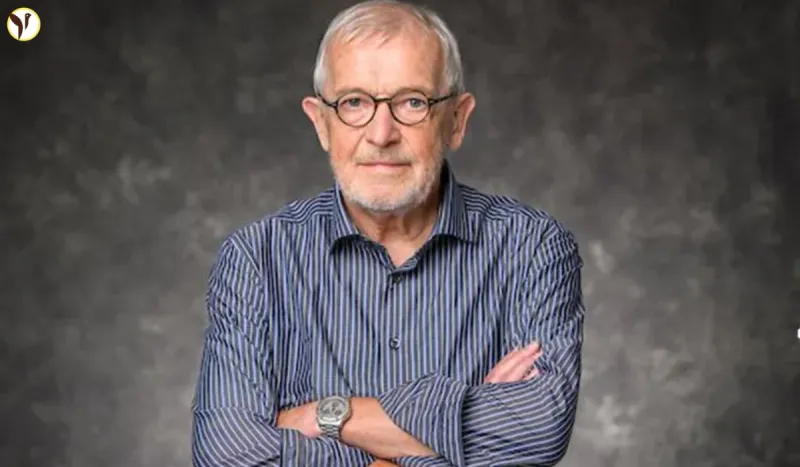
Francis Halzen has won the 2026 Nobel Prize in Physics for decisive contributions to the IceCube Neutrino Observatory and the discovery of high-energy neutrinos of astrophysical origin, the Royal Swedish Academy of Sciences announced in Stockholm on Tuesday. The Belgian-American physicist, based at the University of Wisconsin–Madison, first proposed the observatory in 1988 and has served as its principal investigator. He receives the full prize of 12 million Swedish kronor, around $1.2 million, making this the first Nobel Prize in Physics awarded to a single person since 1992. Taking the call from Italy, Halzen said that when the project began, very few people thought it would work, including himself.
What he said
The quote is the best thing to come out of Stockholm this morning, and it is worth quoting at length because of what it admits.
"When we started this project, everybody realized this was maybe a good idea but very few thought it would work, including myself," Halzen told the Nobel news conference. "So this was kind of an adventure where success wasn't guaranteed."
He described the award as a "great surprise" and a "great pleasure."
A man has just been given the most prestigious prize in his field, alone, for an instrument he spent decades building and his first instinct was to say he had not been sure it would work either.
That is a more honest account of how difficult science actually happens than most Nobel coverage allows for. Halzen proposed IceCube in 1988. The prize arrived in 2026. Thirty-eight years separate the idea from the recognition, and he spent a good portion of that period, by his own account, not certain of the outcome.
Why a solo prize matters
This is the structural detail that nobody is foregrounding, and it is unusual enough to be the story.
The Nobel Prize in Physics is almost always shared. Two or three laureates is the norm, reflecting both how modern physics is done and the committee's preference for recognising parallel contributions.
The last time it went to a single person was 1992, to the French physicist Georges Charpak. Thirty-four years.
Recent years illustrate the pattern. The 2023 prize recognised a tool for studying the motion of electrons. The 2024 prize went to foundational work behind today's artificial intelligence models. The 2025 prize was shared between John Clarke, Michel Devoret and John Martinis for demonstrating quantum phenomena in macroscopic, hand-held devices.
So giving this one to an individual is a deliberate statement, particularly for a project built by an international collaboration of hundreds of researchers and engineers.
Richard Fitzgerald, editor-in-chief of Physics Today, made exactly that point: "It's been a while since the Nobel Prize has gone to a single individual and that points to the uniqueness of his vision. It took a team of hundreds of people to build it, but it all started with one person."
The committee's own language ran the same way. "Francis Halzen has led an international team of researchers and engineers who have provided us with a fantastic instrument," said Mark Pearce, chair of the Nobel Committee for Physics. "His tenacity and scientific vision has paved the way for a new kind of astronomy."
Tenacity is not a word Nobel citations use lightly.
What IceCube actually is
The idea sounds faintly absurd when you first hear it, which is part of why few people believed in it.
Halzen proposed turning a cubic kilometre of Antarctic ice into a telescope.
Neutrinos are subatomic particles that pass through essentially everything. They stream through the Earth, through buildings, through you, in enormous numbers, almost never interacting with anything. That is what makes them scientifically precious and practically maddening: they travel across the universe in straight lines without being deflected or absorbed, carrying information from their source intact and they are correspondingly almost impossible to catch.
Almost. Very occasionally a neutrino strikes an atomic nucleus, and the collision produces a faint flash of light.
Halzen's insight was that if you had a sufficiently large volume of exceptionally clear material, and you filled it with light sensors, you could catch those flashes. Antarctic glacial ice is exactly that: enormous, ancient, extraordinarily clear and, crucially, already there.
IceCube embeds sensors deep in that ice and watches. The ice is the detector. Nobody built it; it was waiting.
Why it changes what we can see
Conventional astronomy observes light — visible, radio, infrared, X-ray, gamma. All of it is electromagnetic radiation, and all of it is absorbed, scattered or deflected on the way here. There are parts of the universe we simply cannot see this way, because something is in front of them.
Neutrinos are not stopped by anything much. A neutrino arriving from a violent event in a distant galaxy has travelled in a straight line from its source, carrying information about processes no telescope can observe directly.
The discovery that IceCube made high-energy neutrinos of astrophysical origin, as the citation puts it confirmed that these particles are reaching us from beyond our own galaxy, and that they can be detected and traced.
That is what Pearce meant by a new kind of astronomy. It is a second way of looking, independent of light, and it opens the parts of the universe that light cannot escape.
Who he is
Francis Halzen is Belgian-born and a naturalised American, a particle physicist by training who became an astrophysicist by consequence.
He is the Hilldale and Gregory Breit Distinguished Professor of Physics at the University of Wisconsin–Madison, and principal investigator of the IceCube Neutrino Observatory.
The Nobel is the latest in a long run of recognition. He has been elected to the National Academy of Sciences, and has received the 2019 Yodh Prize from the International Union of Pure and Applied Physics, the 2021 Homi Bhabha Medal and Prize from IUPAP and the Tata Institute of Fundamental Research in Mumbai, the 2021 Bruno Rossi Prize from the American Astronomical Society alongside the IceCube Collaboration, and the 2026 APS Medal.
The Bruno Rossi citation is worth noting because it names precisely what the Nobel has now recognised: the discovery of a high-energy neutrino flux of astrophysical origin.
The practical details
The prize is 12 million Swedish kronor, approximately $1.2 million, shared among laureates where there are several. Halzen receives all of it.
The medal will be presented by King Carl XVI Gustaf at the ceremony in Stockholm on 10 December, the anniversary of Alfred Nobel's death.
This was the second Nobel announced this year, following Monday's medicine prize. Chemistry follows on Wednesday.
What it says about long science
There is a broader point here worth drawing out, because it applies well beyond neutrinos.
A proposal made in 1988 required sustained funding, international collaboration, construction in one of the least hospitable environments on Earth, and decades of patience before producing the result that won this prize. At no point along that path was success assured the laureate said so himself this morning.
Very little in the current research funding environment is structured to support that. Grant cycles are short, results are expected quickly, and a project whose payoff might arrive twenty years later and might not arrive at all is a difficult case to make.
IceCube is the argument for making it anyway. Whether the people holding the budgets draw that conclusion is a separate question, and the answer determines what the Nobel committee has to choose from in 2060.
Questions readers ask
Who won the 2026 Nobel Prize in Physics?
Francis Halzen, a Belgian-American physicist at the University of Wisconsin–Madison and principal investigator of the IceCube Neutrino Observatory. The Royal Swedish Academy of Sciences announced the award in Stockholm on Tuesday 6 October 2026.
What did he win it for?
The citation reads: "decisive contributions to the IceCube Neutrino Observatory and the discovery of high-energy neutrinos of astrophysical origin."
Why is it unusual that he won alone?
The Nobel Prize in Physics is almost always shared between two or three laureates. The last time it was awarded to a single person was 1992, to the French physicist Georges Charpak. Richard Fitzgerald, editor-in-chief of Physics Today, said this points to the uniqueness of Halzen's vision, noting that while it took hundreds of people to build IceCube, it started with one person.
What is the IceCube Neutrino Observatory?
A detector embedded in roughly a cubic kilometre of glacial ice at the South Pole in Antarctica. Halzen first presented plans for it in 1988. Rather than being constructed from scratch, it uses the Antarctic ice itself as the detecting medium, with light sensors suspended within it.
How does IceCube detect neutrinos?
Neutrinos pass through almost all matter without interacting, but very occasionally one collides with an atomic nucleus, producing a faint flash of light. Sensors embedded in the clear glacial ice detect and track those flashes.
Why are neutrinos scientifically important?
Because they travel across the universe in essentially straight lines without being absorbed, scattered or deflected, carrying information from their source intact. Conventional astronomy relies on electromagnetic radiation, which is blocked or distorted by matter in its path. Detecting astrophysical neutrinos therefore provides a second, independent way of observing the universe, including regions light cannot escape.