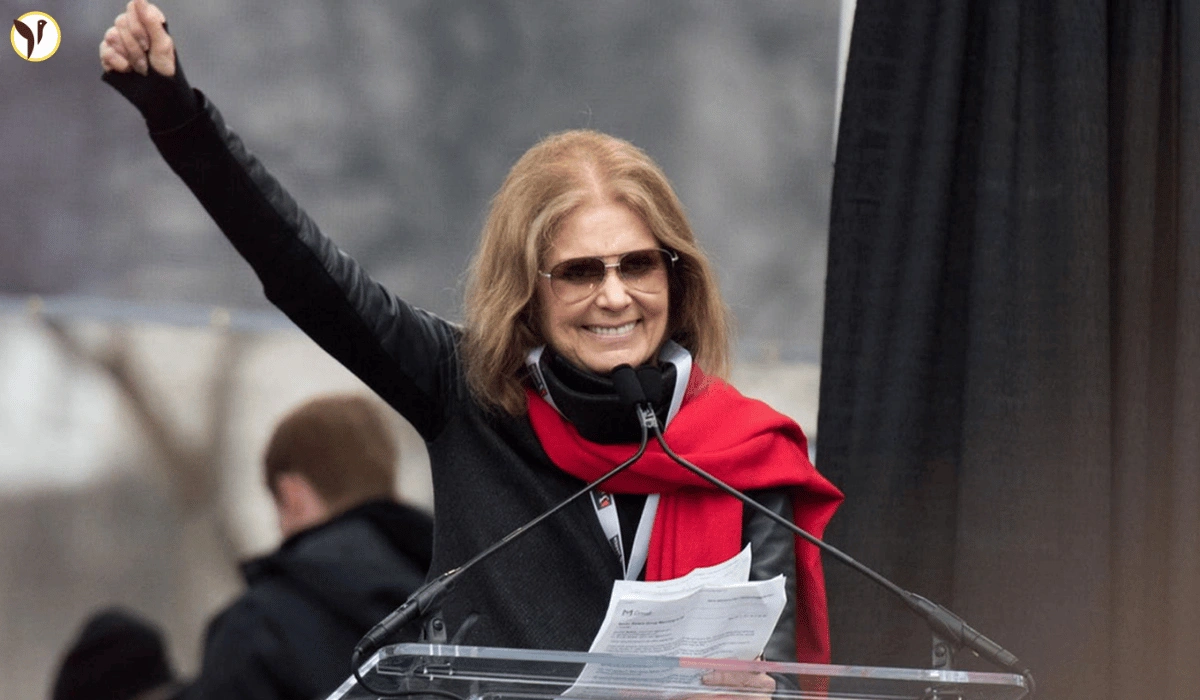


Gloria Steinem has died at the age of 92.
She died on Wednesday at her home in New York City, the brownstone she had lived in for more than fifty years. Her foundation announced the news on Thursday in a statement posted to her verified Instagram account, saying she had died peacefully, surrounded by some of the many people who loved her.
Gloria's near-century on earth were years well-lived, the statement said, adding that she kept working for equality until the very end.
What has been released, and what hasn't
No cause of death has been given.
This is worth stating plainly, because it is the second most-searched question about her death today and the honest answer is that her family and foundation have not disclosed it.
There may be no further announcement. Families are under no obligation to release a cause of death, and for a woman who died peacefully at home at 92, many never do. If you see a specific cause circulating in the next few days, check whether it traces back to her foundation or to an aggregator that guessed.
What her foundation did share was how she spent her final years: in the company of other people, and writing. Both of those turn out to be the whole story of her life in miniature.
The woman who became the face of a movement
Steinem was born on March 25, 1934, in Toledo, Ohio, the second daughter of Leo and Ruth Steinem. Her father was a travelling antiques salesman, and the family spent much of her early childhood on the road; she did not attend school regularly until she was eleven. After her parents divorced in 1944, Steinem stayed in Toledo and cared for her mother an experience she would later write about with unusual honesty, and which shaped how she thought about the invisible labour expected of women.
She got out through education. She studied government at Smith College, spent a junior year in Geneva, earned a Phi Beta Kappa key, and graduated magna cum laude in 1956.
Then she went to India, and everything changed.
The two years in India that made her an activist
This is the part of Steinem's life that most obituaries reduce to a single clause, and it is arguably the most important two years she ever spent.
A Chester Bowles Fellowship took her to India in the late 1950s, when she was in her early twenties. She couldn't afford the trip outright, so she arranged writing work for travel companies and airlines in exchange for a ticket.
Once there, she didn't stay in the cities. She travelled village to village with followers of Vinoba Bhave, the Gandhian leader behind the Bhoodan movement, which asked landowners to voluntarily donate land to the landless. Between 1951 and 1964, that movement gathered more than four million acres without a single law being passed or a shot being fired. Steinem walked with it. She slept on mats villagers shared with her and ate what they fed her.
What she took from it was a method. She watched people sit in a circle in a village, talk until something was agreed, and then act and she saw ordinary people change material conditions without institutional power. She wrote afterwards about the relevance of Gandhian principles to grassroots organising, and specifically to organising women.
She also wrote a government guidebook, The 1000 Indias, and pieces for Indian publications. She kept ties to the country for the rest of her life.
Every organising instinct Steinem later became famous for in America the talking circle, the belief that the movement had to come from below rather than from a leader, the insistence that listening was the actual work traces back to those two years. She said so repeatedly. She called India the starting point.
It is a strange and worthwhile fact that the most recognisable face of American feminism learned her craft in Indian villages.
The Playboy Club, and journalism that made people uncomfortable
Steinem moved to New York in 1960 and ran straight into an industry that did not want her.
She was told by an editor at Life that what they needed was a reporter, not a pretty girl. She got the serious assignments anyway, slowly, and in 1963 she got the one that made her name: she went undercover as a waitress at Hugh Hefner's Playboy Club and wrote about what the job was actually like.
The piece exposed the working conditions behind the glamour the pay, the costumes, the treatment. It made her famous and, for years, made it harder for her to be taken seriously as a political journalist, which was its own bitter proof of the point.
She co-founded New York magazine in 1968 and wrote its political column until 1972.
Ms. magazine and what it actually changed
In 1972 Steinem co-founded Ms., the first nationally circulated magazine to take feminism seriously as a mainstream subject rather than a fringe one. She stayed as an editor for fifteen years.
Ms. was not the only thing she built. She helped found the Women's Action Alliance in 1971, the National Women's Political Caucus the same year, the Ms. Foundation for Women, the Coalition of Labor Union Women in 1974, the Free to Be Foundation and the Women's Media Center.
It is easy, decades later, to lose track of how concrete the changes were. When Steinem started, women in the United States could not reliably get a credit card without a man's signature. Ivy League universities that now educate more women than men were closed to them. Abortion was illegal. Steinem was one of the most visible people arguing, in print and on stage and in front of hostile audiences, that none of that was natural or permanent.
She also campaigned against the Vietnam War, worked with the United Farm Workers, and joined the committee for Angela Davis's legal defence. She wrote about the parallels between the women's movement and the Black freedom movement, and argued that a feminism that did not cross racial and economic lines was not worth much.
President Barack Obama awarded her the Presidential Medal of Freedom, the highest US civilian honour, in 2013. Rutgers created an endowed chair in her name in 2017.
Her life outside the work
Steinem was famously unmarried for most of her life and made no apology for it. She married the environmental activist David Bale in 2000, when she was 66; he died three years later. Christian Bale is her stepson. She chose not to have children and answered questions about that choice, which she was asked far more often than any man in public life has ever been, without flinching.
Her books included Outrageous Acts and Everyday Rebellions, Revolution from Within, Moving Beyond Words, a biography of Marilyn Monroe, and the bestselling My Life on the Road.
What she leaves behind
For years, Steinem hosted gatherings in her New York living room that her foundation calls Talking Circles hundreds of guests, over decades, sitting and talking in the same shape she first saw in Indian villages seventy years ago. Her foundation says she insisted those continue after her death, and they will. She wanted her home to become a centre for social justice movements.
She had a book finished and coming: An Unexpected Life. In it she wrote about the brownstone she had lived in for over fifty years, rooms that held lives before hers and would hold others after she was gone.
Her family have asked that anyone wishing to honour her light a candle, and that donations go to Gloria's Foundation rather than flowers.
She was 92, and she was working until the end.