Did AI Write That Political Speech? Why This Trend Is Growing Fast
Did AI write that political speech? From AI-generated speeches to campaign videos and digital avatars, find out why politicians are using AI and what it means for politics.

- Published
- Reading time
- 8 minutes
A political speech has traditionally been seen as a direct connection between a leader and voters.
A politician stands on a stage, reads from a script and speaks about jobs, development, national security, prices, education or other public issues.
But artificial intelligence is changing that process.
Today, AI tools can help political teams write speeches, translate messages into different languages, create social media posts, produce campaign videos and even generate digital versions of politicians.
This has created a new question for voters:
When a politician gives a powerful speech, how much of it was actually written by the politician or their human team — and how much came from AI?
The question is no longer theoretical.
AI-generated political content is already appearing in campaigns and political social media. In India, reports in 2026 have documented AI-generated politicians and Parliament-style videos gaining millions of views. Political parties and campaign teams are also using AI for videos, targeted communication and other digital outreach.
In another recent case, a Canadian legislator appeared to read an AI-generated instruction during a speech, after an apparent line telling the speaker to provide a “more natural, flowing version” was read into the legislative record.
These developments show why AI and political communication are becoming a major issue in 2026.
Why Is AI Entering Political Speeches?
The biggest reason is simple:
AI can save time.
Political campaigns produce huge amounts of content every day.
A single campaign may need:
- Speeches
- Press statements
- Social media posts
- Short videos
- WhatsApp messages
- Regional-language content
- Advertisements
- Voter responses
- Debate preparation
- Talking points
- Email messages
- Website content
Producing all of this manually requires a large team.
AI can help create a first draft within seconds.
A political communication team can then edit the material, add local information and check the facts before publishing it.
This makes AI attractive to campaigns that need to communicate quickly.
AI Is Not Always Writing The Whole Speech
This is one of the most important points in the debate.
When people hear that a politician is "using AI," they may imagine a chatbot writing the entire speech from beginning to end.
In reality, AI can be used at different stages.
AI can help with:
Research:
Finding themes and summarising large amounts of information.
Drafting:
Creating an initial speech or statement.
Editing:
Making a speech shorter or easier to understand.
Translation:
Converting a message into several languages.
Personalisation:
Creating different versions for different audiences.
Social media:
Turning a long speech into short posts and videos.
Video production:
Creating visuals, avatars or synthetic voices.
So, simply using AI does not prove that a politician did not write or approve the final message.
The important question is how much AI was involved and whether the final content was checked by humans.
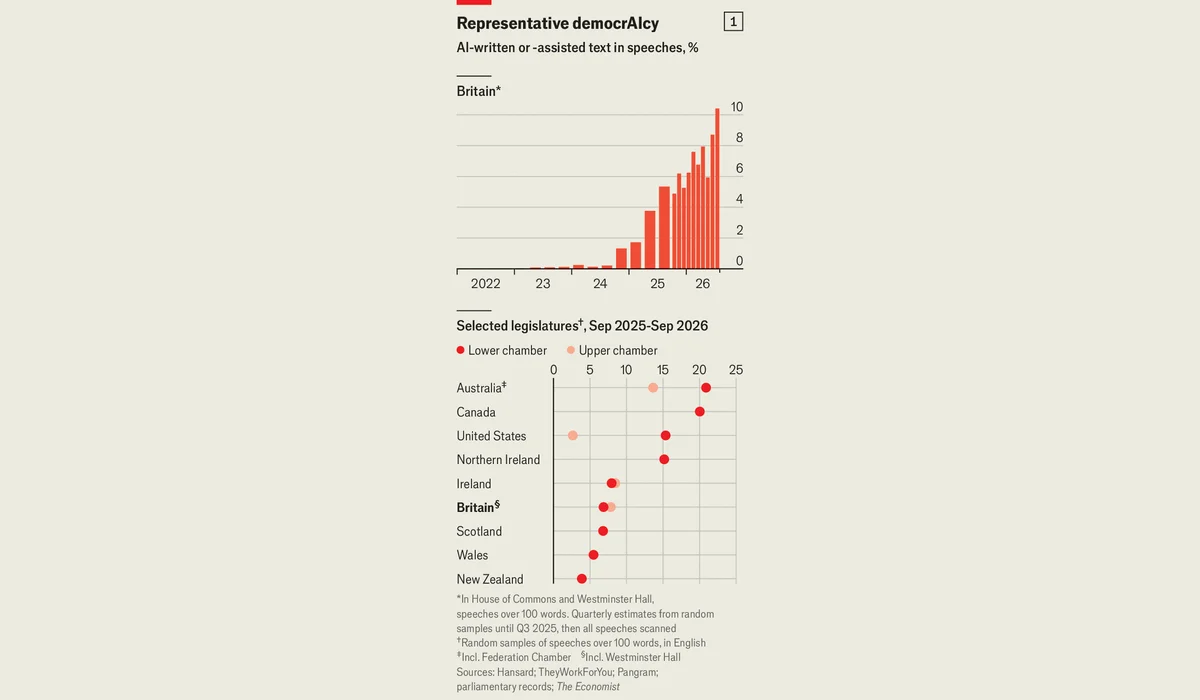
AI-Generated Political Speeches Are Becoming Easier To Produce
Generative AI has changed the cost and speed of political communication.
Earlier, a campaign needed writers, translators, video editors and designers for many tasks.
Now, one small team can use AI tools to produce a much larger volume of material.
A 2026 academic study on generative AI and political campaigns found that AI is increasingly being used to produce large volumes of customised political content, particularly visual material. The researchers noted that some AI-generated content can be difficult to distinguish from human-created material.
This does not mean every political message is AI-generated.
It means the scale of content production has changed.
The Rise Of AI Politicians And Fake Parliament Videos In India
India is already seeing a new form of AI political content.
A report by India Today in April 2026 examined social media accounts using AI-generated politicians and Parliament-style videos.
Some of these videos showed AI-created politicians speaking about political issues as if they were delivering speeches inside Parliament.
According to the report, some accounts saw their reach increase dramatically after moving toward political content, with some reels crossing millions of views.
This trend is important because many viewers may see a short video before they see any explanation that it was generated using AI.
The setting can also make the video appear more authentic.
A Parliament-like background, political language, familiar-looking faces and realistic voices can create the impression that the event actually happened.
But the video may never have taken place in the real world.
Why Do AI Political Videos Get So Much Attention?
There is a simple reason.
They look real.
AI can combine:
- A familiar face
- A realistic voice
- A political setting
- Strong language
- A trending topic
- Emotional music
- Short-video editing
The final product can look like a real political speech.
This is especially powerful on platforms where users scroll quickly.
A viewer may spend only a few seconds on a video.
If the first impression is strong, the person may share it before checking whether the content is genuine.
India Today reported that some AI-generated political accounts were using strong political narratives and Parliament-style videos to increase engagement.
Did A Canadian Politician Accidentally Read AI Text?
One recent incident showed another side of the problem.
In July 2026, Canadian legislator Bill Oliver, a Progressive Conservative member of New Brunswick's legislative assembly, appeared to read an AI-related instruction during a speech.
The phrase referred to making an earlier section sound "more natural" and "flowing."
The wording attracted attention because it appeared to be part of an AI editing instruction rather than a normal political statement.
The incident highlighted a basic problem:
AI-generated text can sometimes contain clues that reveal how it was produced.
It also raised questions about how carefully AI-generated material is reviewed before a politician delivers it publicly.
Why Would Political Leaders Use AI?
There are several practical reasons.
Speed
Politics moves quickly.
A campaign may need a response within minutes after an opponent makes a statement.
AI can create a draft almost instantly.
Multiple Languages
India has a highly multilingual political environment.
A message created in one language can be translated into several others with AI assistance.
This can help political campaigns communicate with voters across different regions.
Social Media
Political communication has moved strongly toward short videos and social media posts.
One speech can be converted into:
- Instagram reels
- YouTube Shorts
- X posts
- Facebook posts
- WhatsApp messages
- Short video scripts
AI can help produce these different formats quickly.
Lower Production Costs
Traditional political communication requires teams of writers, designers, editors and translators.
AI can reduce the amount of manual work required for some tasks.
This is particularly useful for smaller campaigns that cannot maintain large communication departments.
Personalised Messages
AI can create different versions of the same political message.
For example, a campaign might want one message about farmers, another about students and another about small businesses.
The basic political position can remain the same while the examples and language change.
This creates the possibility of highly targeted political communication.
The Big Difference: AI Assistant Or AI Political Actor?
There is an important line between two types of AI use.
AI as an assistant
A politician gives the basic ideas.
The campaign team uses AI to:
- Organise them
- Correct grammar
- Translate them
- Shorten the speech
- Suggest a structure
The final speech is reviewed and approved by humans.
AI as the content creator
The campaign gives AI a short instruction such as:
"Write a powerful speech attacking my opponent."
The AI creates most of the content.
The political team then publishes or delivers it with limited human editing.
The second model raises much bigger questions about authenticity and accountability.
Can AI Write In A Politician's Style?
Yes, AI systems can generate text that attempts to imitate particular communication styles.
Research published in 2025 compared political speeches with GPT-4-generated political texts and found that AI-generated material can reproduce some rhetorical strategies used in political communication. The researchers also found differences that could be difficult to identify simply by looking at the text.
This creates an interesting problem.
A political speech does not need to contain a fake statement to be misleading.
Even if every sentence is factually correct, voters may reasonably want to know whether the words represent the politician's own thinking or were largely generated by a machine.
Why Is This A Problem For Politics?
The central issue is trust.
Political speeches are not ordinary advertisements.
They are used to communicate positions on matters that affect millions of people.
If AI creates the message, several questions arise:
- Who wrote the original argument?
- Who checked the facts?
- Who approved the final speech?
- Was the speech generated by AI?
- Was the public informed?
- Was a politician's voice or face digitally recreated?
- Can voters identify manipulated content?
These questions become more important when AI is used to create material that looks like a real event.
AI Deepfakes Are A Bigger Problem Than AI Speech Drafts
There is a major difference between using AI to help write a speech and creating a fake video of a politician saying something they never said.
The second is generally known as a deepfake or synthetic media.
For example, AI can potentially create a video in which a political leader appears to:
- Make a controversial statement
- Support a policy
- Attack another leader
- Announce a fake decision
- Admit wrongdoing
- Change their political position
If the video is realistic, viewers may believe it is genuine.
This can create serious problems during elections.
Reuters reported in March 2026 that AI-generated political deepfakes were increasingly appearing in U.S. midterm campaign activity, with experts warning about voter confusion and damage to trust in democratic institutions.
AI Is Already Being Used In Political Campaigns
The trend is not limited to speeches.
Campaigns are using AI across multiple areas.
Questions readers ask
Can AI write a political speech?
Yes. Generative AI tools can create a first draft of a political speech based on instructions. Campaign teams can also use AI to edit, translate or shorten speeches.
Does using AI mean the politician did not write the speech?
Not necessarily. AI may only have been used for editing, translation, research or formatting. Without information from the campaign, it is usually not possible to know how much AI contributed.
Why are politicians using AI?
AI can save time and help campaigns produce large amounts of content. It can also help with translation, social media, videos, research and personalised communication.
Is AI-generated political content illegal?
It depends on the country, type of content and circumstances. Election laws and disclosure rules differ between jurisdictions. In India, the Election Commission has directed political parties and candidates to clearly label synthetic or AI-altered campaign content.
What is a political deepfake?
A political deepfake is synthetic media that can make a politician appear to say or do something that did not actually happen.