Diesel Near $3: What Australian Fuel Prices Are Actually Doing to People.
Australian diesel is nearing $3 a litre with petrol above $2.50. Why prices are climbing, how long it lasts, and what it now costs to travel the country.

- Published
- Reading time
- 7 minutes
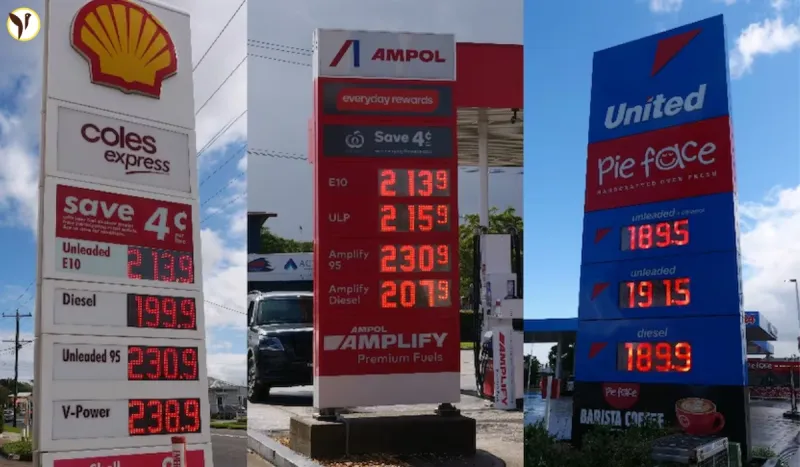
Australian diesel is approaching $3 a litre and petrol has pushed above $2.50, with motorists warned to expect at least two more months at these levels. The rise is being attributed to Middle East conflict disrupting supply Australia imports around 90% of its fuel through Singapore, roughly 80% of which is sourced from the region compounded by the end of the government's temporary fuel excise discount. Canberra has said it is not considering a second cut. For people who travel full-time, the effect is severe: one couple spent $5,260.85 on diesel alone during a five-week, 10,000-kilometre trip, and paid $3.24 a litre in outback South Australia.
What the numbers look like now
Petrol above $2.50 a litre. Diesel approaching $3.
Those are averages, and averages hide the worst of it. In remote areas the figures climb well beyond them. Kate and Gordon Irwin, travelling from Brisbane into central Australia, paid $3.24 a litre in Oodnadatta in South Australia — the most expensive fill of their trip.
For context on how fast this has moved: earlier in the year, at the peak of the initial shock, unleaded topped out at $2.59 and diesel at $3.27. Prices eased, then climbed again.
Drivers have been warned to expect at least two months of averages above $2.50 for petrol and $3 for diesel.
Why it is happening
Two things at once.
Supply. Conflict in the Middle East has disrupted oil supply and pushed prices up globally. Australia is unusually exposed to this. Around 90% of the country's imported fuel comes through Singapore, and roughly 80% of what Singapore refines is sourced from the Middle East. The shipping route runs through the Strait of Hormuz.
That structure means Australian pump prices track Middle Eastern disruption more tightly than many drivers realise.
The excise. The government temporarily halved the fuel excise earlier in the year, cutting retail petrol prices by 26.3 cents a litre and then a further 5.7 cents. That relief has ended.
Notably, the cut did not help diesel drivers nearly as much as petrol drivers. Diesel prices fell by less than 20 cents after the first reduction and continued rising after the second, which is part of why diesel has ended up where it is.
The government has said it is not considering a second cut to the fuel excise.
What this means for you
If you drive to work. You have options most people in this story do not — public transport, carpooling, consolidating trips. Fuel comparison apps are worth the five minutes; the spread between stations in the same suburb is frequently 20 to 30 cents a litre, which on a 60-litre tank is a $12 to $18 difference for the same fuel.
If you drive diesel. You are being hit harder than petrol drivers, and the excise cut did less for you when it existed. There is no relief measure currently aimed at you.
If you are planning a road trip. Budget on current prices rather than last year's, and build in regional premiums. Capital city prices and outback prices are not the same number, and the gap widens the further you get from a refinery or a fuel terminal.
If you live on the road. This is the group with no lever to pull, and the next section is about them.
If you were planning to cancel a trip. Regional tourism operators have asked travellers not to, and there is a reasonable case for shortening rather than cancelling. The section below has the arithmetic.
The people who cannot simply drive less
Seamus Campbell is 70 and has lived on the road for three and a half years, travelling in a 1999 Toyota Troop Carrier he cheerfully describes as dreadfully fuel-inefficient even in good times.
He tracks his costs by the hundred kilometres. That figure used to be around $23. It is now around $50.
"I track my rough average of dollars per 100 kilometres, and it used to be about $23, but now it's about $50," he said. Filling his tank can cost up to $500.
⛽ Diesel prices hit record highs in several key markets in September, - Reuters
— Savchenko Volodymyr (@SavchenkoReview) September 25, 2026
• In the 🇺🇸US, the average price reached a record $6.51 per gallon, up from $3.69 a year ago.
• In the 🇪🇺EU, the weighted average price of diesel was €2.159 per liter on September 14, the… pic.twitter.com/QwhMrkyWKf
His adjustment has been to stay longer in each place. When you live in the vehicle, the only available saving is to move it less.
Kate and Gordon Irwin recently completed a journey of nearly 10,000 kilometres from Brisbane to central Australia and back. They set out just as prices began climbing again.
Across five weeks, they spent $5,260.85 on diesel. It was comfortably their largest single expense. They used apps to find cheaper fuel and still regularly paid over $3 a litre in remote towns.
What a lap of Australia costs now
If you are planning a Big Lap, the arithmetic is worth doing before you commit rather than after.
A vehicle towing a caravan typically uses 15 to 20 litres per 100 kilometres in real-world conditions. At around $2 a litre, a 500-kilometre travel day costs $150 to $200 in fuel alone, before a campsite, before food, before anything.
A full lap of 25,000 to 30,000 kilometres therefore runs to roughly $7,500 to $12,000 in diesel — and that estimate was based on diesel around $1.99. At today's prices, the top of that range is optimistic.
Other costs on top, based on industry and community estimates: groceries for two at $150 to $250 a week, rising to $200 to $350 if you eat out; maintenance contingency at $50 to $100 a week; comprehensive caravan insurance averaging around $630 a year.
The single biggest lever is accommodation, not fuel. Three weeks in caravan parks at $45 a night is $945. The same three weeks with twelve free camps and nine paid nights is $405. That is a $540 saving over three weeks — considerably more than you will claw back by chasing cheap bowsers.
The second biggest lever is distance. Several long-term travellers have said the same thing: plan 2,000-kilometre trips instead of 10,000-kilometre ones, drive fewer kilometres a day, stay longer in each place.
What the industry is seeing
The Caravan Industry Association of Australia's 2026 State of Industry Report found average trip lengths are shortening as travellers adapt, with consumers prioritising value and destinations closer to home. It identified elevated fuel prices as an emerging challenge for the sector.
Demand itself has not collapsed. Australia now has almost 938,000 registered recreational vehicles, up 4% year on year, and Australians took 17.3 million caravan and camping trips last year, spending $12.6 billion.
People are still going. They are going shorter, closer and for less.
How to actually reduce what you spend
Use fuel apps before you fill, not after. The difference between stations in the same town is routinely 20 to 30 cents a litre. On a 100-litre dual-tank fill that is $20 to $30.
Fill in regional centres, not remote towns. The premium in genuinely remote locations can exceed a dollar a litre. Plan fills around larger towns even if it means carrying more.
Carry jerry cans if you are heading somewhere remote. Filling in Coober Pedy rather than Oodnadatta is a meaningful saving on a single tank.
Slow down. Fuel consumption rises sharply above about 90km/h, and more so when towing. Dropping 10km/h on a long haul makes a measurable difference.
Check tyre pressures and reduce weight. Both are free and both matter, particularly when towing.
Shift the savings to accommodation. Free camping intelligently saves more than fuel optimisation will.
What to watch
Whether the government revisits the excise. It has ruled out a second cut, but political pressure in a cost-of-living environment can change positions quickly.
Whether supply stabilises. Prices track the conflict. Any durable de-escalation should feed through to the pump, though historically prices fall more slowly than they rise.
Regional availability, not just price. Earlier in the year hundreds of service stations ran out of diesel over a long weekend. If you are travelling remote, availability matters as much as cost.
The two-month warning. Drivers have been told to expect elevated averages for at least that long. If you have flexibility on when you travel, that is the window to plan around.
Questions readers ask
Why are fuel prices so high in Australia right now?
Two factors. Conflict in the Middle East has disrupted oil supply and pushed global prices up, and Australia is particularly exposed because around 90% of its imported fuel arrives via Singapore, roughly 80% of which is sourced from the Middle East. Separately, the government's temporary fuel excise discount has ended, removing relief that had cut retail petrol prices by 26.3 cents a litre and then a further 5.7 cents.
How much is petrol and diesel in Australia now?
Petrol has risen above $2.50 a litre and diesel is approaching $3, with regional and remote areas considerably higher. Travellers have reported paying $3.24 a litre in Oodnadatta, South Australia. Earlier in the year unleaded peaked at $2.59 and diesel at $3.27.
How long will high fuel prices last?
Motorists have been warned to expect at least two months of average prices exceeding $2.50 a litre for petrol and $3 for diesel. Prices are tied to the ongoing supply situation, and fuel prices historically fall more slowly than they rise.
Will the government cut the fuel excise again?
It has said it is not considering a second cut. The earlier temporary reduction halved the excise, cutting retail petrol prices by 26.3 cents a litre and then a further 5.7 cents, but that measure has ended.
Did the excise cut help diesel drivers?
Less than it helped petrol drivers. Diesel prices fell by under 20 cents following the first reduction and continued rising after the second was delivered.
What does a lap of Australia cost in fuel now?
A vehicle towing a caravan typically uses 15 to 20 litres per 100 kilometres in real-world conditions. At around $2 a litre, a 500-kilometre travel day costs $150 to $200 in fuel alone, and a full lap of 25,000 to 30,000 kilometres works out to roughly $7,500 to $12,000 in diesel. At current prices the upper end of that range is optimistic.
How much are full-time travellers spending?
Kate and Gordon Irwin spent $5,260.85 on diesel during a five-week journey of nearly 10,000 kilometres from Brisbane to central Australia, making it their largest single expense. Seamus Campbell, who has lived on the road for three and a half years, said his cost per 100 kilometres has risen from around $23 to around $50, with a full tank costing up to $500.