A Message From Voyager 1 May Soon Take 24 Hours: Why Is It So Far Away?
NASA's Voyager 1 is expected to reach one light-day from Earth on November 18, 2026. Find out why a message will take 24 hours to reach the spacecraft.
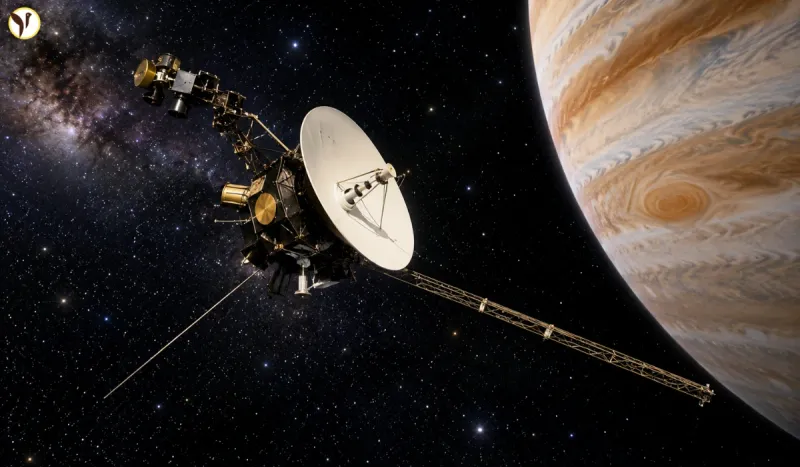

- Published
- Reading time
- 6 minutes
NASA's Voyager 1 spacecraft is approaching a historic milestone that will change how long it takes to communicate with the most distant human-made object in space.
Launched nearly 50 years ago, Voyager 1 has travelled farther from Earth than any other spacecraft. It is now moving through interstellar space and is expected to reach a distance of one light-day from Earth on November 18, 2026.
At that distance, a radio signal sent from Earth will take approximately 24 hours to reach the spacecraft. If Voyager 1 sends a reply immediately, that signal will need another 24 hours to return.
This means a complete message-and-response exchange could take around 48 hours.
According to NASA, Voyager 1 will be approximately 16.09 billion miles (25.9 billion kilometres) from Earth when it reaches this milestone. The achievement will make it the first human-made object to travel one light-day away from our planet.
When Will Voyager 1 Reach One Light-Day From Earth?
NASA expects Voyager 1 to reach the one-light-day distance on November 18, 2026.
The spacecraft will be around 16.09 billion miles, or 25.9 billion kilometres, away from Earth at that time.
A light-day is the distance light travels in 24 hours. Since radio signals travel at the speed of light, communication with Voyager 1 will take approximately one full day in each direction.
This is an important milestone because no human-made spacecraft has travelled this far from Earth before.
However, reaching one light-day will not cause any sudden change to Voyager 1. It is a distance milestone that helps scientists understand just how far the spacecraft has travelled.
Why Will a Message to Voyager 1 Take 24 Hours?
The main reason is the enormous distance between Earth and Voyager 1.
Radio signals used by NASA to communicate with spacecraft travel at the speed of light, which is approximately 300,000 kilometres per second.
Although this is extremely fast, space is so vast that even light needs a long time to cover the distance to Voyager 1.
Once the spacecraft reaches one light-day away:
- A command from Earth will take around 24 hours to reach Voyager 1.
- Voyager 1's reply will take around 24 hours to return.
- A complete round-trip communication exchange will take approximately 48 hours.
This delay means NASA engineers cannot communicate with Voyager 1 in real time. They must send commands and wait for the spacecraft's response before knowing whether everything worked as expected.
It is similar to sending a message to someone who is extremely far away, except that even a simple reply requires an entire day to travel back.
Why Is NASA's Voyager 1 So Far Away?
Voyager 1 was launched by NASA on September 5, 1977, as part of a mission to explore the outer planets of our solar system.
Its original journey included close encounters with Jupiter and Saturn. During these encounters, the spacecraft collected important scientific information and sent images and data back to Earth.
After completing its planetary exploration, Voyager 1 continued travelling away from the Sun.
In August 2012, it crossed the heliopause, the outer boundary of the Sun's protective bubble known as the heliosphere. This made it the first spacecraft to enter interstellar space.
The spacecraft has continued moving through the space between stars ever since.
Its long journey is the reason it is now approaching the one-light-day distance from Earth.
What Is a Light-Day? Understanding Voyager 1's Distance
A light-day is a unit of distance, not a measurement of time spent travelling by a spacecraft.
It describes how far light can travel in 24 hours.
For Voyager 1, one light-day is approximately:
- 16.09 billion miles
- 25.9 billion kilometres
- 24 hours of one-way signal travel time
To understand this distance, consider how quickly light travels in our own solar system.
Sunlight takes around 8 minutes and 20 seconds to reach Earth. A radio signal travelling between Earth and Mars can take anywhere from about 3 to 22 minutes, depending on the planets' positions.
Voyager 1 is much farther away. Its distance is so large that even a signal travelling at the fastest known speed takes an entire day to reach it.
NASA Recently Lost Contact With Voyager 1 for 48 Hours
Voyager 1's long distance is not the only challenge facing NASA engineers.
In October 2026, NASA briefly lost communication with the spacecraft after two scheduled communication attempts failed on October 18 and 19.
The spacecraft's signal returned on October 20, and the mission team was able to continue communicating with it.
NASA said engineers found that one group of thrusters had gone offline and backup thrusters had automatically switched on. The team is investigating what caused the event.
The incident showed how difficult it can be to operate a spacecraft that is billions of kilometres away. Even a short communication problem can require careful analysis because engineers cannot simply visit the spacecraft or repair it directly.
NASA has described the team as relieved to have restored contact with Voyager 1.
NASA Science
Is Voyager 1 Still Working After Nearly 50 Years?
Yes. Despite its age and distance, Voyager 1 is still operating and sending scientific information to Earth.
However, its power supply is gradually decreasing.
The spacecraft uses a radioisotope thermoelectric generator (RTG), which produces electricity from the heat released by radioactive material. Its power output decreases over time.
To keep the mission running, NASA engineers have been switching off selected instruments and other systems to save electricity.
In April 2026, NASA switched off Voyager 1's Low-Energy Charged Particles instrument as part of this power-saving plan.
The mission team is prioritising the systems and instruments that can continue providing useful information about interstellar space.
What Is Voyager 1 Still Studying in Interstellar Space?
Voyager 1 is helping scientists understand the environment beyond the Sun's protective bubble.
Its scientific observations provide information about charged particles, cosmic rays, magnetic fields and plasma waves in interstellar space.
This information is valuable because Voyager 1 and Voyager 2 are the only spacecraft that have directly explored this region beyond the heliosphere.
The mission is giving scientists a rare opportunity to study the space between stars using measurements collected far beyond the planets.
Even though some instruments have been switched off, the spacecraft continues to contribute to our understanding of the universe.
What Happens When Voyager 1 Reaches One Light-Day?
Nothing dramatic will happen to the spacecraft when it crosses the one-light-day mark.
It will continue moving through interstellar space, just as it has been doing for years.
The main change will be the communication delay. NASA will need to wait around 24 hours for a command to reach Voyager 1 and another 24 hours for its response to return.
The milestone is important because it shows the extraordinary distance human technology can travel.
Voyager 1 is carrying a Golden Record, a gold-plated disc containing sounds, music, greetings in different languages and images representing life on Earth. It was designed as a message from humanity to any potential intelligent life that might find the spacecraft in the distant future.
Its journey continues to represent one of the most remarkable achievements in space exploration.
Conclusion
Voyager 1 is approaching a historic milestone as it prepares to reach one light-day from Earth on November 18, 2026.
Once it reaches this distance, a radio signal will take around 24 hours to travel in one direction. This means NASA could wait nearly two days for a complete command-and-response exchange.
Launched in 1977, Voyager 1 has travelled beyond the heliosphere and continues to explore interstellar space despite its ageing power supply.
Its journey is a reminder of how far human technology can reach and how much there is still to discover beyond our solar system.
Questions readers ask
Why will a message from Voyager 1 take 24 hours?
Voyager 1 is travelling so far from Earth that radio signals need approximately 24 hours to cover the distance in one direction.
When will Voyager 1 reach one light-day from Earth?
NASA expects Voyager 1 to reach one light-day from Earth on November 18, 2026.
How far away is Voyager 1 from Earth?
At the one-light-day milestone, Voyager 1 will be approximately 16.09 billion miles or 25.9 billion kilometres from Earth.
How long will NASA wait for a reply from Voyager 1?
A signal will take around 24 hours to reach the spacecraft and another 24 hours for its reply to return. The complete round trip will take approximately 48 hours.
When was Voyager 1 launched?
NASA launched Voyager 1 on September 5, 1977, to explore the outer planets and beyond.