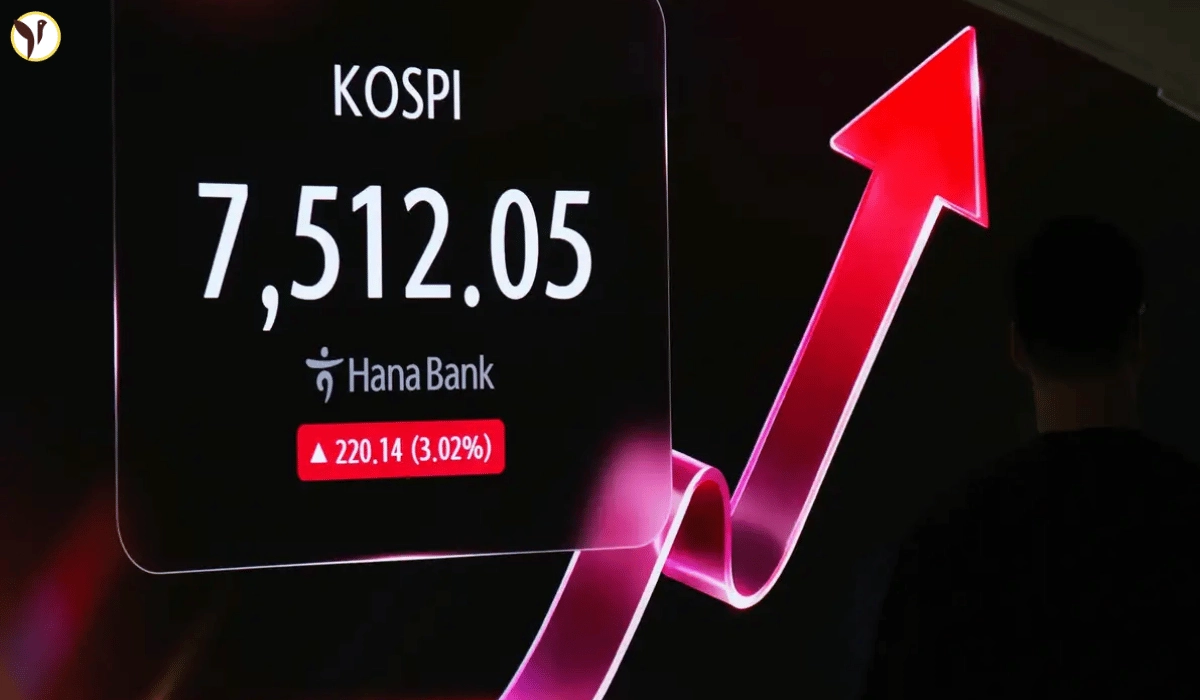


South Korea's benchmark index opened sharply higher on Monday and kept climbing, trading close to 4% above Friday's close as Seoul caught up with a powerful late-week rally in American semiconductor stocks.
The KOSPI opened at 6,910.78, already 3.34% above Friday's close of 6,687.21, and traded between 6,867.91 and 6,963.58 through the morning. Samsung Electronics was up 3.91% by late morning; SK hynix had gained 5.4%.
That is the story most outlets are running. Here is the part that is more useful to know.
441 stocks fell anyway
On a day when the index rose almost 4%, 441 KOSPI-listed stocks still finished lower.
That is what a narrow rally looks like. The index is not measuring the Korean market so much as it is measuring two companies and this is not a figure of speech.
Samsung Electronics and SK hynix now make up around half the KOSPI's total weight. At the end of last year, the two together were around a quarter of it. That shift happened because those two stocks have massively outperformed everything else, and index weighting is a function of market value.
The practical consequence is that "the KOSPI rose 4%" and "Korean stocks rose 4%" have stopped being the same sentence. On days like Monday, a reader looking at the headline number is looking at a memory-chip index wearing a national stock market's name.
Who was actually buying
The flow data points the same way.
By 1:36pm in Seoul, individual investors had sold a net 4.37 trillion won. Foreign investors bought 1.43 trillion won and institutions bought 1.72 trillion won. Turnover ran to 169.2 million shares worth 13.58 trillion won, with the foreign and institutional money concentrated in the biggest chip names.
Retail selling into a 4% rally is unusual. It is the behaviour of investors taking an exit at a level they are relieved to see again, rather than investors who believe the move is the start of something.
To understand why, you need July.
What happened in July
Korea's market had an extraordinarily violent summer, and it explains almost everything about how it is behaving now.
The KOSPI peaked above 9,000 in June. Then it broke.
On 28 July the index fell 10.84% to close at 6,023.66. The following day, in a panic sell-off amplified by leverage, it dropped as low as 5,262.77 and triggered an unprecedented second consecutive circuit breaker. The finance minister convened emergency market-monitoring meetings.
Then on 31 July it did the opposite. The index spiked 17.91% to close at 6,595.45 its sharpest reversal on record. Samsung Electronics and SK hynix each rose close to 30% in a single session, the largest one-day percentage gains either company has ever recorded.
Even after that rebound, July closed down 22%: the steepest monthly loss since the global financial crisis.
And on the day of the record 18% bounce, retail investors sold a record amount of KOSPI shares. They did not stay for the recovery.
The damage that left behind
The regulatory response tells you how serious it got. South Korea capped individual investment in single-stock leveraged exchange-traded funds at 20% of an investor's total portfolio, and financial authorities opened an inquiry into whether foreign high-frequency traders had amplified the swings after program trading nearly doubled following the launch of those leveraged products.
The reputational damage went further. Korean retail investors a cohort with a long-standing reputation for appetite for risk were badly burned. Some publicly compared the market to a casino. Fund managers described a market swinging between panic and euphoria almost overnight.
That is the crowd that sold 4.37 trillion won into Monday's rally.
Where the index actually stands
Monday's gain is real and the chip rally driving it is real. Seoul was following through on Friday's move in New York, where the Philadelphia Semiconductor Index closed 3.37% higher.
But context matters for anyone reading a 4% headline.
Around 6,930, the KOSPI sits roughly a quarter below the peak above 9,000 it reached in June. It has spent the period since mid-August oscillating hard up 2.41% to 6,977.34 on 14 August, capping an 11.5% week that snapped a seven-week losing streak; down 3.12% to 6,696.96 on 24 August when Samsung fell 8.70%; then grinding back through early September.
This is a market that moves 3% in either direction on a regular basis. A 4% up day in Seoul in 2026 is not the anomaly it would be almost anywhere else.
What to watch
Breadth, not the index. The advance-decline count tells you whether a rally is broad or whether two stocks are carrying it. On Monday it told you the latter.
Whether retail comes back. Foreign and institutional money is buying. Domestic individuals are not. A durable recovery in Korean equities probably needs the domestic bid to return, and July's damage may take longer than a few good sessions to repair.
US semiconductor tariffs. Washington has floated a targeted policy tying tariff relief to investment in US chip manufacturing, with rates and exemptions unsettled. Given the concentration in the index, a rule that hits Samsung or SK hynix hits the KOSPI directly.
Concentration itself. Two companies at half the index is a structural fact now, not a passing distortion. It makes the KOSPI a higher-beta bet on global memory demand than most people holding Korea exposure may realise.
This article is news reporting, not investment advice. Market levels quoted are intraday and change continuously.