Will the CEC Impeachment Motion Move Ahead? Om Birla Clarifies the Rules
Lok Sabha Speaker Om Birla says any fresh motion to remove CEC Gyanesh Kumar will follow parliamentary rules. Know the process and latest update.

- Published
- Reading time
- 9 minutes
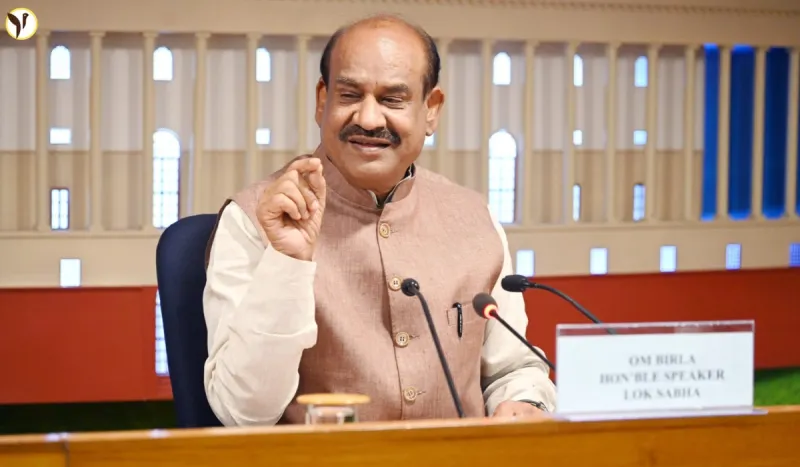
The political dispute over Chief Election Commissioner (CEC) Gyanesh Kumar has intensified, with opposition parties demanding action against him over alleged irregularities in the revision of voter lists. Amid the controversy, Lok Sabha Speaker Om Birla has clarified that any fresh motion seeking the CEC's removal will be examined under established parliamentary rules.
Birla made the statement on October 22, saying that the prescribed procedure would be followed if a fresh notice was formally submitted. His remarks come as opposition parties continue to question the Election Commission's handling of the Special Intensive Revision (SIR) of electoral rolls.
However, Birla has not announced that a fresh motion has been accepted, nor has he said that Gyanesh Kumar will be removed. His statement is about the procedure that would apply if a fresh notice comes before him.
The opposition has already made two attempts to initiate removal proceedings against the CEC. Notices from the first attempt were rejected by both Houses of Parliament, while notices from the second attempt were reported to be pending in the Rajya Sabha.
So, will the motion move ahead? What powers does the Lok Sabha Speaker have, and how difficult is it to remove a Chief Election Commissioner in India? Here is a detailed explanation.
What Did Om Birla Say About the CEC Removal Motion?
Lok Sabha Speaker Om Birla said that any fresh notice seeking the removal of CEC Gyanesh Kumar would be examined according to the rules and procedures laid down for the purpose.
He explained that the Constitution provides a specific process for removing the Chief Election Commissioner, similar to the procedure for removing a Supreme Court judge.
Birla did not announce a decision on a new motion. Instead, he said that the matter would be considered if a fresh notice formally came before him.
His statement is important because the removal of a CEC is not an ordinary parliamentary matter. It involves a high constitutional threshold and a defined process under the Constitution.
The Speaker's clarification also means that political demands alone cannot remove the CEC. The prescribed legal and parliamentary steps must be followed.
Why Is the Opposition Seeking Gyanesh Kumar's Removal?
The opposition's demand is linked to the controversy surrounding the Election Commission's Special Intensive Revision of electoral rolls.
SIR is an exercise to review and update voter lists. It can involve checking voter information, identifying eligible voters and correcting or removing entries according to election laws.
Opposition parties have raised concerns about the handling of the process and alleged irregularities in decisions connected with electoral rolls. They have questioned the Election Commission's conduct and demanded accountability from its leadership.
The dispute intensified after a report by The Indian Express said that Election Commissioners Sukhbir Singh Sandhu and Vivek Joshi had raised objections on multiple occasions over decisions and orders connected with electoral-roll matters.
The report prompted further political questions about the Commission's internal decision-making.
The Election Commission, however, has rejected the suggestion that the reported objections established a split in the institution. It has maintained that official decisions, including SIR-related decisions, were taken through established procedures.
It is important to distinguish between political allegations and established findings. The opposition's demand for removal does not itself prove that the CEC has committed an offence or violated the law.
How Many Times Has the Opposition Tried to Remove the CEC?
The opposition has made two attempts to initiate proceedings against Gyanesh Kumar.
According to reports, notices submitted during the first attempt were rejected by both the Lok Sabha and the Rajya Sabha.
The second attempt followed as the controversy continued. Notices from that attempt were reported to be pending in the Rajya Sabha.
Birla's latest statement concerns the possibility of a fresh notice. He said that if such a notice is submitted, it will be examined under the applicable rules.
This distinction matters because a proposal being discussed by political parties is not the same as a motion being formally accepted by Parliament.
At the time of Birla's remarks, his statement did not confirm that a new motion had been admitted or that removal proceedings had reached a final stage.
Is It Correct to Call It the Impeachment of the CEC?
The word "impeachment" is commonly used in political reporting about the proposed removal of Gyanesh Kumar. However, the Constitution describes the process as the removal of the Chief Election Commissioner.
Under Article 324(5) of the Constitution, the CEC can be removed only in the same manner and on the same grounds as a Supreme Court judge.
This means the process is very different from a normal resignation demand or a simple parliamentary resolution.
Removal requires a specific constitutional procedure, including a special majority in both Houses of Parliament and an order by the President after the required parliamentary process is completed.
The constitutional protection is designed to help preserve the independence of the Election Commission from political pressure.
How Can a Chief Election Commissioner Be Removed?
The process is demanding and involves several steps.
Step 1: A Formal Notice Must Be Submitted
Members of Parliament must initiate the process through a formal notice under the applicable parliamentary procedure.
A political statement or a public demand for resignation does not by itself begin the complete removal process.
Step 2: The Notice Is Examined
The relevant presiding authority examines the notice under the applicable rules.
For a notice submitted in the Lok Sabha, the Speaker has a role in examining it. A notice in the Rajya Sabha is dealt with under that House's procedures.
Birla's latest statement means that any fresh notice before him would be considered according to the rules.
Step 3: The Required Inquiry Process May Follow
The removal procedure for a Supreme Court judge includes a statutory process for examining allegations of proved misbehaviour or incapacity.
The precise steps depend on the applicable parliamentary law and the stage reached by the motion.
The allegations must meet the high constitutional standard required for removal. Political disagreement with the CEC's decisions is not, by itself, equivalent to a finding of proved misbehaviour or incapacity.
Step 4: Both Houses Must Pass the Required Motion
For removal, each House of Parliament must pass the required address with a special majority.
This means the motion must receive:
- A majority of the total membership of that House; and
- A majority of at least two-thirds of the members present and voting.
Both Houses must satisfy the constitutional requirement in the same session.
This is a much higher threshold than a simple majority of members who happen to be present.
Step 5: The President Issues the Removal Order
If the constitutional requirements are met in both Houses, the process proceeds to the President for the required order.
The CEC is not removed merely because a notice is submitted or because a political party demands action.
What Is the Role of Om Birla in This Process?
Om Birla is the Speaker of the Lok Sabha, the lower House of Parliament.
His role is to apply the rules governing parliamentary proceedings when a notice is submitted to the Lok Sabha.
He does not have the power to remove the Chief Election Commissioner on his own.
The constitutional process requires the prescribed parliamentary steps and, ultimately, an order by the President after the required addresses from both Houses.
Birla's statement therefore clarifies the procedural position rather than predicting the outcome.
If a fresh notice is formally submitted to the Lok Sabha, it would be considered under the applicable rules. The outcome would depend on those rules and the subsequent stages of the process.
Can the CEC Be Removed by a Simple Majority?
No.
The removal of the Chief Election Commissioner requires a special constitutional process. A simple majority vote in Parliament is not enough.
The required majority in each House consists of both a majority of the House's total membership and at least two-thirds of members present and voting.
The grounds for removal are also restricted. They must meet the constitutional standard of proved misbehaviour or incapacity.
These safeguards make removal difficult and are intended to protect the independence of the office.
What Happens If a Motion Is Rejected?
If a notice is rejected at the preliminary stage, it does not proceed through the same route as an admitted motion.
If a motion proceeds to later stages but fails to obtain the required support, the constitutional requirements for removal are not met.
The exact consequences depend on the stage of the proceedings and the applicable rules.
In the present case, the earlier rejection of notices and the reported status of the second attempt should not be confused with a final parliamentary decision to remove Gyanesh Kumar.
Birla's statement about a possible fresh notice also does not mean that the notice has already been accepted.
Could the SIR Controversy Affect the Removal Motion?
The SIR controversy is the central political issue behind the opposition's demand.
Opposition parties argue that concerns about electoral-roll revision deserve serious examination and that the CEC should be held accountable for the Commission's functioning.
The Election Commission has defended its decision-making process and disputed the interpretation that internal objections prove that official decisions were divided.
For the removal motion to succeed, however, the constitutional requirements must be met. The allegations must be dealt with through the applicable process, and Parliament must satisfy the special-majority requirement.
The political controversy could continue even if the removal motion does not proceed. Opposition parties can continue raising questions about the voter-list revision process through parliamentary debates, public campaigns and other lawful channels.
What Happens Next?
The next step depends on whether a fresh notice is formally submitted and how the relevant parliamentary authority deals with it.
Possible developments include:
A Fresh Notice
Opposition parties could submit another notice seeking the CEC's removal. If it comes before the Lok Sabha Speaker, Birla has said it will be examined according to the rules.
Further Parliamentary Scrutiny
The relevant House would have to follow its applicable procedure. A notice would not automatically result in removal.
Continued Political Protests
Opposition parties may continue to protest over SIR and demand accountability from the Election Commission.
Further Clarification From the Election Commission
The ECI could face further questions about its internal decision-making and electoral-roll revision procedures.
A Long Constitutional Process
Even if proceedings advance, the special-majority requirement in both Houses makes removal a difficult process. The final outcome cannot be predicted from Birla's statement alone.
Will the CEC Removal Motion Move Ahead?
The future of a fresh removal motion against CEC Gyanesh Kumar remains uncertain.
Om Birla has clarified that any fresh notice submitted to him will be examined according to parliamentary rules. His statement does not mean that a new motion has already been accepted or that the CEC is about to be removed.
The dispute is linked to opposition allegations concerning the Special Intensive Revision of electoral rolls. The Election Commission has defended its decisions, while opposition parties continue to demand accountability.
The next important development will be whether a fresh notice is formally submitted and how the relevant parliamentary authority responds.
For now, the key point is that removing the Chief Election Commissioner requires a demanding constitutional process, not just a political demand or a simple parliamentary vote.
Questions readers ask
What did Om Birla say about the CEC removal motion?
Om Birla said that any fresh notice seeking the removal of CEC Gyanesh Kumar would be examined according to established parliamentary rules and procedures.
Has the fresh motion against Gyanesh Kumar been accepted?
Birla's statement did not confirm that a fresh motion had been formally submitted or accepted. He said the procedure would be followed if a notice came before him.
Why does the opposition want to remove CEC Gyanesh Kumar?
Opposition parties have raised allegations about the Election Commission's handling of the Special Intensive Revision of electoral rolls and are demanding accountability. These are political allegations, not a final finding of wrongdoing.
How many attempts have been made to remove the CEC?
The opposition has made two attempts to initiate removal proceedings. Notices from the first attempt were rejected by both Houses, while notices from the second attempt were reported to be pending in the Rajya Sabha.
Can Om Birla remove the CEC?
No. The Lok Sabha Speaker cannot remove the CEC on his own. The Constitution requires a special process involving both Houses of Parliament and an order by the President.