Cyclone Arnab Crossed a Coast Where 12 Million People Live: Six Hours Later What Was It?
Cyclone Arnab hit Andhra Pradesh as a very severe cyclonic storm with gusts to 150kmph. Three deaths reported by midday, 57,000 in relief camps, eight districts braced for heavy rain.

- Published
- Reading time
- 6 minutes
Cyclone Arnab made landfall on the Andhra Pradesh coast on Wednesday as a very severe cyclonic storm, with sustained winds of 125 to 135kmph and gusts to 150kmph. Three deaths and 31 damaged houses were reported by midday. The storm is weakening inland, but eight districts remain braced for heavy rain and a storm surge of up to 1.5 metres.
Hold those two facts next to each other, because together they are the story: a very severe cyclonic storm crossed a coastline where more than 12 million people live, and by early afternoon the recorded toll was three.
The landfall
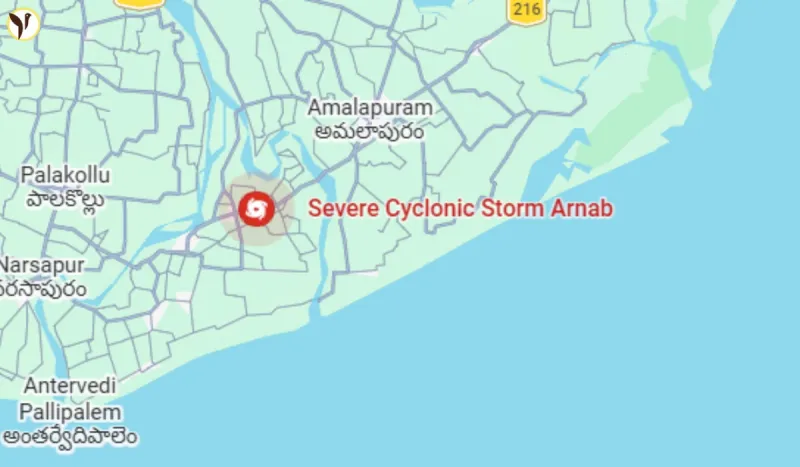
Arnab crossed the Andhra Pradesh and Yanam coast between Bapatla and Visakhapatnam, close to south of Yanam, early on Wednesday. The India Meteorological Department classified it as a very severe cyclonic storm the third-highest category on India's scale with sustained winds of 125 to 135kmph and gusts reaching 150kmph.
It has since weakened to a severe cyclonic storm as it moved inland, and officials expect it to degrade further into a cyclonic storm and then a deep depression by evening.
NDRF Inspector General Narendra Singh Bundela, briefing reporters in New Delhi, said: "Andhra Pradesh has been the most affected." He cited uprooted trees, 31 damaged houses and three deaths. Odisha, which had also prepared for a direct hit, reported no serious impact on preliminary figures. The north of Andhra Pradesh and the southern part of Odisha took the strongest winds and rain.
The downgrade is not the all-clear
This is the part that catches people, and it is worth being plain about.
A falling category describes the storm's structure, not the amount of water still falling out of it. Anakapalli has already recorded 10 to 15cm of rain, with roads damaged at Mungapaka and elsewhere. Heavy rain has also hit Visakhapatnam, Kakinada and Konaseema, and more is expected across Polavaram, Kakinada, Konaseema, East Godavari, West Godavari, Eluru, NTR and Krishna.
The IMD forecast a storm surge of up to 1.5 metres above tide level, enough to submerge low-lying coastal areas of Andhra Pradesh. Its warnings also covered total destruction of thatched houses, localised flooding, uprooted power and communication poles, and widespread damage to crops.
So the wind threat is receding and the water threat is not. For anyone in those districts, the next day matters more than the last one did.
The number that deserves more attention than it will get
More than 12 million people live along the storm's expected path, according to the Andhra Pradesh State Disaster Management Authority. That is a population larger than most countries, in the way of a storm with 150kmph gusts.
What was done about it, before landfall:
- More than 2,000 cyclone shelters opened across 20 districts
- Emergency alerts pushed to mobile phones across the warning area
- Over 30,000 fishing boats secured
- Nearly 1,100 medical teams deployed
- 39 NDRF teams positioned across Andhra Pradesh, Odisha, Chhattisgarh, Jharkhand, Puducherry, Telangana and the Andaman and Nicobar Islands, with four more sent to Andhra Pradesh overnight
- Around 57,000 people moved into relief camps in Andhra Pradesh, and 38 evacuated from Yanam overnight
Evacuation totals differ between accounts because they measure different things at different hours. Al Jazeera reported at least 180,000 people evacuated across Andhra Pradesh and Odisha by Tuesday. Euronews put it at about 50,000 moved to safety in Andhra Pradesh and 48,000 in Odisha. PTI's figure of 57,000 refers specifically to people in relief camps in Andhra Pradesh. All three can be true at once.
Chief Minister Nara Chandrababu Naidu framed the operation simply: "Protecting every life is our foremost priority." Prakhar Jain, who heads the state disaster management authority, set out the alert and shelter arrangements.
Three deaths is three families, and the figure may yet rise as access to cut-off areas is restored damage assessments routinely revise early numbers upward. But the gap between what a storm of this size could have done to 12 million people and what has so far been recorded is not luck. It is shelters, phone alerts, boats pulled up, buses that came, and people who left when they were told to. India's cyclone response has been rebuilt over three decades, largely out of the lessons of catastrophes that killed in the tens of thousands, and Wednesday is what the rebuilt version looks like in operation.
It reached much further than Andhra Pradesh
A Bay of Bengal system does not stay over the Bay of Bengal, and Arnab's indirect effects have run a long way inland and across the water.
Nepal told tourists to stay out of high-altitude areas from Thursday to Saturday, warning of torrential rain, snowstorms and avalanche risk, and suspended trekking permits for three days. In peak season the country issues around 750 permits a day, so the economic cost of that decision is not small — and it comes while Nepal is still recovering from August's glacial mountain collapse, which killed more than 1,400 people and left at least 5,000 missing.
Sri Lanka closed schools, and its Department of Meteorology warned of flash floods and landslides.
If you are in the affected districts
Police guidance is specific and short.
Do not go outdoors unless it is absolutely necessary. Avoid any area that is flooded standing water hides road damage, open drains and live cables, and moving water takes a vehicle's traction long before it looks dangerous. Anyone in difficulty or needing rescue should call 112, or the Kakinada Police Control Room in that district. Rescue operations were under way through the morning.
Two additions that apply to the next 48 hours rather than the last 12. Treat every downed power line as live, including ones lying in water or tangled in a fallen tree, and report them rather than approaching. And expect the outage to outlast the storm distribution networks damaged by falling trees take days to repair, not hours.
Your district administration and the IMD's own bulletins will be more current than any news report, including this one.
What happens next
Arnab is forecast to continue weakening through the evening into a deep depression, which moves the hazard inland with the rain rather than ending it. Rain is expected to continue across Andhra Pradesh, Odisha and adjoining areas.
The figures in this article were accurate at midday and will not stay that way. The death toll, the damage count and the crop assessment are all early, and all three typically move in one direction once roads reopen.
Figures were accurate as of approximately 1:45pm IST on 28 October 2026 and are changing. For current warnings, road conditions and relief information, consult the India Meteorological Department and your district administration.
Questions readers ask
Where and when did Cyclone Arnab make landfall?
It crossed the Andhra Pradesh and Yanam coast early on Wednesday 28 October 2026, between Bapatla and Visakhapatnam, close to south of Yanam. The India Meteorological Department classified it as a very severe cyclonic storm — the third-highest category on India's scale — with sustained winds of 125 to 135kmph and gusts to 150kmph.
How many people have died, and how much damage has been reported?
Three deaths and 31 damaged houses had been reported as of about 1:45pm IST, according to the NDRF. Andhra Pradesh was worst affected and Odisha reported no serious impact on preliminary figures. These are early numbers and typically rise as access to cut-off areas is restored.
Is Cyclone Arnab still dangerous now that it has weakened?
The flooding risk is still rising even as the wind threat recedes. A falling category describes the storm's structure, not how much rain it is still producing. Anakapalli has recorded 10 to 15cm of rain, the IMD forecast a storm surge of up to 1.5 metres above tide level, and heavy rain is expected across Polavaram, Kakinada, Konaseema, East Godavari, West Godavari, Eluru, NTR and Krishna.
How many people were evacuated, and what preparations were made?
Around 57,000 people were moved into relief camps in Andhra Pradesh, with other accounts citing roughly 50,000 moved in Andhra Pradesh and 48,000 in Odisha, and up to 180,000 evacuated across both states by Tuesday — the figures measure different things at different times. Preparations included more than 2,000 cyclone shelters across 20 districts, emergency alerts to mobile phones, over 30,000 fishing boats secured, nearly 1,100 medical teams and 39 NDRF teams across seven states and territories.
What should people in the affected districts do?
Police have advised people not to go outdoors unless absolutely necessary and to avoid flood-inundated areas, since standing water conceals road damage and live cables. Anyone needing help should call 112 or, in that district, the Kakinada Police Control Room. Treat every downed power line as live, including in water, and expect power outages to last days rather than hours where trees have brought down distribution lines.