Can Anyone Remove Modi as PM? Rajnath Singh Has a Direct Reply to Congress
Rajnath Singh says only the people of India can remove PM Narendra Modi from office. Read his direct reply to Congress and understand the constitutional process.

- Published
- Reading time
- 6 minutes
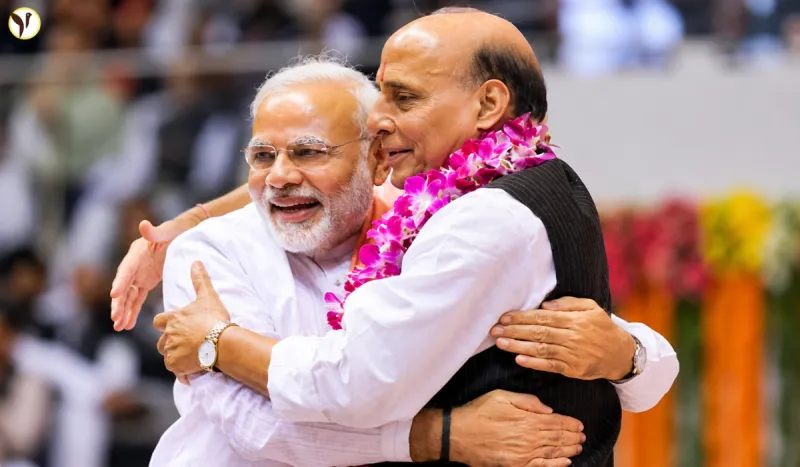
Defence Minister Rajnath Singh has launched a strong political attack on the Congress, making it clear that Prime Minister Narendra Modi's position depends on the support of the people of India. Addressing a public rally in Jammu on November 28, Singh said that Modi became Prime Minister because of the people's mandate and only the people have the authority to take that responsibility away.
His remarks came during the BJP's 'Loktantra Bachao, Arajakta Hatao' (Save Democracy, End Anarchy) foot march and rally. The event was organised amid growing political tensions between the BJP and Congress over allegations of vote theft and demands for political change.
Singh directly challenged the opposition and declared, "Modi Ji is not going anywhere." He also said that if anyone needed to leave politics, it was the Congress rather than the Prime Minister.
The statement has added another chapter to the ongoing political confrontation between the ruling BJP and the opposition.
What Exactly Did Rajnath Singh Say About Removing PM Modi?
During his speech in Jammu, Rajnath Singh strongly defended Prime Minister Narendra Modi's political position.
He said that Modi did not become Prime Minister through family inheritance or political connections. According to Singh, the people of India gave him the responsibility through their votes.
He further explained that the same voters have the authority to decide when Modi should leave office.
Singh said that the Prime Minister has often described himself as a 'faqir' and has maintained that he would leave office whenever the people wanted him to.
Taking a direct dig at Congress leaders, Singh questioned their attempts to remove a Prime Minister who, according to him, has received the people's support.
He then delivered his strongest message to the opposition by saying that Modi was not going anywhere and that Congress should prepare for its own political exit.
Why Did Rajnath Singh Target Congress?
The latest remarks are connected to the continuing political dispute between the BJP and Congress over electoral irregularities and allegations of vote theft.
Congress leaders, including Rahul Gandhi, have repeatedly raised concerns about the electoral process and questioned the functioning of democratic institutions.
The opposition has demanded greater accountability and transparency in elections.
However, the BJP has rejected these allegations and accused Congress of questioning democratic institutions because of its electoral defeats.
Rajnath Singh argued that political parties should accept the people's mandate instead of trying to create uncertainty around the government.
He also accused Congress and its allies of attempting to destabilise the country and create an atmosphere of political unrest.
The BJP's message is that any change in government must happen through constitutional and democratic methods.
Can Anyone Legally Remove Narendra Modi as Prime Minister?
One of the biggest questions following Rajnath Singh's statement is whether any political party or leader can remove a sitting Prime Minister.
The answer is that India's Constitution provides a democratic process through which a Prime Minister can lose office.
Under Article 75(3) of the Indian Constitution, the Council of Ministers is collectively responsible to the Lok Sabha.
This means that the government must maintain the confidence of the elected members of the Lok Sabha to remain in power.
Here are the main ways a Prime Minister can leave office:
Losing a No-Confidence Motion
If the opposition brings a no-confidence motion and it is passed by the Lok Sabha, the government loses the House's confidence. The Prime Minister and the Council of Ministers are then expected to resign.
Losing Majority Support
A Prime Minister may also leave office if the ruling party or coalition loses its majority support in the Lok Sabha and cannot demonstrate confidence in the House.
General Elections
Voters can change the government during general elections by choosing a different party or coalition. If the existing Prime Minister's party or alliance cannot form the government, a new Prime Minister can be appointed.
Voluntary Resignation
A Prime Minister can also resign voluntarily. The President then follows the constitutional process to appoint a new Prime Minister who can command the confidence of the Lok Sabha.
Therefore, no opposition leader can simply remove the Prime Minister through a political statement or protest. A change of government must follow the constitutional process.
What Is Article 75(3) of the Indian Constitution?
Article 75(3) is one of the most important constitutional provisions related to the functioning of the Union Government.
It states that the Council of Ministers shall be collectively responsible to the House of the People, which is the Lok Sabha.
In simple words, the Prime Minister and the entire Council of Ministers must enjoy the confidence of the Lok Sabha.
This provision ensures that the government remains accountable to elected representatives.
If the government loses the confidence of the Lok Sabha, it cannot continue in office in the normal parliamentary manner.
This is why elections and parliamentary majority play such an important role in deciding who becomes India's Prime Minister.
What Is BJP's 'Loktantra Bachao, Arajakta Hatao' Campaign?
Rajnath Singh's statement came during the BJP's 'Loktantra Bachao, Arajakta Hatao' campaign.
The campaign focuses on defending democratic institutions and countering what the BJP describes as attempts by the opposition to create political instability.
During the Jammu programme, Singh led a foot march and addressed a public gathering at Parade Ground.
He accused Congress and its allies of trying to remove Modi from power without accepting the democratic mandate.
He also argued that political parties should focus on winning elections rather than creating unrest.
The BJP has been using this campaign to respond to Congress's allegations about electoral irregularities and its criticism of the government.
Rajnath Singh vs Congress: What Is the Main Political Difference?
The latest exchange highlights two different political positions.
Congress has been raising questions about electoral transparency, democratic institutions and the government's accountability.
The BJP, on the other hand, argues that the opposition should respect election results and use democratic methods to challenge the government.
Rajnath Singh's latest statement reflects the BJP's position that political power comes from the voters and can only be changed through constitutional procedures.
The Congress has continued to question the electoral process, while the BJP has rejected its allegations.
This political disagreement is expected to remain an important issue in national politics.
What Does Rajnath Singh's Statement Mean for Indian Politics?
Rajnath Singh's statement is politically significant because it directly addresses the opposition's criticism of the Modi government.
By saying that only the people can remove Modi, Singh has placed the debate around electoral mandates and democratic accountability.
The statement also shows that the BJP is preparing to defend the Prime Minister's leadership against opposition attacks.
For Congress, the challenge will be to continue raising its concerns about electoral transparency while presenting its arguments through parliamentary and constitutional channels.
The larger political question is how both sides will take this debate forward in the coming months.
Conclusion
Rajnath Singh's latest statement has intensified the political debate between the BJP and Congress over Prime Minister Narendra Modi's leadership.
In Jammu, the Defence Minister made it clear that Modi's political authority comes from the people and that only voters can decide when he should leave office.
However, the Constitution also provides a parliamentary mechanism through which a government can lose power if it loses the confidence of the Lok Sabha.
The central message is that India follows a parliamentary democracy where political power depends on constitutional procedures, elections and the support of elected representatives.
Questions readers ask
Can anyone remove Narendra Modi as Prime Minister?
No individual political leader can simply remove the Prime Minister. A change of government must happen through constitutional procedures, such as losing the Lok Sabha's confidence or a change following elections.
What did Rajnath Singh say about removing PM Modi?
Rajnath Singh said that only the people of India have the authority to take away the responsibility of being Prime Minister from Narendra Modi. He also declared that Modi was not going anywhere.
Why did Rajnath Singh target Congress?
Singh criticised Congress over its allegations of vote theft and what he described as attempts to destabilise the government.
Where did Rajnath Singh make his latest statement?
He made the statement during a BJP public rally at Parade Ground in Jammu on November 28, 2026.
What is Article 75(3) of the Indian Constitution?
Article 75(3) states that the Council of Ministers is collectively responsible to the Lok Sabha. This means the government must maintain the confidence of the elected House.