The Sixth National Day for Truth and Reconciliation: What It Marks, and How Canada Is Observing It
September 30 is Canada's National Day for Truth and Reconciliation, also known as Orange Shirt Day. What it marks, why the shirt is orange, and how it is observed.
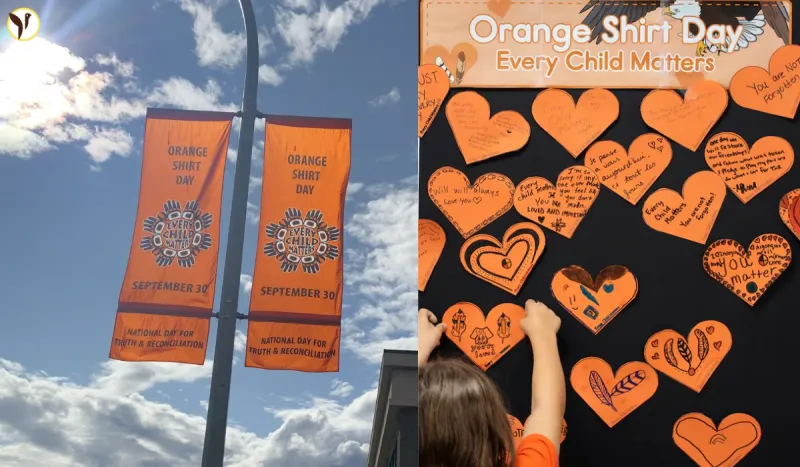

- Published
- Reading time
- 6 minutes
September 30 is Canada's National Day for Truth and Reconciliation, also known as Orange Shirt Day, marked for the sixth time this year. It honours the children who never returned home from residential schools, along with survivors, their families and their communities, and became a federal statutory holiday in 2021 in response to Call to Action 80 of the Truth and Reconciliation Commission. The Commission estimated that more than 6,000 children died while at residential schools, a figure it said was likely far higher because record-keeping was incomplete.
Why the shirt is orange
The orange shirt belongs to a specific child, and the story is worth telling properly rather than summarising.
Phyllis Webstad was six years old when she was sent to residential school. Her grandmother had bought her a new orange shirt for her first day. When she arrived, it was taken from her, and she never saw it again.
She told that story publicly decades later, and Orange Shirt Day grew from it. The shirts now carry the words Every Child Matters, and the date of 30 September was chosen because it falls in the time of year when Indigenous children were historically taken from their homes and communities to be sent to the schools.
One shirt, taken from one child, standing for a system that took more than 150,000 of them.
What the day commemorates
Residential schools operated in Canada for more than a century, funded by the federal government and largely run by churches. Indigenous children were removed from their families and their communities, often by force, and punished for speaking their own languages or practising their own cultures.
The Truth and Reconciliation Commission estimated that more than 6,000 children died while at these schools, and said plainly that the true figure is almost certainly higher because not all schools kept complete records. In Prince Albert alone, at least 18 children died at the local residential school between 1898 and 1949.
In 2021, ground-penetrating radar at the former Kamloops Indian Residential School identified what Tk'emlúps te Secwépemc described as 215 potential burial sites. Searches at other former school sites followed. It was that year the national day was established.
Five years on, Pam Glode-Desrochers, executive director of the Mi'kmaw Native Friendship Centre in Halifax, said racism remains a present reality rather than a historical one. "It's bringing people together more often than not, and it gives us a time to reflect and actually get to know each other," she said of the day itself.
The Calls to Action, and Call 80
The Truth and Reconciliation Commission issued 94 Calls to Action in 2015, covering child welfare, education, language and culture, health, justice, and the relationship between Canada and Indigenous peoples.
Call to Action 80 asked the federal government, in collaboration with Indigenous peoples, to establish a statutory holiday to honour survivors, their families and communities, and to ensure that public commemoration of the history and legacy of residential schools remains a vital component of the reconciliation process.
That is the call this day answers. It is the reason it exists, and it is one of relatively few Calls to Action to have been implemented.
The Beyond 94 project tracks progress on all 94. It is worth reading on 30 September specifically, because the distance between the number issued and the number completed is the clearest available measure of where reconciliation actually stands, as distinct from how it is discussed.
How it is being marked in Halifax
Halifax City Hall is lit orange from 28 September to 2 October.
A flag-raising ceremony was held at noon on 29 September at Grand Parade, in front of City Hall, with residents invited to attend. Mayor Andy Fillmore was scheduled to read a proclamation marking the commemoration at 1.30pm.
The Mi'kmaw Native Friendship Centre on Brunswick Street is holding events including interactive cultural demonstrations and refreshments. The centre is partnering with East Coast Lifestyle on orange T-shirt sales, with proceeds going towards its new location under construction on Gottingen Street.
The Maritime Museum of the Atlantic is open with free admission, 9.30am to 4.30pm. The Canadian Museum of Immigration at Pier 21 is holding film screenings from 10.30am to 4.30pm, included with museum admission, and admission is free for Indigenous Peoples. The Museum of Natural History is open 9.30am to 4.30pm.
Mi'kmaq Treaty Day follows on 1 October, with the Friendship Centre hosting a salmon dinner.
Events are being held across the country, including powwows, walks and commemorations in communities from Waterloo Region to British Columbia.
What is open and closed
In Nova Scotia, the day is not a paid general holiday or a retail closing day, so businesses may choose to open.
Closed: provincial government offices, public schools and regulated child care. No classes at any HRCE school, with classes resuming 1 October. BMO and RBC branches are closed, and RBC has said domestic payment systems do not run that day.
Open: Halifax Shopping Centre, Mic Mac Mall and Sunnyside Mall, 9.30am to 5pm, with individual stores setting their own hours.
Arrangements differ between provinces and territories, since the federal statutory holiday applies directly to federally regulated workplaces and federal employees, while provinces decide their own observance. Check locally rather than assuming.
Ways to observe
The most commonly suggested actions are small and specific.
Wear an orange shirt, preferably one designed by an Indigenous artist or sold by an Indigenous organisation, so that the money goes where the day is directed.
Read the 94 Calls to Action, and look at the Beyond 94 tracker to see which have been acted on.
Use the resources at the National Centre for Truth and Reconciliation, which hosts educational material, survivor statements and Truth and Reconciliation Week programming, including virtual sessions available in English, French and ASL.
Attend a local commemoration if one is being held near you, and listen rather than participate in ways that centre yourself.
Learn the history of the land you are on, and of the schools that operated closest to where you live. For most Canadians there was one nearer than they expect.
A day of mourning
It is worth stating plainly, because coverage sometimes blurs it.
This is not a celebration. It is a commemoration of children who were taken from their families and did not come home, and of survivors who did come home and have carried it since. Many of those survivors are alive today, and 30 September is a difficult day for them and for their families.
For anyone marking it for the first time, the appropriate posture is attention rather than participation, and the most useful thing most people can do is learn something they did not know before.
Support is available 24 hours a day. Survivors and family members can reach the National Indian Residential School Crisis Line on 1-866-925-4419. The Hope for Wellness Help Line offers 24/7 support to all Indigenous people on 1-855-242-3310, or by online chat at hopeforwellness.ca, available in English and French and on request in Cree, Ojibway and Inuktitut. Individuals affected by the issue of Missing and Murdered Indigenous Women and Girls can contact the MMIWG Crisis Line on 1-844-413-6649.
Questions readers ask
What is the National Day for Truth and Reconciliation?
A federal statutory holiday observed annually on 30 September, honouring the children who never returned home from residential schools along with survivors, their families and their communities. It was established in 2021 in response to Call to Action 80 of the Truth and Reconciliation Commission's Final Report, and 2026 marks the sixth observance.
Why is it also called Orange Shirt Day?
After Phyllis Webstad, who was six years old when she was sent to residential school wearing a new orange shirt bought by her grandmother. The shirt was taken from her on arrival and she never saw it again. Orange Shirt Day grew from her telling that story publicly, and shirts worn on the day commonly carry the words Every Child Matters.
Why is it held on 30 September?
The date was chosen because it falls in the time of year when Indigenous children were historically taken from their homes and communities to be sent to residential schools.
How many children died at residential schools?
The Truth and Reconciliation Commission estimated more than 6,000, while noting the true figure is likely considerably higher because not all schools kept complete records. In 2021, ground-penetrating radar at the former Kamloops Indian Residential School identified what Tk'emlúps te Secwépemc described as 215 potential burial sites.
What is Call to Action 80?
One of the 94 Calls to Action issued by the Truth and Reconciliation Commission in 2015. It asked the federal government, in collaboration with Indigenous peoples, to establish a statutory holiday honouring survivors, their families and communities, and to ensure that public commemoration of the history and legacy of residential schools remains a vital component of the reconciliation process.
What is closed on the National Day for Truth and Reconciliation?
Arrangements vary by province. In Nova Scotia the day is not a paid general holiday or retail closing day, so businesses may choose to open. Provincial government offices, public schools and regulated child care are closed, with no classes at any HRCE school. BMO and RBC branches are closed, and RBC has said domestic payment systems do not run that day. Major Halifax malls remain open from 9.30am to 5pm, with individual stores setting their own hours.