AI Startup SiMa.ai Raises $150 Million to Build Smarter Robots
Physical AI chipmaker SiMa.ai raises $150 Mn Series C at $1.45 Bn valuation, becoming a unicorn as it takes on Nvidia in edge AI hardware

- Published
- Reading time
- 3 minutes
SiMa.ai, a San Jose-based chipmaker building silicon for robots, cars and drones, has closed a $150 million Series C round at a $1.45 billion valuation officially making it a unicorn.
The round was oversubscribed and co-led by Fidelity Management & Research and Amplify Partners, pulling in a notably mixed investor base that includes both venture funds and public-market names like J.P. Morgan and AllianceBernstein.
That valuation is up 51% in a single year, and this Series C alone ranks in the top 5% of enterprise software Series C rounds raised in the US this year a rare signal of investor appetite for AI hardware that isn't built by Nvidia.
The Details
- Round size$150 Mn, Series C (oversubscribed)
- Valuation$1.45 Bn (up 51% YoY)
- Total funding to date$500 Mn
- Co-leadsFidelity Management & Research, Amplify Partners
- Existing investors participatingAlter Venture Partners, Dell Technologies Capital, Maverick Capital, ND Capital, Point72, StepStone Group
- New investorsAllianceBernstein, Baron Capital, J.P. Morgan, State of Michigan
- Implied math$150 Mn on a $1.45 Bn valuation works out to roughly a 10% stake sold in this round a relatively small slice for that much capital, suggesting strong demand let SiMa.ai hold pricing power
Betting Against Nvidia's GPUs
SiMa.ai builds both the chip and the software that runs AI directly inside physical devices robots, self-driving cars, drones instead of relying on the cloud.
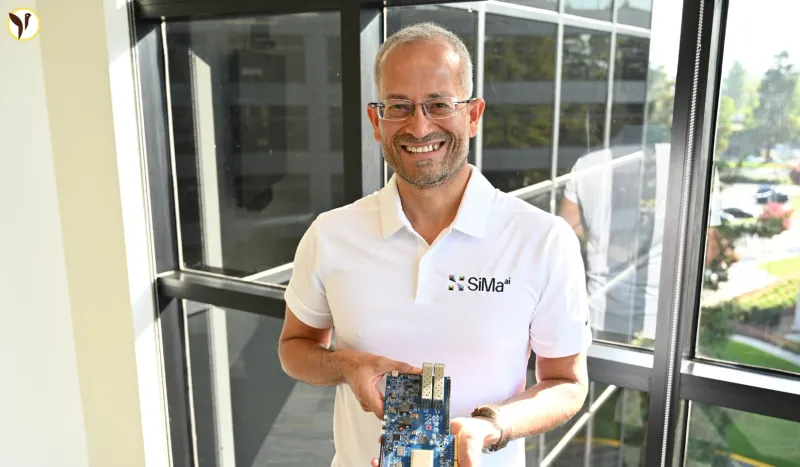
Its core product, Modalix, is a system-on-chip that runs vision and AI models on a single piece of silicon, paired with a no-code software suite called Palette.
The pitch is straightforward: today, most of this "edge AI" workload still runs on expensive, power-hungry Nvidia GPUs. SiMa.ai is positioning itself as the cheaper, leaner alternative cutting deployment time from months down to days.
Founder and CEO Krishna Rangasayee spent 18 years at Xilinx, eventually running a business that hit $2.5 billion in revenue at 70% gross margin, before serving as COO at AI chipmaker Groq. He founded SiMa.ai in 2018.
Revenue Quadrupled, But the Chip Still Trails
SiMa.ai says its revenue quadrupled year-over-year between 2024 and 2025, with more growth expected in 2026 the kind of number that typically justifies a sharp valuation jump like this one.
But there's a technical gap worth noting. SiMa.ai's next-generation chip is targeting 1,000 dense TOPS of compute, expected only in the first half of 2028.
That's still half the performance of Nvidia's current Jetson AGX Thor, which already delivers 2,000 FP4 TOPS today meaning SiMa.ai is chasing a moving target, not catching up to a static one.
The new capital will go toward expanding Palette Neat, billed as the industry's first agentic development environment for physical AI, alongside this next chip generation.
What the Numbers Don't Tell You
A 51% valuation jump backed by quadrupled revenue looks clean on paper, but the chip roadmap tells a more cautious story.
SiMa.ai's flagship next-gen product the one this funding is largely paying for won't ship until 2028, and even then trails Nvidia's current-generation hardware on raw compute.
That's not necessarily a red flag; physical AI chips compete on power efficiency and deployment speed, not just raw TOPS. But it does mean investors are betting on a roadmap, not a shipped product that already beats the incumbent.
The Bottom Line
SiMa.ai now has the balance sheet to play a long game against Nvidia the real test is whether "faster to deploy" is enough to win customers before 2028 arrives.
Questions readers ask
How much did SiMa.ai raise and at what valuation?
SiMa.ai raised $150 million in Series C funding at a $1.45 billion valuation, making it a unicorn.
Who led SiMa.ai's Series C round?
The round was co-led by Fidelity Management & Research and Amplify Partners, with new investors including J.P. Morgan and AllianceBernstein.
What does SiMa.ai actually build?
SiMa.ai builds AI chips and software for physical devices robots, self-driving cars and drones — as an alternative to power-hungry Nvidia GPUs.
How much total funding has SiMa.ai raised?
This round brings SiMa.ai's total funding to $500 million since its founding in 2018.
What will SiMa.ai use the new funding for?
The capital will expand its Palette Neat software platform and fund a next-generation chip targeting 1,000 TOPS of compute, expected in H1 2028.