

Mika Hakkinen has warned Formula 1 teams that using team orders now carries a price most of them have not priced in: their own fans.
The two-time world champion was speaking to Sky Sports after the Dutch Grand Prix, where Ferrari declined to move Charles Leclerc aside for Lewis Hamilton and Mercedes did the opposite with its own pair.
"The fans are going to crucify this team," Hakkinen said of any team that publicly designates one driver as its number two.
He is not guessing. He is one of the few people alive who has been on both sides of this.
What actually happened at Zandvoort
The Dutch Grand Prix produced two teams facing the same question within minutes of each other, and answering it in opposite ways.
Mercedes told George Russell to let Kimi Antonelli through, citing an unnecessary fight given the difference in tyre life between the two cars. Russell later said the inversion had always been the plan.
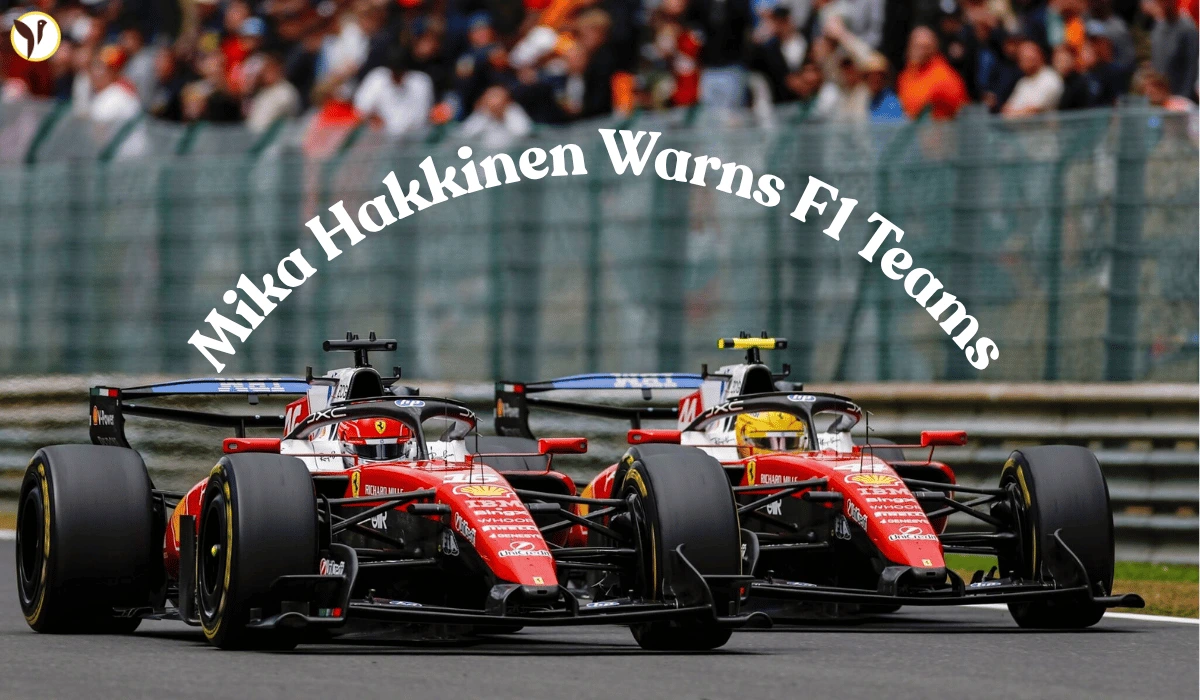
Ferrari did not act on Hamilton's request to be let past Leclerc. Hamilton made his displeasure known on team radio, telling the pit wall it was a fine way to waste time, and said afterwards that the team had not been unlucky that its indecisiveness had cost him a podium. Leclerc also questioned Ferrari's strategy afterwards, and the team publicly defended its calls.
Neither driver finished on the podium. Lando Norris won from Antonelli and Russell, with Hamilton fourth and Leclerc fifth, in a race red-flagged on the opening lap after Max Verstappen crashed heavily at his final home grand prix.
Hakkinen's actual argument: drivers are flying blind
Hakkinen's first point was sympathetic to Hamilton rather than critical of him.
He said the reason drivers react the way Hamilton did is that they are working with a fraction of the information available to everyone else. Watching from the paddock rather than the cockpit, he has been struck by how much more he can see the timing screens, the tyre models, the calculations the pit wall is running in real time.
A driver stuck behind a teammate sees a car he believes he is faster than. The team sees the whole race. Hakkinen described Hamilton's reaction as entirely normal, and suggested it was not purely emotional either there was a straightforward points argument underneath it.
His warning was aimed at what happens next. If a team decides to formalise a hierarchy, he asked, what exactly does it tell the fans of the driver being demoted?
Why the numbers make this urgent
This is not a theoretical problem for either team, which is what gives Hakkinen's warning its edge.
After 12 of 23 rounds, Antonelli leads the drivers' championship with 242 points. Russell and Hamilton are tied on 183, with Russell ahead on countback thanks to two wins to Hamilton's one. Norris is fourth on 159, Leclerc fifth on 155.
Read that again and the shape of the problem appears. Mercedes has its two drivers separated by 59 points, with the leading one chasing the record as the youngest world champion in the sport's history. Ferrari has two drivers 28 points apart, both mathematically alive, and sits 87 points behind Mercedes in the constructors' standings.
Mercedes gave an order at Zandvoort and it cost the team nothing measurable across the sprint and the race, Antonelli and Russell scored the same points and cancelled each other out. Russell even reclaimed second in the standings.
Ferrari declined to give one, and its lead driver publicly said it cost him a podium.
So the two teams have now run the experiment in both directions on the same afternoon, and neither result settles the argument.
Hakkinen has been on both sides of this
Here is the context almost nobody reporting these quotes will give you.
At the 1998 Australian Grand Prix, McLaren's David Coulthard moved aside on the final lap to let Hakkinen win, honouring a pre-race agreement between the two drivers that whoever led into the first corner would take the race. Hakkinen had lost the lead through a pit-stop mix-up. He won. McLaren was heavily criticised, and the sport spent weeks arguing about whether the result was legitimate.
Four years later came the moment that changed the rules. At the 2002 Austrian Grand Prix, Ferrari ordered Rubens Barrichello to let Michael Schumacher past within sight of the finish line. The crowd booed. The podium ceremony descended into farce, Ferrari was fined for it, and the FIA banned team orders outright from 2003.
The ban lasted until 2011. It was scrapped after Ferrari's coded instruction to Felipe Massa at Hockenheim in 2010 the infamous line about Fernando being faster demonstrated that teams would issue orders regardless, just less honestly. Team orders have been legal ever since.
Hakkinen was the man who benefited in 1998 and the man racing against the Ferrari that got booed in 2002. When he says fans will crucify a team, he is describing something he watched happen from about ten metres away.
What has changed since his era
Hakkinen was clear that the sport he raced in operated differently.
He noted that Ferrari began applying team orders from the opening race of the season during the Schumacher years, on the straightforward logic that a team wanting the drivers' title backs one driver completely. McLaren, he said, ran a different philosophy: both drivers got equal opportunity until the points made it mathematically clear, at which point the trailing driver supported the leader. He described that as a common-sense arrangement rather than a favour.
What has changed, in his view, is not the maths but the audience. Individual drivers now command enormous personal followings, and those followings do not accept a team decision on team logic. A Hamilton fan does not care about Ferrari's constructors' position. And teams now want both championships, which means they need maximum performance from both cars in every race an aim that is difficult to square with telling one of them to move over.
Monza is the immediate test
The Italian Grand Prix runs at Monza this weekend. Ferrari races there in front of the tifosi, 87 points adrift in the constructors' championship, with a seven-time world champion and a home-team favourite who are 28 points apart and both out of realistic title contention unless something dramatic happens.
If Ferrari faces the Zandvoort question again on Sunday, it will face it in the one place where the crowd's reaction is guaranteed to be loud.
That is presumably why Hakkinen chose this week to say it.