Priyanka Gandhi Targets CEC: Why Is She Demanding His Prosecution?
Priyanka Gandhi has demanded criminal prosecution of CEC Gyanesh Kumar over the SIR voter-roll controversy. Know what she alleged, what the ECI said and why the row matters.

- Published
- Reading time
- 7 minutes
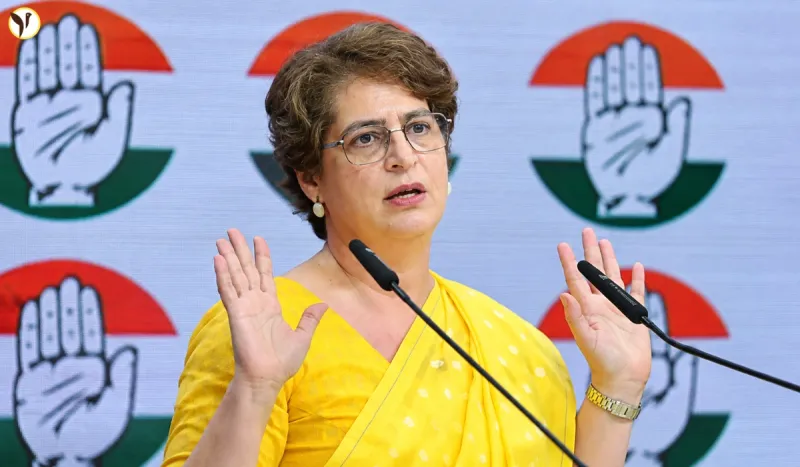
Congress MP Priyanka Gandhi Vadra has stepped up the political attack on Chief Election Commissioner Gyanesh Kumar, demanding that he face criminal prosecution if allegations of illegal changes to electoral rolls are established.
Speaking to reporters in Wayanad, Kerala, on September 24, 2026, Priyanka Gandhi linked her demand to the ongoing controversy over the Election Commission's Special Intensive Revision (SIR) of electoral rolls.
She alleged that deleting voters' names and allowing an unfair electoral process would amount to a serious offence against democracy and the Constitution. She also argued that constitutional protection should not prevent legal action if an illegal act is established.
The Election Commission, however, has rejected the suggestion that the reported internal objections amounted to a split in the Commission. The ECI said its decisions, including those related to SIR, were taken unanimously and according to law and established procedures.
So, what exactly triggered Priyanka Gandhi's demand? And what is the controversy surrounding CEC Gyanesh Kumar?
What Did Priyanka Gandhi Say About CEC Gyanesh Kumar?
Priyanka Gandhi said that if the allegations about electoral-roll manipulation are established, the people responsible should face criminal proceedings.
She argued that interference with the democratic election process is a serious matter and used the term "treason" while describing her political position.
According to her, if the Chief Election Commissioner knowingly allowed illegal changes to voter rolls, he should not receive special protection from prosecution.
Her comments came amid a growing political controversy over reports of objections raised inside the Election Commission regarding certain decisions connected with electoral rolls and SIR.
It is important to note that Priyanka Gandhi's statements are allegations and a political demand, not a finding by a court that Gyanesh Kumar committed a criminal offence.
Why Is Priyanka Gandhi Targeting The CEC?
The immediate trigger is an investigative report published by The Indian Express on September 23.
The report said that Election Commissioners Sukhbir Singh Sandhu and Vivek Joshi had formally raised objections at least 14 times over a period of 10 months regarding decisions and orders connected with electoral-roll matters.
The reported issues included:
- Voter registration
- Deletion and restoration of names
- Changes involving Form 6
- Electoral-roll database issues
- SIR-related decisions
- Administrative and technical procedures
The report has become the centre of a fresh political dispute over the functioning of the Election Commission.
What Is The SIR Controversy?
SIR stands for Special Intensive Revision of electoral rolls.
It is an exercise aimed at reviewing and updating voter lists.
The process can involve checking voter information, identifying eligible voters and removing names that do not meet the legal requirements for inclusion.
The current controversy is about how some of these processes and decisions were carried out.
Opposition parties have raised concerns about voter deletions and the transparency of the process.
The Election Commission has maintained that its actions were conducted under the constitutional and legal framework governing elections.
What Did The Indian Express Report Say?
The Indian Express investigation reported that two Election Commissioners had raised objections on multiple occasions.
According to the report, their concerns covered several aspects of electoral-roll management and decisions taken in the Commission's name.
The report has been politically significant because it raised questions about whether all three Election Commissioners were always in agreement during the decision-making process.
Opposition leaders have used the report to question the functioning of the Election Commission.
However, the ECI has disputed the interpretation that these internal notes show a division within the Commission.
What Is The Election Commission's Response?
The Election Commission has rejected the suggestion that the reported correspondence represents a breakdown or split within the Commission.
According to the ECI, written notes, observations, technical suggestions and internal checks are part of normal functioning within a multi-member constitutional body.
The Commission said that its official decisions and orders were issued through established procedures.
Most importantly, the ECI said that all decisions, including SIR-related decisions, were unanimous and had the approval of all three commissioners.
This creates two clearly different positions:
|
|
|
|
|
|
|
|
|
|
|
|
|
|
|
|
|
|
|
|
|
|
|
|
What Does The BJP Say?
The BJP has defended the Election Commission.
BJP national spokesperson Sambit Patra argued that discussions and exchanges among Election Commissioners are part of the democratic and institutional decision-making process.
He cited the ECI's position that the final decisions on SIR were unanimous.
According to Patra, the existence of internal correspondence should not automatically be interpreted as evidence of disagreement over the final decisions.
Therefore, the political debate currently has two competing interpretations:
Congress and other opposition parties: The reported objections raise serious questions about the electoral process and require investigation.
ECI and BJP: Internal notes and discussions are normal, while the final decisions were taken unanimously and according to established procedures.
What Is The Special Intensive Revision Of Electoral Rolls?
The Special Intensive Revision is an electoral-roll verification exercise.
Its purpose is to ensure that voter lists contain eligible voters and that electoral records are updated.
In a large country such as India, voter lists regularly require updating because of:
- Deaths
- Changes of residence
- Duplicate entries
- New eligible voters
- Changes in voter details
- Other legal reasons for deletion or correction
The controversy is not about whether electoral rolls can legally be revised.
The main political dispute is over how the revision is being conducted, how names are being removed or retained, and whether voters have adequate opportunities to challenge decisions.
Why Are Election Commissioners' Objections Important?
The reported objections have attracted attention because the Election Commission is a multi-member constitutional institution.
If commissioners disagree internally, that does not automatically mean a decision is illegal.
In many institutions, officials record concerns during the decision-making process.
The important questions are:
- What exactly did the commissioners object to?
- Were their concerns addressed?
- What was the final decision?
- Was the final decision legally authorised?
- Were affected voters given the required opportunity to respond?
- Did the process follow the Election Commission's own rules?
These questions are more important for establishing facts than simply focusing on political statements.
What Could Happen Next?
The political pressure on the Election Commission is likely to continue.
Congress has indicated that the SIR issue will remain a major political matter.
The Congress Working Committee is scheduled to meet on September 29, with the SIR controversy expected to be on the agenda.
The next important developments could include:
More political demands
Opposition parties may continue demanding an investigation or action against the CEC.
Election Commission clarification
The ECI may provide additional information about the reported internal objections and SIR procedures.
Judicial scrutiny
Courts could examine specific legal questions concerning the electoral-roll revision process.
4. Parliamentary action
Political parties may raise the issue through Parliament and other constitutional mechanisms.
Further electoral-roll data
More official information about deletions, additions and appeals could help clarify the scale and nature of the controversy.
What We Know And What Is Still An Allegation
Because this is a politically sensitive story, it is important to separate confirmed developments from claims.
Confirmed developments
- Priyanka Gandhi has demanded criminal prosecution of CEC Gyanesh Kumar.
- She made the remarks in Wayanad on September 24.
- The demand followed reports about objections raised by two Election Commissioners.
- The Election Commission has defended its decision-making process.
- The ECI says SIR-related decisions were unanimous.
Political allegations
- Opposition leaders allege that electoral-roll changes could undermine the fairness of elections.
- Priyanka Gandhi has alleged that large-scale voter deletions amount to a criminal attack on democracy.
- Opposition leaders have questioned the CEC's role in the process.
These allegations have not been established as criminal findings against Gyanesh Kumar.
Why This Matters For Voters
Voter lists are one of the basic foundations of an election.
If a legitimate voter is removed from the electoral roll, that person can face difficulty in exercising the right to vote.
At the same time, election authorities are legally required to maintain accurate electoral rolls and remove entries that do not meet eligibility requirements.
This creates the central challenge:
The process must protect genuine voters while keeping electoral rolls accurate.
That is why transparency, notice procedures, appeals and verification are important whenever a large-scale revision is carried out.
Questions readers ask
Why is Priyanka Gandhi demanding prosecution of CEC Gyanesh Kumar?
Priyanka Gandhi is demanding criminal prosecution because she alleges that electoral-roll manipulation and deletion of voters, if carried out illegally, would constitute a serious offence against democracy and the Constitution.
What did Priyanka Gandhi say about Gyanesh Kumar?
She said that if the CEC committed or knowingly allowed illegal acts involving electoral rolls, he should face criminal prosecution. She also described interference with the democratic election process as an extremely serious matter.
What is the SIR controversy?
SIR, or Special Intensive Revision, is an exercise to revise and update electoral rolls. The current controversy concerns allegations about the process used for voter deletion and other electoral-roll decisions.
Did the Election Commission admit that there was disagreement among commissioners?
The ECI has rejected the suggestion that the reported objections represent a split in the Commission. It has said that internal notes, observations and technical suggestions are part of normal institutional functioning and that final decisions, including SIR decisions, were unanimous.
Has Gyanesh Kumar been found guilty of any crime?
No. Priyanka Gandhi's demand is a political call for prosecution based on her allegations. It should not be presented as a court finding that Gyanesh Kumar committed a crime.