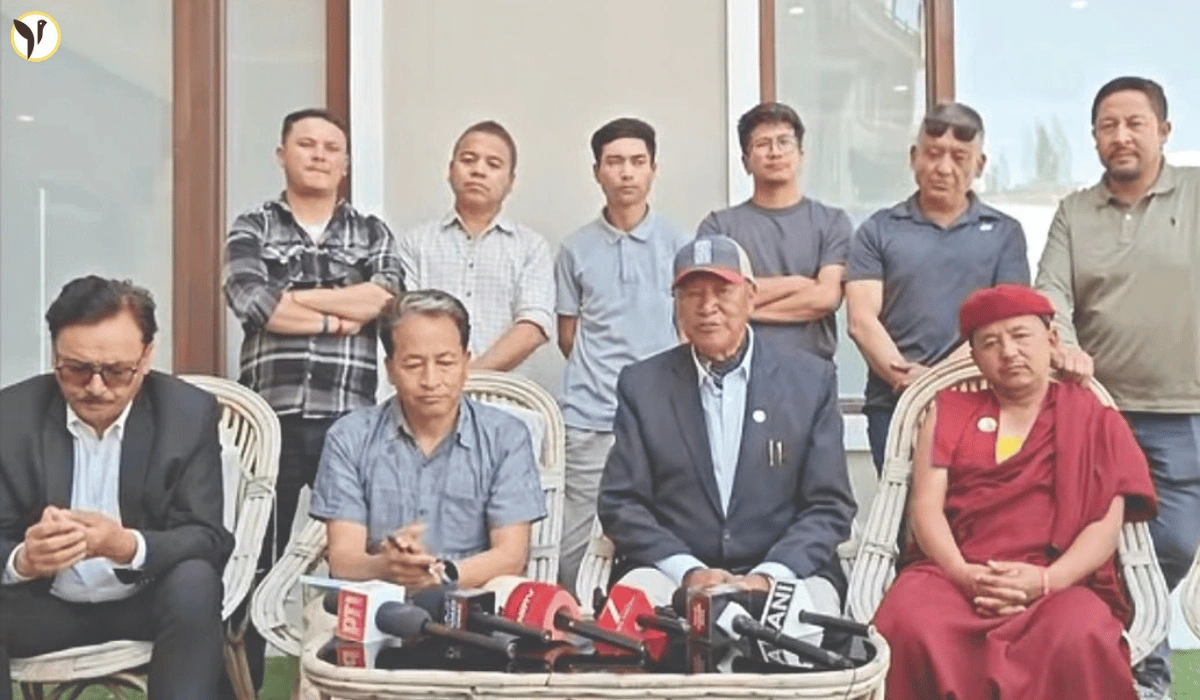


The Leh Apex Body has warned that it will step up its agitation if talks with the Ministry of Home Affairs on Tuesday produce nothing concrete.
A sub-committee of Ladakhi representatives is due to meet MHA officials in New Delhi on September 9. Ladakh's Chief Secretary Ashish Kundra has confirmed the meeting, describing it as part of an ongoing dialogue aimed at strengthening democratic processes in the Union Territory.
LAB chairman Chering Dorje Lakruk said the group welcomes the meeting, but will judge it entirely on what comes out of it.
What the Apex Body is asking for
Here is where this round differs from the ones before it, and it is worth reading closely.
The demands reported ahead of Tuesday's meeting are: legislation for Ladakh at the Union Territory level, safeguards under Article 371, withdrawal of the cases filed after the September 24 violence, compensation for the victims, and publication of the judicial inquiry commission's report.
Separately, LAB and the Kargil Democratic Alliance have placed a fresh set of demands before the Centre that includes an elected legislative assembly, substantial control over finances and law and order, a separate Public Service Commission for Ladakh, and constitutional safeguards.
Compare that with where the two groups stood in March.
The demands have shifted, and almost nobody is saying so
For nearly five years, the movement was defined by two words: statehood, and Sixth Schedule.
In March 2026, days after Sonam Wangchuk was released from detention, he suggested publicly that both sides needed to be flexible. I'm sure talks are a give-and-take process; both sides have to be flexible,
he said at a press conference in Delhi.
Leaders of the Apex Body and the KDA responded the following day by stating that statehood and Sixth Schedule inclusion remained non-negotiable and that they would not backtrack.
Six months later, the package reported ahead of the September 9 talks looks different. A legislature within the Union Territory framework is not statehood. Safeguards under Article 371 are not the Sixth Schedule. Both are real constitutional protections, but they are the kind of arrangement a government can concede without redrawing the map — which is precisely what makes them negotiable.
Two important caveats. Neither LAB nor KDA has publicly announced that it is dropping statehood or the Sixth Schedule, and the fuller list of fresh demands still includes constitutional safeguards without specifying the route. And different outlets are describing the demands differently, which may reflect genuine ambiguity in what the sub-committee will actually table on Tuesday rather than a settled change of position.
But the language has moved. Whether that reflects a tactical narrowing for one round of talks or a durable change in the movement's position is the single most important thing to watch on September 9.
Why the Kargil-to-Leh march was called off
A 15-day padyatra was scheduled to set out from Kargil on September 10 and walk to Leh, highlighting the region's long-pending demands.
It has been postponed. Wangchuk said the decision was collective and taken because of the timing — the march would have begun the day after the talks, which the organisers judged unhelpful. He has said the march could be revived if the September 9 meeting fails to produce a satisfactory outcome, and indicated it would then be organised in the days before September 24.
That date matters. September 24 is the first anniversary of the violence in Leh, and LAB is observing this month as what it calls Martyrs' Month, in memory of those killed, injured and jailed last year.
So the sequence is deliberate. Talks on the 9th. If they fail, a march timed to arrive at the anniversary. The Apex Body has structured its calendar so that the cost of a fruitless meeting is immediate and visible.
The unfinished business from September 24
Four people were killed and nearly a hundred injured when protests in Leh turned violent on September 24 last year, during a shutdown called to push the Centre on statehood and the Sixth Schedule. More than fifty people were detained.
The MHA notified a judicial inquiry under former Supreme Court judge Justice B.S. Chauhan. The commission began proceedings in late October 2025 and publicly sought evidence from residents, with a submission deadline of November 28.
Its report has still not been published. Lakruk has expressed disappointment at the delay, and publication is now itself one of the Apex Body's demands.
He also raised the pending cases. According to Lakruk, only 25 of the 80 cases registered in connection with the violence have been withdrawn. He welcomed reports that cases relating to the July 20 Jantar Mantar incident in Delhi were being withdrawn, but accused the Centre of applying a double standard to Ladakh.
The lives of the people of Ladakh are not so cheap,
he said, calling for compensation for the families of those killed and for the wounded.
Sonam Wangchuk was detained under the National Security Act after the September 2025 violence and held for close to six months. The MHA revoked the detention on March 14, 2026, saying it wanted to foster an environment of peace, stability, and mutual trust for meaningful dialogue. His wife, Gitanjali Angmo, had challenged the detention in the Supreme Court, and the release came shortly before the court was expected to rule.
The Centre's position
The government's account of the dialogue is not the same as the Apex Body's.
The MHA has said its doors have always been open, and that the High-Powered Committee mechanism has already produced results: increased reservations for Ladakh's Scheduled Tribes, women's reservation in the Ladakh Autonomous Hill Development Councils, protection for local languages, and recruitment underway for 1,800 government posts. Earlier rounds of talks are described as having settled the job reservation and domicile questions.
The disagreement is not really about whether anything has been delivered. It is about whether administrative concessions can substitute for constitutional ones. The Centre points to what has been granted. Ladakh's leadership points to what has not a legislature, protected land and job rights with constitutional backing, and a second parliamentary seat.
How the region got here
Ladakh was separated from Jammu and Kashmir and made a Union Territory in August 2019, following the abrogation of Article 370. Unlike Jammu and Kashmir, Ladakh was given no legislature.
The initial reaction in Leh was largely favourable. That changed as it became clear what the absence of an elected assembly meant in practice: decisions taken in Delhi, land and employment protections resting on administrative orders rather than constitutional guarantee, and a single MP for a region larger than most Indian states.
LAB and KDA, one based in Buddhist-majority Leh, the other in Muslim-majority Kargil, and historically not natural allies began campaigning jointly. Talks with the Centre have run since 2021, with the High-Powered Committee formed in 2023 under Minister of State for Home Affairs Nityanand Rai. The four-point agenda has been statehood, Sixth Schedule inclusion, a dedicated Public Service Commission, and two parliamentary seats instead of one.
That the two bodies have held together across a religious and regional divide for five years is, in itself, the reason the Centre has kept coming back to the table.
What to watch on September 9
Whether the sub-committee tables Article 371 or the Sixth Schedule. This is the substantive question. One is a negotiation; the other is the original demand.
Whether the Chauhan commission report gets a date. Publication is a low-cost concession for the Centre and a high-value one for the Apex Body. If nothing else moves, this might.
The remaining 55 cases. Withdrawal is within the government's gift and would address the double-standard charge directly.
Whether the padyatra is revived. If the march is back on within days of the meeting, the talks failed, whatever either side says publicly.