Vijay Gets 'Aroharа', But Did You Know Jayalalithaa Also Had Her Own Ragas?
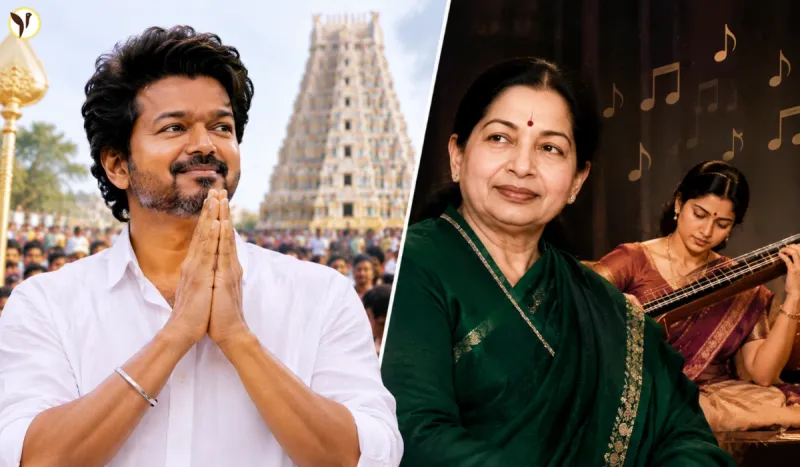
Vijay’s ‘Arohara’ controversy has brought back memories of musical tributes to Jayalalithaa, including a special Carnatic raga composed in her honour.

- Published
- Reading time
- 4 minutes
A recent controversy involving Tamil Nadu Chief Minister C. Joseph Vijay and the devotional chant ‘Arohara’ has brought an interesting chapter from the state’s political and cultural history back into the spotlight.
The debate began after the sacred chant, traditionally associated with Lord Murugan, was used to praise Vijay during the Soorasamharam celebrations at the Tiruchendur Murugan Temple on November 15, 2026. The incident triggered criticism from opposition parties and religious groups, raising questions about the use of devotional expressions for political praise.
However, this is not the first time Tamil Nadu has witnessed unusual musical tributes to a political leader. Former Chief Minister J. Jayalalithaa also received special recognition from celebrated musicians, including the creation of a Carnatic raga in her honour.
What Is the ‘Arohara’ Controversy Involving Vijay?
The controversy erupted during the Soorasamharam festival at the famous Tiruchendur Murugan Temple in Tamil Nadu.
During the event, folk and playback singer Velmurugan led devotees in chanting ‘Vetrivel Muruganukku Arohara’, a traditional invocation praising Lord Murugan. However, the singer later extended the chant to Chief Minister Vijay and Hindu Religious and Charitable Endowments Minister S. Ramesh.
The video of the incident circulated widely on social media and attracted criticism.
For devotees, ‘Arohara’ is a sacred religious expression associated particularly with Lord Murugan. It is commonly heard during important festivals such as Kanda Sashti and Thaipusam.
The use of this devotional chant to praise political leaders was criticised by several political parties and religious organisations.
Why Did the Incident Become a Political Issue?
The incident quickly developed into a political controversy, with both the DMK and BJP questioning the use of a religious chant for political glorification.
The DMK criticised the episode and demanded an apology from Vijay. BJP leaders also expressed concern, arguing that a sacred invocation should not be used to praise politicians.
The controversy also raised questions about the role of performers participating in official religious programmes.
Tamil Nadu Minister S. Ramesh clarified that neither Vijay nor the state government encouraged personal glorification. He said the performers had been asked to explain the incident and had expressed regret.
Singer Velmurugan also reportedly apologised and assured that such an incident would not happen again.
Jayalalithaa Also Had a Special Raga Named After Her
While Vijay’s ‘Arohara’ controversy has attracted attention, the historical connection with Jayalalithaa is equally interesting.
In July 2005, legendary Carnatic musician M. Balamuralikrishna composed a special raga named ‘Jaya Jaya Lalithe’ in honour of Jayalalithaa, who was serving as Tamil Nadu Chief Minister at the time.
The raga was introduced during a function in Chennai organised to celebrate Balamuralikrishna’s 75th birthday.
The occasion became a memorable moment in Tamil Nadu’s political and cultural history because a new musical composition had been created in the Chief Minister’s honour.
Jayalalithaa reportedly expressed her admiration for the musician and said she would like to become his student in another life and learn Carnatic music from him.
The episode showed how political personalities in Tamil Nadu have sometimes received recognition through music and cultural performances.
Why Is ‘Jaya Jaya Lalithe’ Still Being Discussed?
The name of the raga has returned to public discussion because of the current debate surrounding Vijay.
The two incidents, however, are different.
In Jayalalithaa’s case, a celebrated Carnatic musician composed a new raga in her honour. In Vijay’s case, a traditional devotional chant associated with Lord Murugan was extended to praise the Chief Minister during a religious festival.
The distinction is important. A musical composition created as a tribute to a political leader is not the same as using a religious invocation during a temple ritual.
The comparison highlights how music, religion and politics have often intersected in Tamil Nadu.
Music, Politics and Tamil Nadu’s Political Culture
Tamil Nadu has a long history of political leaders receiving public admiration through songs, cultural programmes, posters and other forms of popular expression.
Music has played an important role in the state's political culture. Several leaders have built strong connections with the public through cinema, speeches and cultural symbolism.
Jayalalithaa’s special raga and the recent Arohara controversy involving Vijay are two different examples of how music can become connected with political personalities.
However, the latest controversy also shows that religious expressions carry a different level of sensitivity. Devotional chants are deeply connected with faith and tradition, which is why their use outside religious worship can lead to public debate.
What Happens Next in the Vijay Arohara Controversy?
The controversy has placed the spotlight on the management of official religious events and the responsibility of performers.
The government has said that it does not support personal glorification of political leaders at religious programmes. The performers have also expressed regret.
The larger question is whether religious events should remain focused entirely on devotion or whether political references should be allowed during such occasions.
For now, the comparison with Jayalalithaa’s musical tribute has added another dimension to the debate, reminding people of Tamil Nadu’s unusual history of music and political admiration.
Conclusion: Vijay’s Arohara controversy has reopened an interesting discussion about music, religion and politics in Tamil Nadu. While Jayalalithaa received a special Carnatic raga named ‘Jaya Jaya Lalithe’ in 2005, Vijay’s case involves a traditional devotional chant used during a temple festival. The two incidents are different, but both show how musical and cultural expressions can become part of political conversations.
Questions readers ask
Why is Vijay’s Arohara controversy in the news?
The controversy began after singer Velmurugan used the devotional chant ‘Arohara’ to praise Tamil Nadu Chief Minister Vijay during the Soorasamharam celebrations at Tiruchendur Temple.
What does Arohara mean?
Arohara, also written as Arogara, is a devotional chant associated with Lord Murugan. Devotees use it during religious festivals to express their devotion.
Who composed the Jaya Jaya Lalithe raga?
Renowned Carnatic musician M. Balamuralikrishna composed the special raga ‘Jaya Jaya Lalithe’ in honour of Jayalalithaa in 2005.
When was the Jaya Jaya Lalithe raga introduced?
It was introduced in July 2005 during a function in Chennai celebrating Balamuralikrishna’s 75th birthday.
How did Jayalalithaa respond to the musical tribute?
Jayalalithaa expressed admiration for the musician and said she would like to learn Carnatic music from him in another life.