1.07 Crore Names Missing From Karnataka's Draft Voter Roll: Hearings Close on 12 October
Karnataka's draft electoral roll left out 1.07 crore voters, about 19% of the electorate. The figures, the deadlines, the Election Commission's response and the Supreme Court position.

- Published
- Reading time
- 8 minutes
Karnataka's draft electoral roll left out 1.07 crore voters, cutting the state's electorate from 5.5 crore to 4.4 crore about 19%. Claims and objections closed on 23 September, hearings end on 12 October, and the final roll publishes on 27 October. The Election Commission says no name has yet been deleted through a Form 7 objection.
Those four dates matter more than anything said at a microphone this week, because they are the only part of this that still moves.
The timetable, and what is left of it
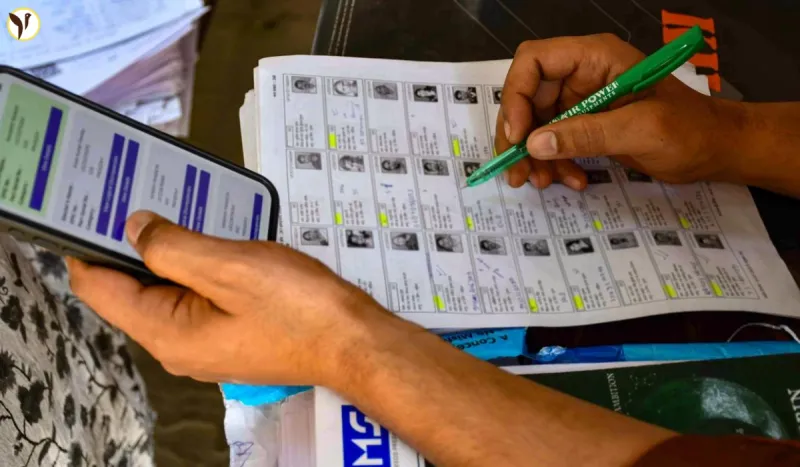
The Special Intensive Revision in Karnataka began on 30 June. Booth Level Officers went door to door with partly pre-filled enumeration forms, and every voter was required to take part — unlike the annual revision, where most people are left alone.
The draft roll came out on 24 August. The window to file a claim, correction or objection ran from that date to 23 September. That window is shut.
What remains is the processing. Hearings on claims and objections close on 12 October. Electoral Registration Officers must dispose of them by 22 October. The revised roll publishes on 27 October. Anyone whose application is still pending has a few days in which a hearing can still be held, and after the final roll their route is a later revision cycle rather than this one.
Where 1.07 crore names went
The recorded reasons, as reported from the Commission's figures: 65.4 lakh marked permanently shifted, 15.1 lakh absent, 12.3 lakh deceased, 7 lakh duplicate entries, and more than 3.8 lakh in an "other" category that has not been explained. The heaviest deletions were in Bengaluru's urban districts.
Karnataka is not an outlier within this phase. Haryana's draft roll shed over 16% and Andhra Pradesh's 10.8%. The first phase, in Bihar between June and September 2025, removed roughly 47 lakh electors, around 5 to 6% of that electorate. Karnataka sits in the third phase, covering 16 states and three union territories.
What the Election Commission says is actually happening
This is where the official account and the protest account diverge sharply, and both deserve to be set out plainly.
Karnataka's Chief Electoral Officer, V Anbukkumar, said this week that no name has been deleted from the rolls through the Form 7 process so far. The Commission's position is that filing a Form 7 objection against someone cannot by itself remove them: notice must go to both the voter and the objector, both can respond, and an Electoral Registration Officer must issue a reasoned order, which can then be challenged before higher election authorities.
The volumes support the narrower reading. Of 22,05,171 applications in the claims and objections process as of 4 October, only 91,278 were Form 7 deletion objections. The largest categories were 11,98,484 Form 8 corrections and 9,10,732 Form 6 inclusion requests people getting on the roll, not being taken off it. Form 7 filings did rise, from 58,220 up to 23 September to 91,278 by 4 October. Individual objectors are capped at ten Form 7 applications; booth level agents of registered parties can file up to fifty.
On the notices that worried people most: 43,82,313 had been generated by 5 October, of which 43,55,818 were delivered. They cover categories such as "No Mapping" and "Anomalies" meaning the enumeration form could not be matched rather than that a decision had been taken. Hearings had been completed on 36,89,063 applications with 6,66,755 pending.
Anbukkumar also said Electoral Registration Officers must follow the prescribed procedure on every application, and that action will be taken where false information is used to seek a deletion. Police cases have been registered in Bengaluru: an FIR in Jayanagar concerns deletion applications covering 5,698 voters, and a Malleswaram case concerns 778. Both are under investigation and nothing has been established.
UP Chief Electoral Officer has now admitted, in his own statement on X, what the Election Commission & the BJP have been denying all along. 16.18 lakh applications to add new names to Uttar Pradesh's voter rolls were collected before the draft electoral roll was even published. Think about what that means. Under the ECI's own SIR instructions, a voter whose name is missing from the draft list can file Form 6 only during the claims and objections phase, after the draft roll is out. That is the only way a genuine voter would even know their name had been struck off. So who were these 16.18 lakh people applying before the list existed? & who told them to apply? When questioned, CEO Navdeep Rinwa hid behind Delhi, claiming the ECI ordered him to keep these details secret. That claim has now collapsed. @reporters_co has unearthed the internal ECI instructions he cited, and they say the exact opposite: every Form 6 application must be made public. There is no exception for Uttar Pradesh. So the CEO broke the rules on when the forms were accepted, then broke the rules again by hiding them & then blamed the Election Commission for it. Add to this a 96.27% acceptance rate for additions in UP, a figure no other SIR state comes close to. This is no clerical error. This is a voter roll being shaped in the dark. Election Commission must answer 3 questions today: 🔹Who are these 16.18 lakh applicants and on what basis were they accepted? 🔹Why were ECI's own instructions violated? 🔹Why are those instructions hidden from the public in the first place? If the process is clean, publish the list. If it isn't, the people of Uttar Pradesh deserve to know who is manipulating their vote. https://t.co/f3F9FP2Bh5
— Kushagra S🇮🇳 (@KushagraSaxena_) October 8, 2026
What happened at Freedom Park
The protest in Bengaluru on Thursday was organised by the Cockroach Janta Party, founded by Abhijeet Dipke, and joined by the YouTuber Dhruv Rathee and the actor and activist Prakash Raj. Organisers described it as a people's tribunal for voters affected by the SIR across Karnataka, and said it would be followed by a "chappal protest" they framed as being in solidarity with women. Participants included women and students. Placards read "Error 404 — Name Not Found," "Don't erase us, hear us" and "Grand Theft Democracy," alongside images of Bhagat Singh and Subhas Chandra Bose.
The demand was that Chief Election Commissioner Gyanesh Kumar resign immediately, and that the revision be scrapped.
Dipke alleged that deletions had targeted opponents of the BJP and said the agitation would continue: "We will hit the streets, reclaim democracy and continue agitation till the CEC resigns." Rathee alleged "zero transparency and zero accountability from the EC," while adding, "I have not come here for regime change." Prakash Raj argued the revision was an attack on citizens' dignity and rights rather than only a matter of deleted votes, and alleged that Kumar is acting at the behest of Prime Minister Narendra Modi and Home Minister Amit Shah.
Those are allegations made by the speakers. None has been established, and the Election Commission rejects the characterisation. Police said tight security was in place.
The protest also produced the thing these events are actually useful for — a named case. Mujibur Rehman, a software engineer in Bengaluru, said his name had been deleted and that he did not know who had filed the Form 7 request against him. "I have lost my own vote," he said. Whether his entry is restored before 27 October now depends on the hearing process rather than on the rally.
Where the courts have got to
On 5 October, a Supreme Court bench of Chief Justice Surya Kant, Justice Joymalya Bagchi and Justice V Mohana heard two petitions arising from a report that Gyanesh Kumar took fourteen decisions on the SIR in the Commission's name despite objections recorded by Election Commissioners Sukhbir Singh Sandhu and Vivek Joshi.
The court declined to suspend the CEC and issued notice to the Union government, the Election Commission, Gyanesh Kumar, both Election Commissioners and two senior Commission officials. When the consequences of suspension were raised, the bench asked simply, "Who will conduct the elections?"
Chief Justice Kant said: "There is a mandatory law, and we expect them to follow it. If there is any violation, we will undo." Justice Bagchi added, "We expect them to respond in a clear, transparent manner." The Chief Justice also said the court could not pass an order on the strength of newspaper reports alone, and clarified that the Supreme Court has not approved the modified Form 6.
One of the petitions, filed by advocate Shailendra Mani Tripathi, alleges that 13 crore names have been deleted across 30 states and union territories and seeks a judicial inquiry and a forensic audit of the Commission's databases. That figure is the petitioner's allegation and has not been established.
In May this year the Supreme Court upheld the legality of the revision as part of the Commission's constitutional duty to hold free and fair elections, while holding that the Election Commission cannot itself determine whether a person is an Indian citizen.
The part worth being clear about
Two things are true at the same time, and most coverage picks one.
A fifth of Karnataka's draft electorate is not on the list, and the explanations for several lakh of those entries are not public. That is a large enough gap to justify scrutiny regardless of anyone's politics.
And the Commission's procedural claim that a Form 7 objection does not delete anyone without notice, a hearing and a reasoned order is a specific, checkable claim that the hearing figures so far support.
What will settle it is not the rally. It is what the final roll looks like on 27 October against the draft, and whether the 6.66 lakh pending applications are heard in the days that remain.
Questions readers ask
How many voters were left out of Karnataka's draft electoral roll?
1.07 crore. The draft roll published on 24 August 2026 lists about 4.4 crore electors, down from roughly 5.5 crore before the Special Intensive Revision began on 30 June — a fall of about 19.4%. The heaviest deletions were in Bengaluru's urban districts.
What reasons were recorded for the deletions?
About 65.4 lakh were marked as permanently shifted, 15.1 lakh as absent, 12.3 lakh as deceased and 7 lakh as duplicate entries. More than 3.8 lakh fall into an "other" category that has not been explained.
What are the remaining deadlines?
The claims and objections window ran from 24 August to 23 September 2026 and has closed. Hearings end on 12 October, Electoral Registration Officers must dispose of claims and objections by 22 October, and the final electoral roll publishes on 27 October. Applications received after the cut-off are considered in later revision processes.
Can my name be deleted just because someone filed an objection against me?
The Election Commission says no. Its position is that a Form 7 objection cannot by itself remove a name: notice must be issued to both the voter and the objector, both may respond, and an Electoral Registration Officer must pass a reasoned order, which can be challenged before higher election authorities. Karnataka's Chief Electoral Officer V Anbukkumar said this week that no name had been deleted through the Form 7 process so far.
What is the difference between Form 6 and Form 7?
Form 6 is an application to include a name on the electoral roll. Form 7 is used to object to an inclusion or to seek deletion of an existing entry. Of 22,05,171 applications in Karnataka's claims and objections process as of 4 October, 9,10,732 were Form 6 inclusions and 91,278 were Form 7 objections, with 11,98,484 Form 8 corrections.
What is the Special Intensive Revision?
The SIR is an Election Commission exercise to verify and revise electoral rolls through house-to-house enumeration and checks against older rolls, intended to remove deceased, shifted and duplicate entries. It was announced nationwide in October 2025 after a first phase in Bihar. Karnataka falls in the third phase, which covers 16 states and three union territories.